Bury St Edmunds in Suffolk, England, United Kingdom — Northwestern Europe (the British Isles)
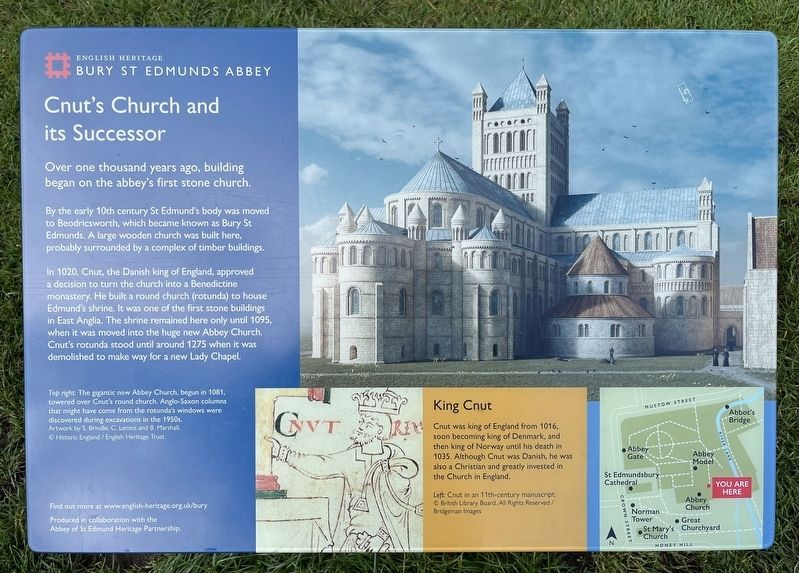
Cnut's Church and its Successor
Photographed by Ray Gurganus, March 27, 2024
1. Cnut's Church and its Successor Marker
By the early 10th century St Edmund's body was moved to Beodricsworth, which became known as Bury St Edmunds. A large wooden church was built here, probably surrounded by a complex of timber buildings.
In 1020, Cnut, the Danish king of England, approved a decision to turn the church into a Benedictine monastery. He built a round church (rotunda) to house Edmund's shrine. It was one of the first stone buildings in East Anglia. The shrine remained here only until 1095, when it was moved into the huge new Abbey Church. Cnut's rotunda stood until around 1275 when it was demolished to make way for a new Lady Chapel.
Top right: The gigantic new Abbey Church, begun in 1081, towered over Cnut's round church. Anglo-Saxon columns that might have come from the rotunda's windows were discovered during excavations in the 1950s.
King Cnut
Cnut was king of England from 1016, soon becoming king of Denmark, and then king of Norway until his death in 1035. Although Cnut was Danish, he was also a Christian and greatly invested in the Church in England.
this page online
Erected by English Heritage.
Topics. This historical marker is listed in this topic list: Religion & Religious Structures. A significant historical year for this entry is 1020 CE.
Location. 52° 14.651′ N, 0° 43.183′ E. Marker is in Bury St Edmunds, England, in Suffolk. It can be reached from no nearby street. In the Abbey Gardens. Touch for map. Marker is in this post office area: Bury St Edmunds, England IP33 1YA, United Kingdom. Touch for directions.

Regionally, this marker is in East Anglia. Globally, it is on the Atlantic Ocean, in the North Atlantic Region, in Europe, in Atlantic Europe, on one of the British Isles, in the Western World, and in the Anglosphere. Historically, it finds itself in what was once the Roman Empire.
Other nearby markers. At least 8 other markers are within walking distance of this marker: The Eastern End (within shouting distance of this marker); The Magna Carta (within shouting distance of this marker); The Heart of the Church (within shouting distance of this marker); The Chapter House (within shouting distance of this marker); St Edmunds Abbey
Photographed by Ray Gurganus, March 27, 2024
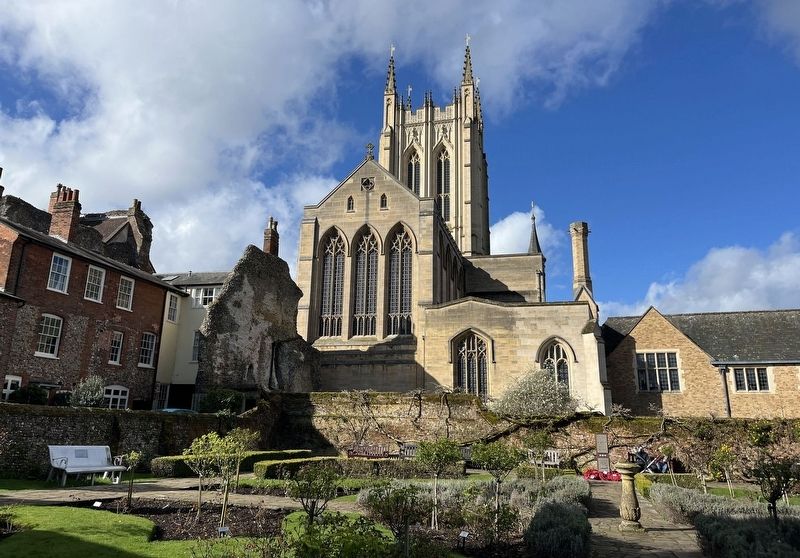
2. St Edmundsbury Cathedral Today
Credits. This page was last revised on June 24, 2026. It was originally submitted on May 4, 2024, by Ray Gurganus of Washington, District of Columbia. This page has been viewed 265 times since then and 54 times this year. Photos: 1, 2. submitted on May 4, 2024, by Ray Gurganus of Washington, District of Columbia. • Andrew Ruppenstein was the editor who published this page.
