
Near Cartago in Inyo County, California — The American West (Pacific Coastal)
Cottonwood Charcoal Kilns
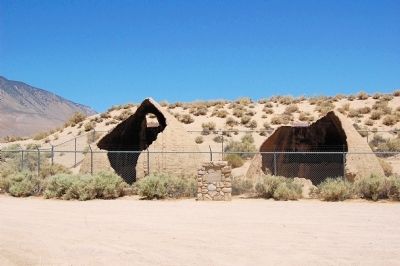
Photographed by Eric Polk, July 2, 2010
1. Cottonwood Charcoal Kilns and Marker Base
In June 1873 Colonel Sherman Stevens built a sawmill and flume on Cottonwood Creek high in the Sierras directly west of this spot. The flume connected with the Los Angeles Bullion Road. The lumber from the flume was used for timbering in the mine and buildings, and the wood was turned into charcoal in these kilns, then hauled to Steven's Wharf east of here on Owens Lake. There it was put on the Steamer "Bessie Brady," or the "Mollie Stevens," hailed directly across the lake, and from there wagons tool it up the "Yellow Grade" to Cerro Gordo Mine high in the Inyo Mountains above Keeler. M. W. Belshaw's Furnaces had used all available wood around the Cerro Gordo and the charcoal was necessary to continue production.
The bullion which was then taken out by the reverse of this route was hauled to Los Angeles on Remi Nadeau's 14, 16, 18 animal freight wagons and played a major part in the building of that little pueblo unto the city it is today.
Erected 1955 by California Eastern Sierra Museum Association. (Marker Number 537.)
Topics and series. This historical marker is listed in these topic lists: Industry & Commerce
this page online
Location. This marker has been replaced by another marker nearby. It was located near 36° 24.912′ N, 118° 0.722′ W. Marker was near Cartago, California, in Inyo County. It could be reached from no nearby street one mile east of U.S. 395, on the left when traveling east. Located one mile east of Hwy 395, 7 miles north of Cartago, on an unnamed dirt road. Touch for map. Marker was in this post office area: Olancha CA 93549, United States of America. Touch for directions.

Regionally, this marker was in California’s Sierra Nevada. It was also in the American Mountain West. Globally, it was in North America, on the Ring of Fire, in the Pacific Rim, in the Western Hemisphere, in the Western World, and in the Anglosphere. Historically, it found itself in what was once New Spain and also Mexico’s Alta California.
Other nearby markers. At least 8 other markers are within 10 miles of this location, measured as the crow flies: A different marker also named
courtesy Colorpicture Publishers
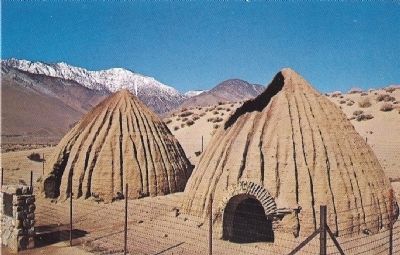
2. The Charcoal Kilns
This postcard view shows the kilns as well as the marker.
"The Charcoal Kilns near Olancha, Calif., are historical remnants of fabulous silver mining in the 1870's at the Cerro Gordo mine high in the Inyo Range above Keeler. Charcoal from the Kilns went across Owens Lake (now dry) by steamer and then by wagon to the mine. An estimated $17 million in bullion came from Cerro Gordo.
"The Charcoal Kilns near Olancha, Calif., are historical remnants of fabulous silver mining in the 1870's at the Cerro Gordo mine high in the Inyo Range above Keeler. Charcoal from the Kilns went across Owens Lake (now dry) by steamer and then by wagon to the mine. An estimated $17 million in bullion came from Cerro Gordo.
More about this marker. The marker was stolen in 1970, then later recovered by the Inyo County Sheriff's Department. It was re-dedicated in 1976 on this dirt road, near Hwy 395.
This site was designated California Historical Landmark No. 537 on September 14, 1955.

Photographed by Denise Boose, September 30, 2010
3. Cottonwood Charcoal Kilns Marker at its New Site
The marker was stolen in 1970 and recovered by the Inyo County Sheriff's Department. It was re-dedicated nearby in 1977. See Nearby Marker.
Credits. This page was last revised on January 29, 2026. It was originally submitted on August 1, 2010, by Eric Polk of Lakewood, California. This page has been viewed 2,540 times since then and 31 times this year. Photos: 1. submitted on August 1, 2010, by Eric Polk of Lakewood, California. 2. submitted on August 2, 2010. 3. submitted on March 1, 2013, by Denise Boose of Tehachapi, California. • Syd Whittle was the editor who published this page.
