Strasburg in Shenandoah County, Virginia — The American South (Mid-Atlantic)
Historic Strasburg
Stop #4
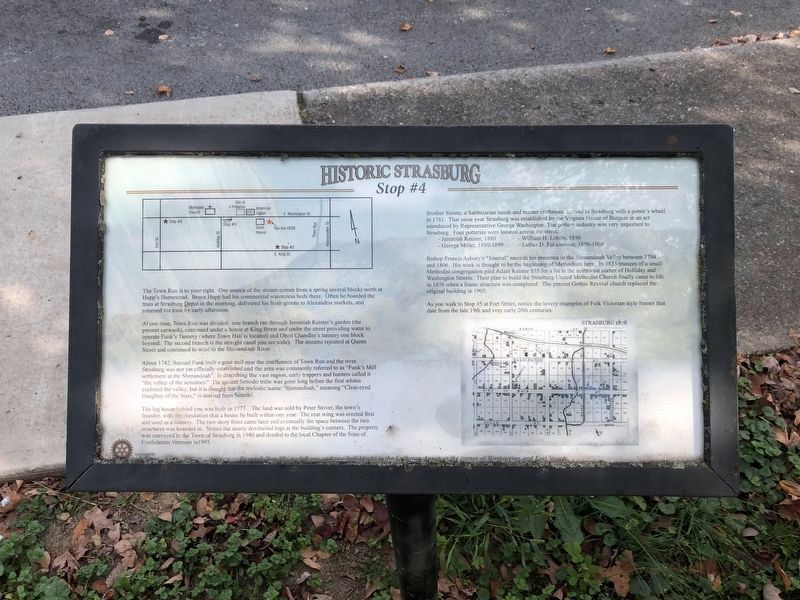
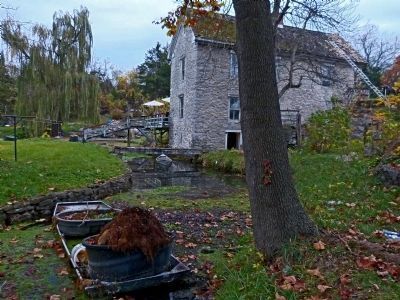
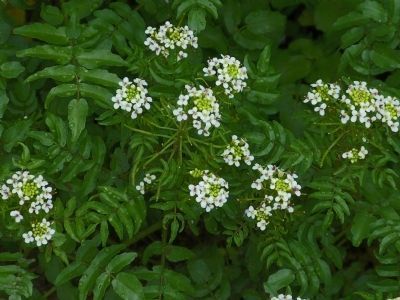
The Town Run is to your right. One source of the stream comes from a spring several blocks north at Hupp's Homestead. Bruce Hupp had his commercial watercress beds there. Often he boarded the train at Strasburg Depot in the morning, delivered his fresh greens to Alexandria markets, and returned via train by early afternoon.
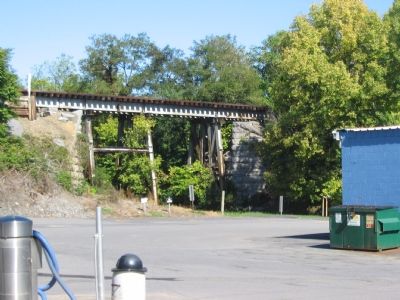
At one time, Town Run was divided: one branch ran through Jeremiah Keister's garden (the present carwash), continued under a house at King Street and under the street providing water to operate Funk's Tannery (where Town Hall is located) and Obed Chandler's tannery on block beyond. The second branch is the straight canal you see today. The streams rejoined at Queen Street and continued to wind to the Shenandoah River.
About 1742, Samuel Funk built a grist mill near the confluence of Town Run and the river. Strasburg was not officially established and the area was commonly referred to as "Funk's Mill settlement at the Shenandoah." In describing the vast region, early trappers and hunters called it "the valley of the senedoes." The ancient Senedo tribe was gone long before the first whites explored the valley,
this page online
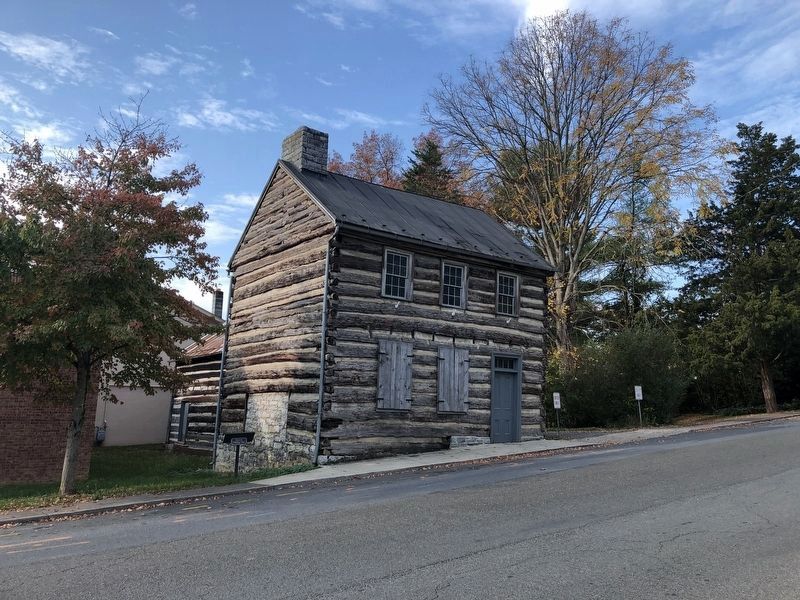
The log house behind you was built in 1777. The land was sold by Peter Stover, the town's founder, with the stipulation that a house be built within one year. The rear wing was erected first and used as a tannery. The two-story front came later and eventually the space between the two structures was boarded in. Notice the neatly dovetailed logs at the building's corners. The property was conveyed to the Town of Strasburg in 1940 and deeded to the local Chapter of the Sons of Confederate Veterans in 1995.
Brother Sirone, a Sabbatarian monk and master craftsman, arrived in Strasburg with a potter's wheel in 1761. That same year Strasburg was established by the Virginia House of Burgess in an act introduced by Representative George Washington. The pottery industry was very important to Strasburg. Four potteries were located across the street:
-Jeremiah Keister, 1880
-William H. Lehew, 1890
-George Miller, 1890-1899
-Luther D. Funkhouser, 1899-1905
Bishop Francis Asbury's "Journal" records his presence in the Shenandoah Valley
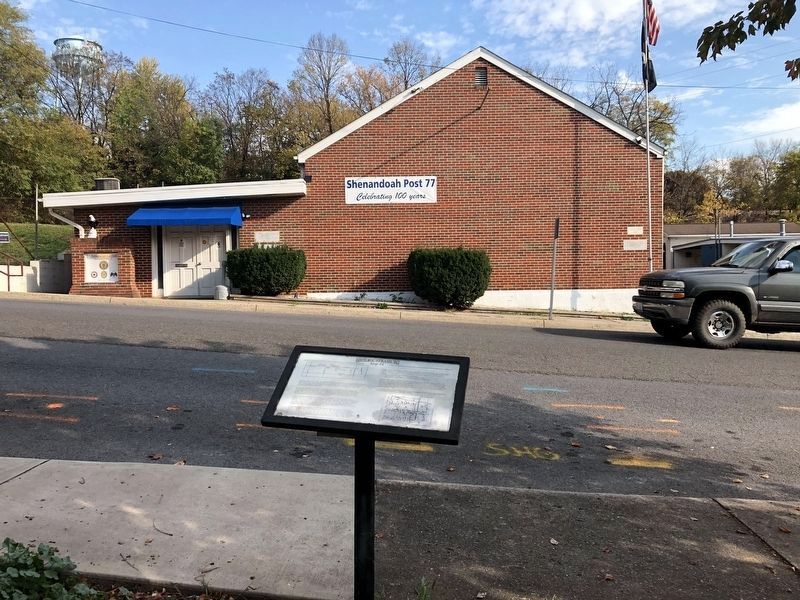
As yo uwalk to Stop #5 at Fort Street, notice the lovely examples of Folk Victorian style homes that date from the late 19th and very early 20th Centuries. (Marker Number 4.)
Topics and series. This historical marker is listed in these topic lists: Industry & Commerce • Religion & Religious Structures • Settlements & Settlers. In addition, it is included in the Sons of Confederate Veterans/United Confederate Veterans series list. A significant historical year for this entry is 1742.
Location. This marker has been replaced by another marker nearby. It was located near 38° 59.401′ N, 78° 21.622′ W. Marker was in Strasburg, Virginia, in Shenandoah County. It was at the intersection of West Washington Street and
Photographed by Devry Becker Jones (CC0), October 23, 2020
3. Log house
The marker stands just to the left of the house.

Regionally, this marker was in Virginia’s Shenandoah Valley. It was also in the American South, specifically in the Upper South, and in the Mid-Atlantic. Globally, it was in North America, the Western Hemisphere, the Western World, and the Anglosphere. Historically, it found itself in what was once the territory of the Mississippian Culture, one of the original Thirteen Colonies, one of the Confederate States of America, and the Antebellum South.
Other nearby markers. At least 8 other markers are within walking distance of this location: A different marker also named Historic Strasburg (here, next to this marker); American Legion (a few steps from this marker); Stonewall's Surprise (about 300 feet away, measured in a direct line); a different marker also named Historic Strasburg (about 300 feet away); a different marker also named Historic Strasburg (about 400 feet away); This Fertile Land (about 400 feet away);
Photographed by Craig Swain, September 29, 2007
4. Railroad Bridge over Town Run
The car wash referenced on the marker is to the left of this bridge, and was the site of Jeremiah Keister's garden. Water Street is blocked at this point to through traffic.
Other markers no longer nearby. Historic Strasburg (was about 400 feet away but has been replaced with another marker now near it); a different marker also named Historic Strasburg (was about 700 feet away but has been replaced with another marker now near it).
More about this marker. On the upper left of the marker is a tour stop map indicating the location of this marker with a red star. On the lower right is a street map of Strasburg from 1878.
Related marker. Click here for another marker that is related to this marker. This marker has been replaced by another at this location.
Also see . . . Strasburg Historic District. Virginia Department of Historic Resources website entry (Submitted on November 11, 2007, by Craig Swain of Leesburg, Virginia.)
Additional commentary.
1. Samuel Funk Mill?
Jacob Funk and brother, John, settled the Strasburg, VA area. Jacob (b 1695) was the first to move from PA to VA in 1735.
Photographed by Allen C. Browne, October 28, 2012
5. Hupp Homestead
The "Frontier Fort", where Bruce Hupp grew watercress for sale in Alexandria.
— Submitted March 25, 2010, by Dennis Long of St Marys, Ohio.
Photographed by Allen C. Browne, May 14, 2014
6. Watercress
Credits. This page was last revised on August 7, 2025. It was originally submitted on November 11, 2007, by Craig Swain of Leesburg, Virginia. This page has been viewed 3,100 times since then and 82 times this year. Photos: 1, 2, 3. submitted on October 24, 2020, by Devry Becker Jones of Washington, District of Columbia. 4. submitted on November 11, 2007, by Craig Swain of Leesburg, Virginia. 5, 6. submitted on May 29, 2014, by Allen C. Browne of Silver Spring, Maryland.
