
Downtown El Paso in El Paso County, Texas — The American South (West South Central)
Historic Sidewalk Clock
Photographed by Mansfieldphoto.com, October 4, 2025
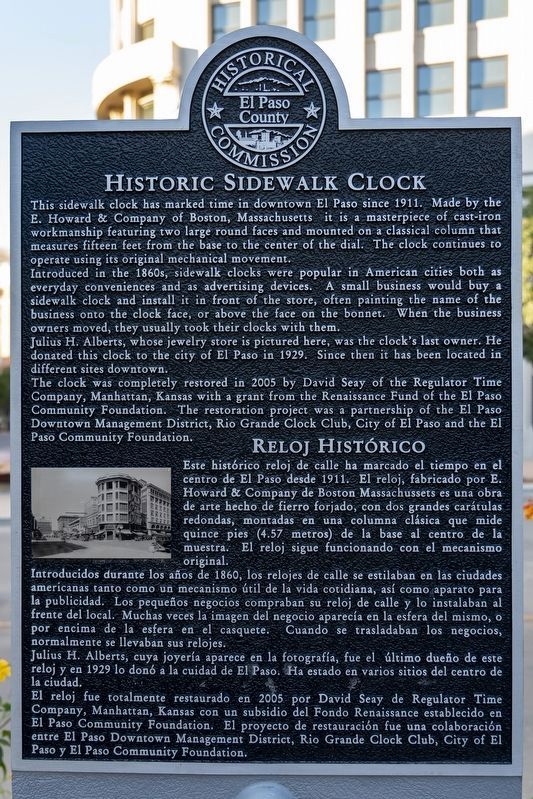
1. Historic Sidewalk Clock Marker
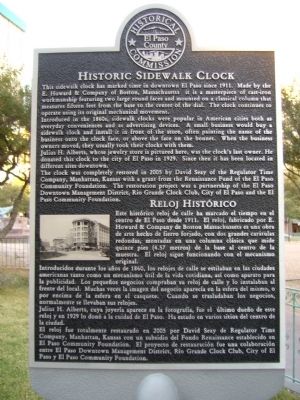
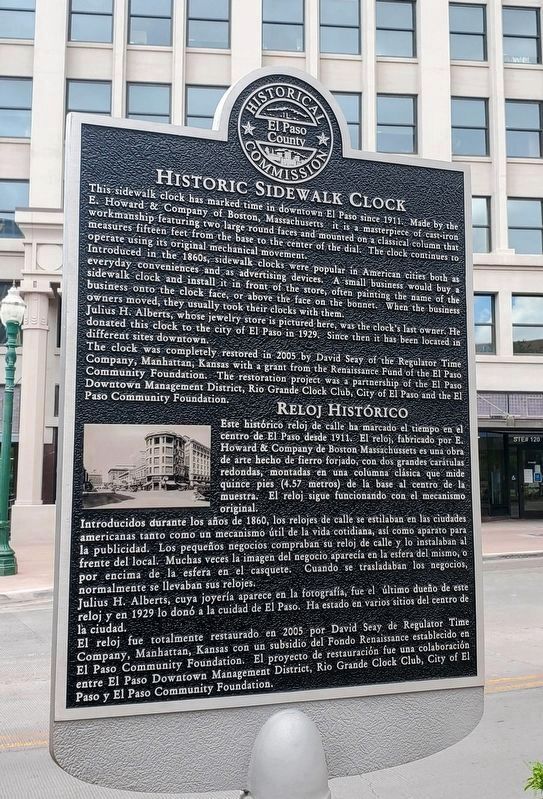
Introduced in the 1860s, sidewalk clocks were popular in American cities both as everyday conveniences and as advertising devices. A small business would buy a sidewalk clock and install it in front of the store, often painting the name of the business onto the clock face, or above the face on the bonnet. When the business owners moved, they usually took their clocks with them.
Julius H. Alberts, whose jewelry store is pictured here, was the clock's last owner. He donated this clock to the city of El Paso in 1929. Since then it has been located in different sites downtown.
The clock was completely restored in 2005 by David Seay of the Regulator Time Company, Manhattan, Kansas with a grant from the Renaissance Fund of the El Paso Community Foundation. The restoration project was a partnership of the El Paso downtown Management District, Rio Grande Clock Club, City of El Paso and the El Paso Community Foundation.
Introducidos durante los años de 1860, los relojes de calle se estilaban en las ciudades
this page online
Julius H. Alberts, cuya joyería aparece en la fotografía, fue el ultimo dueño de este reloj y en 1929 lo donó a la cuidad de El Paso. Ha estado en varios sitios del centro de la ciudad.
El reloj fue totalmente restaurado en 2005 por David Seay de Regulator Time Company, Manhattan, Kansas con un subsidio del Fondo Renaissance establecido en El Paso Community Foundation. El proyecto de restauración fue una colaboración entre El Paso Downtown Management District, Rio Grande Clock Club, City of El Paso y El Paso Community Foundation.
Erected by Historical El Paso County Commission.
Topics. This historical marker is listed in this topic list: Landmarks. A significant historical year for this entry is 1911.
Location. 31° 45.561′ N, 106° 29.317′ W. Marker is in El Paso,
Photographed by Ian Lefkowitz, September 3, 2022
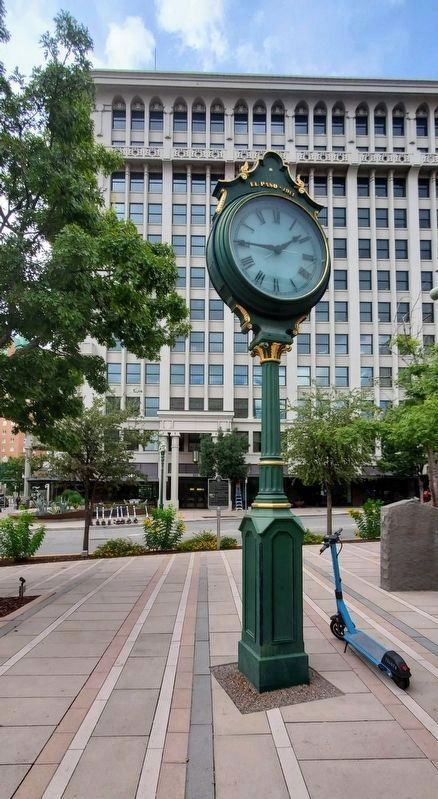
2. El Paso's Historic Sidewalk Clock

Regionally, this marker is in Texas’ Trans-Pecos & Big Bend Region. It is also in the American Southwest. Globally, it is in North America, a Gulf of Mexico state, the Western Hemisphere, the Western World, and the Anglosphere. Historically, it finds itself in what was once New Spain, the Republic of Texas, and one of the Confederate States of America.
Other nearby markers. At least 8 other markers are within walking distance of this marker: El Camino Real (a few steps from this marker); San Jacinto Plaza (within shouting distance of this marker); El Paso's Chinese Community (within shouting distance of this marker); The First United States Soldiers to Be Stationed at the Pass of the North (within shouting distance of this marker); Site of United States Courthouse
Photographed by Bill Kirchner, November 3, 2010
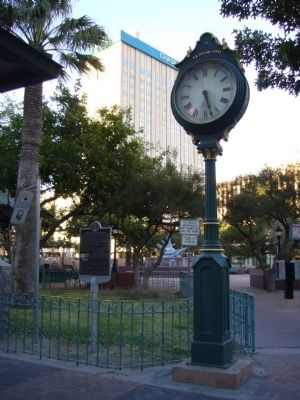
3. Historic Sidewalk Clock and Marker
Photographed by Ian Lefkowitz, September 3, 2022
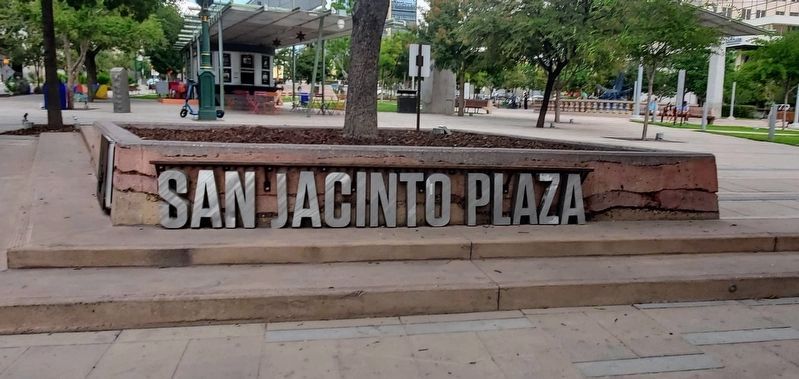
4. San Jacinto Plaza
The historic clock is located in El Paso's central San Jacinto Plaza.
Photographed by Bill Kirchner, November 3, 2010
5. Historic Sidewalk Clock Marker
Photographed by Ian Lefkowitz, September 3, 2022
6. Historic Sidewalk Clock Marker
Credits. This page was last revised on November 4, 2025. It was originally submitted on November 11, 2010, by Bill Kirchner of Tucson, Arizona. This page has been viewed 1,555 times since then and 27 times this year. Photos: 1. submitted on November 4, 2025, by James Hulse of Medina, Texas. 2. submitted on March 31, 2025, by Ian Lefkowitz of New York, New York. 3. submitted on November 11, 2010, by Bill Kirchner of Tucson, Arizona. 4. submitted on March 31, 2025, by Ian Lefkowitz of New York, New York. 5. submitted on November 11, 2010, by Bill Kirchner of Tucson, Arizona. 6. submitted on March 31, 2025, by Ian Lefkowitz of New York, New York. • Syd Whittle was the editor who published this page.
