Gallion in Hale County, Alabama — The American South (East South Central)
Freetown
Photographed by Tim & Renda Carr, November 12, 2010
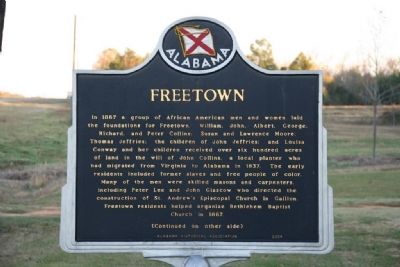
1. Freetown Marker (Side A)
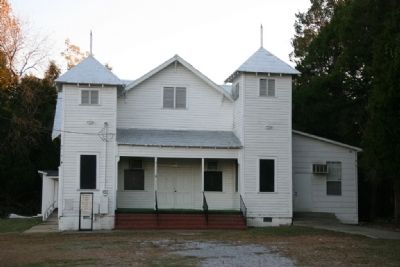
Many of the men were skilled masons and carpenters, including Peter Lee and John Glascow who directed the construction of St. Andrew’s Episcopal Church in Gallion. Freetown residents helped organize Bethlehem Baptist Church in 1867.
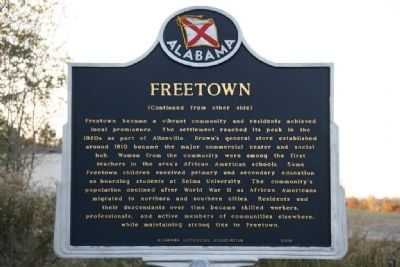
Freetown became a vibrant community and residents achieved local prominence. The settlement reached its peak in the 1920s as part of Allenville. Brown’s general store established around 1910 became the major commercial center and social hub. Women from the community were among the first teachers in the area’s African American schools. Some Freetown children received primary and secondary education as boarding students at Selma University.
this page online
Erected 2004 by Alabama Historical Association.
Topics and series. This historical marker is listed in these topic lists: African Americans • Settlements & Settlers. In addition, it is included in the Alabama Historical Association, and the Historically Black Colleges and Universities series lists. A significant historical year for this entry is 1867.
Location. 32° 29.608′ N, 87° 40.019′ W. Marker is in Gallion, Alabama, in Hale County. It is on U.S. 80 2 miles east of State Highway 69, on the right when traveling east. Touch for map. Marker is in this post office area: Gallion AL 36742, United States of America. Touch for directions.

Regionally, this marker is in the American South, specifically in the Deep South, and in the Black Belt. Globally, it is in North America, a Gulf of Mexico state, the Western Hemisphere, the Western World,
Photographed by Tim & Renda Carr, November 12, 2010
2. Freetown Marker (Side B)
Other nearby markers. At least 8 other markers are within 10 miles of this marker, measured as the crow flies: Dr. Benjamin M. Duggar (approx. 2.3 miles away); St. Andrew’s Church (approx. 2.3 miles away); Oak Grove School (approx. 3.7 miles away); St. Michael's Cemetery (approx. 5.2 miles away); St. Michael's Episcopal Churchyard (approx. 5.2 miles away); Vine And Olive Colony (approx. 8 miles away); Church of the Holy Cross (approx. 9.2 miles away); U.S. Jones High School (approx. 9.6 miles away).
Photographed by Tim & Renda Carr, November 12, 2010
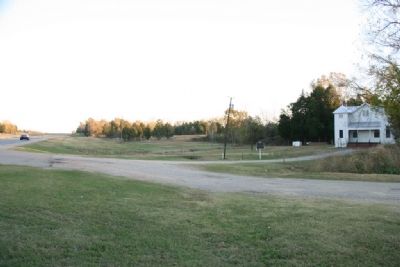
3. Freetown Marker and Bethlehem Church
Photographed by Tim & Renda Carr, November 12, 2010
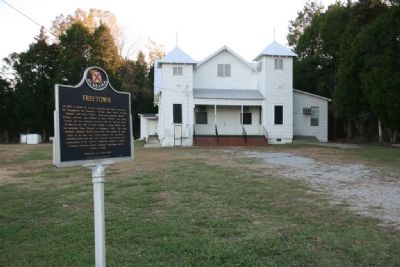
4. Freetown Marker and Bethlehem Church
Photographed by Tim & Renda Carr, November 12, 2010
5. Bethlehem Church
Credits. This page was last revised on November 14, 2019. It was originally submitted on November 18, 2010, by Timothy Carr of Birmingham, Alabama. This page has been viewed 4,049 times since then and 172 times this year. Photos: 1, 2, 3, 4, 5. submitted on November 18, 2010, by Timothy Carr of Birmingham, Alabama. • Bill Pfingsten was the editor who published this page.
