Antioch in Prince William County, Virginia — The American South (Mid-Atlantic)
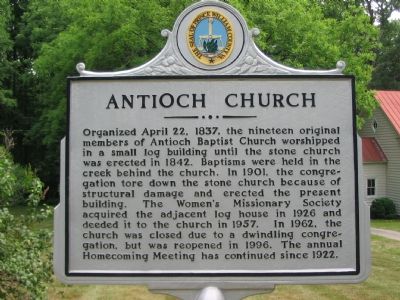
Antioch Church
Photographed by Craig Swain, June 23, 2007
1. Antioch Church Marker
Erected 2002 by Prince William County Historical Commission.
Topics and series. This historical marker is listed in these topic lists: Notable Buildings • Religion & Religious Structures. In addition, it is included in the Virginia, Prince William County Historical Commission series list. A significant historical date for this entry is April 22, 1863.
Location. 38° 51.465′ N, 77° 41.057′ W. Marker is in Antioch, Virginia, in Prince William County. It is on Waterfall Road (Virginia Route 601), on the right when traveling east. Touch for map. Marker is
this page online

Regionally, this marker is in the Washington Metropolitan Area, in Northern Virginia, and in the Piedmont. It is also in the American South, specifically in the Upper South, in the Mid-Atlantic, and on the Eastern Seaboard. Globally, it is in the North Atlantic Region, North America, the Western Hemisphere, the Western World, and the Anglosphere. Historically, it finds itself in what was once the territory of the Mississippian Culture, one of the original Thirteen Colonies, one of the Confederate States of America, and the Antebellum South.
Other nearby markers. At least 8 other markers are within 3 miles of this marker, measured as the crow flies: Hopewell Gap (within shouting distance of this marker); The Carolina Road (approx. 2.6 miles away); a different marker also named Bull Run Mountains Natural Area Preserve (approx. 2.6 miles away); a different marker also named Chapman's Mill (approx. 2.6 miles away); Free People Of Color At Thoroughfare (approx. 2.6 miles away); Thoroughfare Gap (approx. 2.8 miles away); a different
Photographed by Craig Swain, June 23, 2007
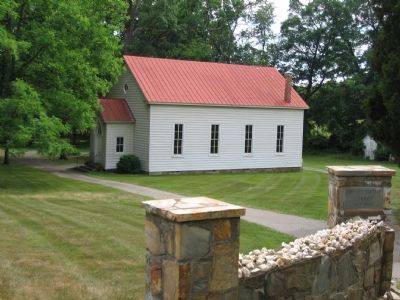
2. Antioch Baptist Church
Other markers no longer nearby. Bull Run Mountains Natural Area Preserve (was approx. 2.6 miles away but has been replaced with another marker now near it); Chapman's Mill (was approx. 2.6 miles away but has been replaced with another marker now near it); a different marker also named Thoroughfare Gap (was approx. 2.8 miles away but has been replaced with another marker now near it).
Also see . . . History of Antioch Baptist Church. (Submitted on September 27, 2008.)
Photographed by Craig Swain, June 23, 2007
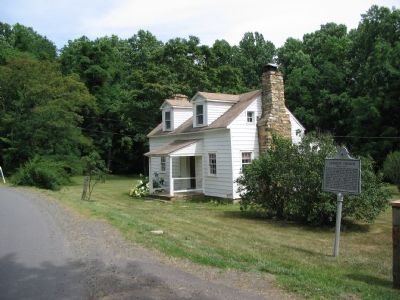
3. Is this the adjacent log building?
Credits. This page was last revised on June 16, 2016. It was originally submitted on June 29, 2007, by Craig Swain of Leesburg, Virginia. This page has been viewed 3,054 times since then and 64 times this year. Last updated on February 5, 2011. Photos: 1, 2, 3. submitted on June 29, 2007, by Craig Swain of Leesburg, Virginia. • Kevin W. was the editor who published this page.
