Ridgeville in Dorchester County, South Carolina — The American South (South Atlantic)
Cypress Methodist Camp Ground
Photographed by Mike Stroud, 2011
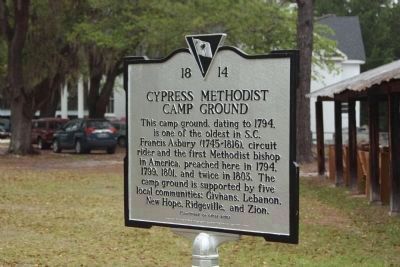
1. Cypress Methodist Camp Ground Marker
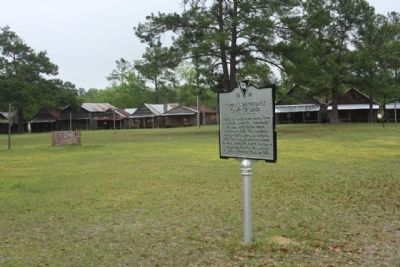
This camp ground, dating to 1794, is one of the oldest in S.C. Francis Asbury (1745-1816), circuit rider and the first Methodist bishop in America, preached here in 1794, 1799, 1801, and twice in 1803. The camp ground is supported by five local communities: Givhans, Lebanon, New Hope, Ridgeville, and Zion.
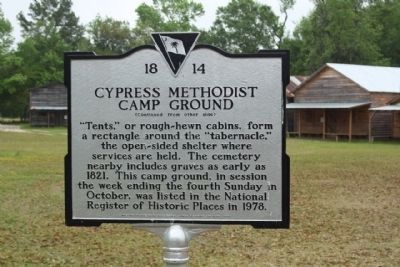
(Reverse text)
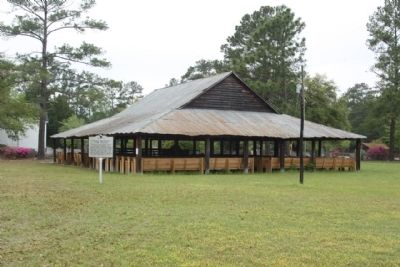
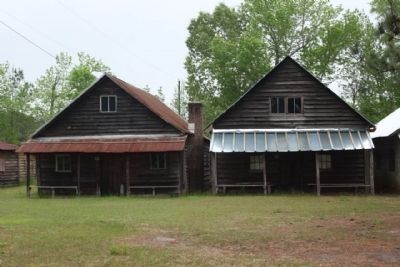
“Tents,” or rough-hewn cabins, form a rectangle around the “tabernacle,” the open-sided shelter where services are held. The cemetery nearby includes graves as early as 1821. This camp ground, in session the week ending the fourth Sunday in October, was listed in the National Register of Historic Places in 1978.
Erected 2009 by The Upper Dorchester County Historical Society. (Marker Number 18-14.)
Topics and series. This historical marker is listed in this topic list: Religion & Religious Structures. In addition, it is included in the Francis Asbury, Traveling Methodist Preacher series list. A significant historical year for this entry is 1794.
Location. 33° 6.204′ N, 80° 16.397′ W. Marker is in Ridgeville, South Carolina, in Dorchester County. It is on Cypress
this page online

Regionally, this marker is in the Lowcountry. It is also in the American South, specifically in the Deep South, and on the Eastern Seaboard. Globally, it is in the North Atlantic Region, North America, the Western Hemisphere, the Western World, and the Anglosphere. Historically, it finds itself in what was once the territory of the Mississippian Culture, one of the original Thirteen Colonies, one of the Confederate States of America, and the Antebellum South.
Other nearby markers. At least 8 other markers are within 8 miles of this marker, measured as the crow flies: Ridgeville (approx. 2½ miles away); Berkeley County (approx. 3.1 miles away); Murray United Methodist Church (approx. 5.1 miles away); Moorefield Memorial Highway, (Southern Terminus) (approx. 5.2 miles away); Revolutionary War Cannon (approx. 5.3 miles away); Four Holes Swamp (approx. 5.3 miles away);
Photographed by Mike Stroud, April 10, 2011
2. Cypress Methodist Camp Ground Marker, reverse side
National Register of Historic Places:
Cypress Methodist Camp Ground ** (added 1978 - - #78002504)
Historic Significance: Architecture/Engineering, Person • Architect, builder, or engineer: Unknown • Architectural Style: No Style Listed • Historic Person: Ashbury,Francis • Area of Significance: Architecture, Religion • Period of Significance: 1900-1924, 1875-1899, 1850-1874, 1825-1849, 1800-1824 •
Historic Significance: Architecture/Engineering, Person • Architect, builder, or engineer: Unknown • Architectural Style: No Style Listed • Historic Person: Ashbury,Francis • Area of Significance: Architecture, Religion • Period of Significance: 1900-1924, 1875-1899, 1850-1874, 1825-1849, 1800-1824 •
Regarding Cypress Methodist Camp Ground. Cypress Methodist Camp Ground is one of only a few campgrounds in South Carolina which, up until the time of its nomination, continues to host annual week-long camp meetings—a vestige of the Great Awakening in American religious life in the nineteenth century. Cypress is significant for its association with Francis Asbury, pioneer of American Methodism, and for its long, uninterrupted use as a site of revivalism for almost 200 years. The campground is in the general shape of a rectangle of 34 tents, or cabins, made of rough-hewn lumber. These cabins, rectangular shaped, are generally 1½ stories and contain earthen floors. The typical floor plan features a hall extending the length of the cabin with as many as three rooms on the opposite side. The second story is accessible by a small stairway or ladder. In the center of the rectangle is the tabernacle, an open-sided wooden structure that is the focal point of these revival
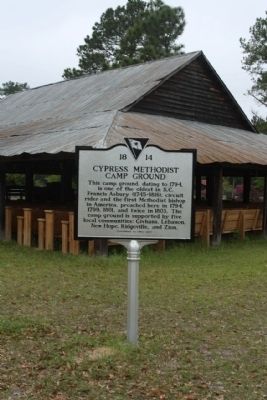
Photographed by Mike Stroud, April 10, 2011
3. Cypress Methodist Camp Ground Marker with the “tabernacle,” the open-sided shelter
Photographed by Mike Stroud, April 10, 2011
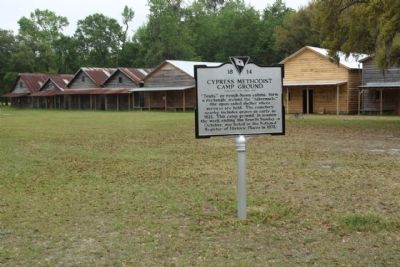
4. Cypress Methodist Camp Ground Marker, located in the center of the campground
tents were gradually replaced by the current rough-hewn cabins, seen in the background
Photographed by Mike Stroud, April 10, 2011
5. Cypress Methodist Camp Ground Marker and the “tabernacle,”
Photographed by Mike Stroud, April 10, 2011
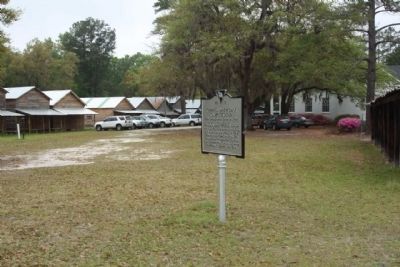
6. Marker and adjacent Cypress United Methodist Church
Photographed by Mike Stroud, April 10, 2011
7. Cypress Methodist Camp Ground rough-hewn cabins
Photographed by Mike Stroud, April 10, 2011
8. Cypress Methodist Camp Ground Marker
The campground is in the general shape of a rectangle of tents, or cabins, made of rough-hewn lumber.
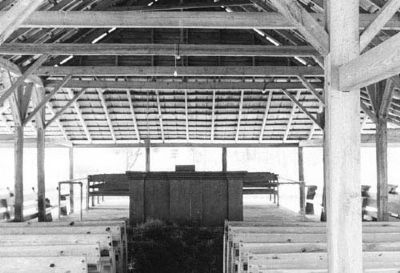
South Carolina Department of Archives and History., circa 1978
9. Cypress Methodist Camp Ground Tabernacle
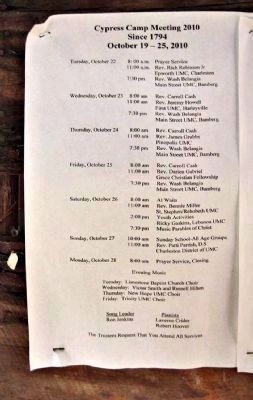
Photographed by Mike Stroud, April 10, 2011
10. Cypress Methodist Camp Ground Agenda from 2010
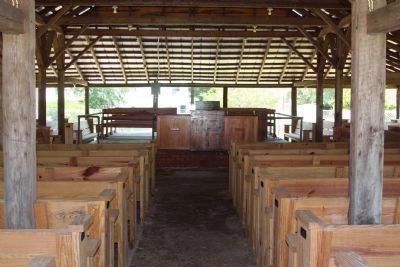
Photographed by Mike Stroud, September 8, 2013
11. Cypress Methodist Camp Ground Pulpit, seen today
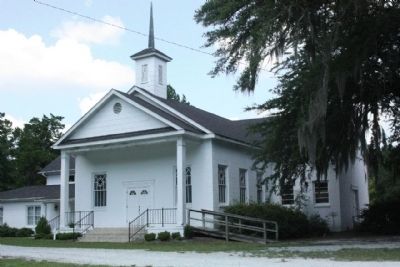
Photographed by Mike Stroud, September 8, 2013
12. Cypress Methodist Church at the campground. within the rectangle
Credits. This page was last revised on June 16, 2016. It was originally submitted on April 17, 2011, by Mike Stroud of Bluffton, South Carolina. This page has been viewed 2,993 times since then and 77 times this year. Photos: 1, 2, 3, 4, 5, 6, 7, 8, 9. submitted on April 17, 2011, by Mike Stroud of Bluffton, South Carolina. 10. submitted on April 18, 2011, by Mike Stroud of Bluffton, South Carolina. 11, 12. submitted on September 9, 2013, by Mike Stroud of Bluffton, South Carolina.
