Penokee Iron Range Trail - Plummer Location
Iron County Heritage Area
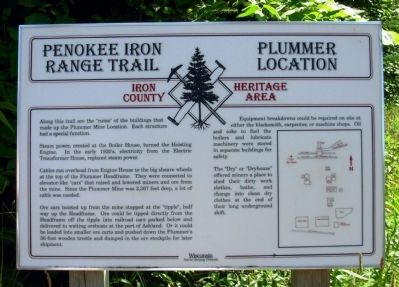
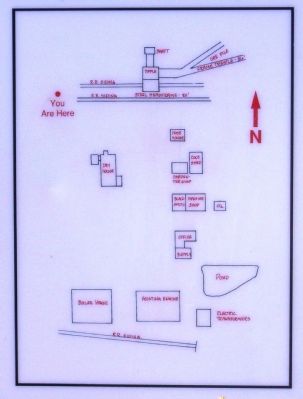
 Along this trail are the “ruins” of the buildings that made up the Plummer Mine Location. Each structure had a special function.
Steam power, created at the boiler House, turned the Hoisting Engine. In the early 1920’s, electricity from the Electric Transformer House, replaced steam power.
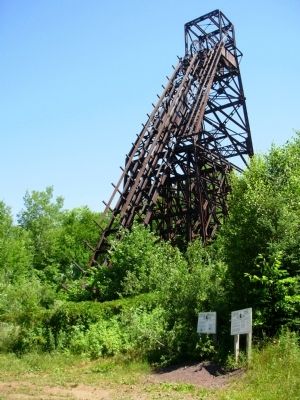
Cables ran overhead from Engine House to the big sheave wheels at the top of the Plummer Headframe. They were connected to elevator-like “cars” that raised and lowered miners and ore from the mine. Since the Plummer Mine was 2,367 feet deep, a lot of cable was needed.
Ore cars hoisted up from the mine stopped at the “tipple”, half way up the Headframe. Ore could be tipped directly from the Headframe off the tipple into railroad cars parked below and delivered to waiting oreboats at the port of Ashland. Or it could be loaded into smaller ore carts and pushed down the Plummer’s 36 foot wooden trestle and dumped in the ore stockpile for later shipment.
Equipment breakdowns could be repaired on site at either the blacksmith, carpenter, or machine shops. Oil and coke to fuel the boilers
this page online
The “Dry” or “Dryhouse” offered miners a place to shed their dirty work clothes, bathe, and change into clean dry clothes at the end of their long underground shift.
Topics. This historical marker is listed in this topic list: Industry & Commerce.
Location. 46° 24.459′ N, 90° 17.582′ W. Marker is near Pence, Wisconsin, in Iron County. It can be reached from Plummer Road ¼ mile south of Wisconsin Highway 77. Marker is located in Plummer Mine Headframe Interpretive Park. Touch for map. Marker is in this post office area: Montreal WI 54550, United States of America. Touch for directions.
Regionally, this marker is in Copper Country and on the North Shore. It is also in the American Midwest and in the Corn Belt. Globally, it is in North America, the Great North Woods, the Western Hemisphere, the Western World, and the Anglosphere. Historically, it finds itself in what was once the territory of the Mississippian Culture and also the Northwest Territory.
Other nearby markers. At
Another marker is no longer nearby. Montreal Trails – The Montreal Mine (was approx. 3.4 miles away but has been confirmed missing).
Additional keywords. Mining
Credits. This page was last revised on June 16, 2016. It was originally submitted on August 2, 2011, by Paul Fehrenbach of Richfield, Wisconsin. This page has been viewed 1,566 times since then and 31 times this year. Photos: 1, 2, 3. submitted on August 2, 2011, by Paul Fehrenbach of Richfield, Wisconsin. • Bill Pfingsten was the editor who published this page.