Petrified Trees
Fossils Give Clues to Wyoming's Paleo-Past
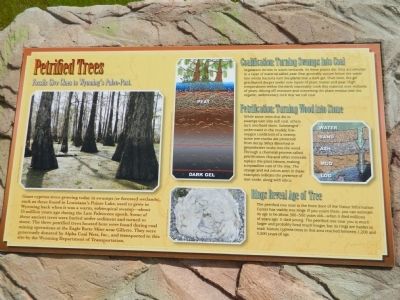
Coalification: Turning Swamps into Coal
Vegetation thrives in warm wetlands. As these plants die, they accumulate in a layer of material called peat. Peat generally occurs below the water line where bacteria turn the plants into a dark gel. Over time, the gel gets buried deeper under new layers of plant batter and peat. high temperatures within the earth essentially cook this material over millions of years, driving off moisture and converting the plant residue into the organic, sedimentary rock that we call coal.
Petrification: Turning Wood into Stone
While some trees
this page online
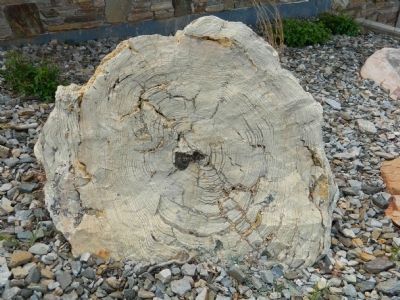
Rings Reveal Age of Tree
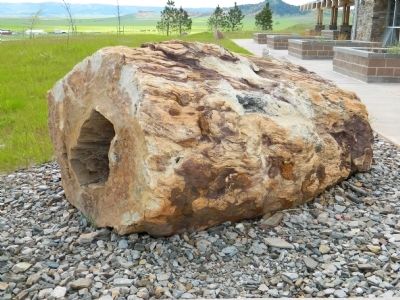
The petrified tree next to the front door of the Visitor Information Center has visible tree rings. If you count them, you can estimate its age to be about 300-500 years old - when it died millions of years ago. it died young. The petrified tree near you is much larger and probably lived much longer, but its rings are harder to read. mature cypress trees in this area reached between 1,200 and 1,500 years of age.
Topics. This historical marker is listed in these topic lists: Horticulture & Forestry • Paleontology.
Location. 44° 31.661′ N, 104° 12.346′ W. Marker is in Sundance, Wyoming, in
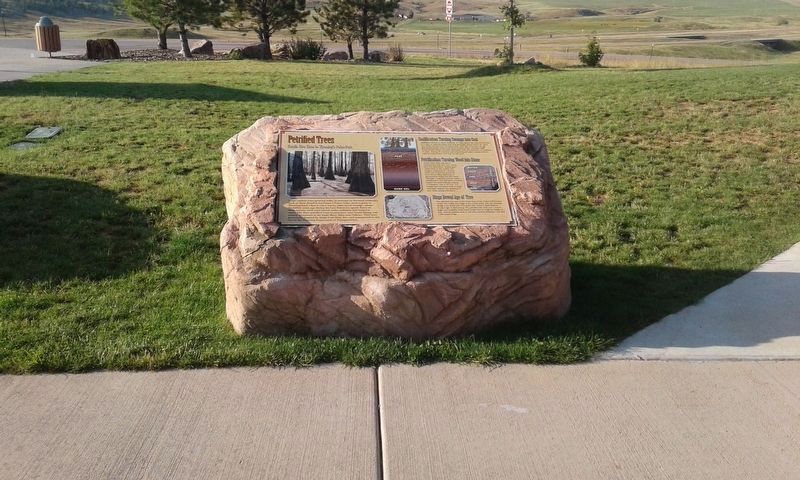

Regionally, this marker is in the Powder River Basin. It is also in the American Mountain West, in the Black Hills, on the Great Plains, on the Northern Plains, and specifically on the High Plains. Globally, it is in North America, the Western Hemisphere, the Western World, and the Anglosphere. Historically, it finds itself in what was once the Louisiana Purchase.
Other nearby markers. At least 8 other markers are within 3 miles of this marker, measured as the crow flies: The Custer Trail (here, next to this marker); Rich Colors, Rich Lands (here, next to this marker); Bird of the Black Hills (here, next to this marker); The Vore Buffalo Jump (here, next to this marker); Paha Sapa, Black Hills (here, next to this marker); Matthew S. Driskill (within shouting distance of this marker); a different marker also named Vore Buffalo Jump (approx. 2½ miles away); Understanding Bison Behavior Brought Success (approx. 2½ miles away).
Credits. This page was last revised on April 16, 2022. It was originally submitted on August 4, 2011, by Bill Pfingsten of Bel Air, Maryland. This page has been viewed 2,227 times since then and 48 times this year. Photos: 1. submitted on August 4, 2011, by Bill Pfingsten of Bel Air, Maryland. 2. submitted on November 22, 2021, by Craig Doda of Napoleon, Ohio. 3, 4. submitted on August 4, 2011, by Bill Pfingsten of Bel Air, Maryland.
