Palmdale in Los Angeles County, California — The American West (Pacific Coastal)
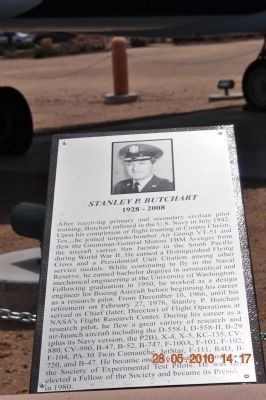
Stanley P Butchart 1928 - 2008
⎯⎯⎯
C-140 Jetstar
Photographed by Sandra Hughes, May 28, 2010
1. Stanley P Butchart Marker
1928 - 2008
Following graduation in 1950, he worked as a design engineer for Boeing Aircraft before beginning his career as a research pilot. From December 10, 1966, until his retirement on February 27, 1976, Stanley P. Butchart served as Chief (later, Director) of Flight Operations at NASA's Flight Research Center. During his career as a research pilot, he flew a great variety of research and air-launch aircraft including the D-558-1, D558-II, B-29, (plus its Navy version, the P2B), X-4, X-5, KC-135, CV-880, CV-990, B-47, B-52, B-747, F-100A, F-101, F-102, F-104, PA-30 Twin Comanche, JetStar, F-111, R4D, B-720, and B-47.
He became one of 65 charter members of the Society of Experimental Test Pilots. He was later elected a Fellow of the Society and became its President in 1980.
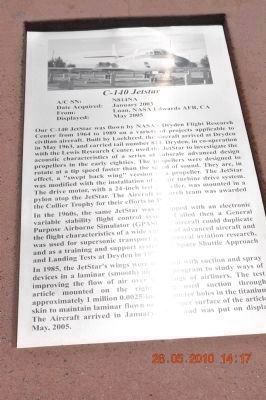
A/C SN - N814NA
Date Acquired: - January 2003
Acquired From: - Loan, NASA Edwards AFB, CA
Displayed: May 2005
Our C-140 JetStar was flown by NASA's Dryden Flight Research Center from 1964 to 1989 on a variety of projects applicable to civilian aircraft. Built by Lockheed, the aircraft arrived at Dryden in May 1963, and carried tail number 814. Dryden, in co-operation with the Lewis Research
this page online
In the 1960's the same JetStar was equipped with an electronic variable stability flight control system. Called then a General Purpose Airborne Simulator (GPAS), the aircraft could duplicate the flight characteristics of a wide variety of advanced aircraft and was used for supersonic transport and general aviation research, and as a training support system for Space Shuttle Approach and Landing Tests at Dryden in 1977.
In 1985 the JetStar wings were modified with suction and spray devices in laminar (smooth) air flow program to study ways of improving the flow of air over the wings of airliners.
Photographed by Sandra Hughes, May 28, 2010
2. C-140 Jetstar (Right Panel)
[Left Panel]
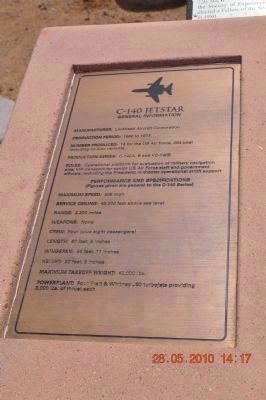
General Information
Production Period: 1960 TO 1973
Number Produced: 16 for the US Air Force, 204 total including civilian variants
Production Series: C-140A, B and VC-140B
Roles: Operational platform for evaluation of military navigation aids; VIP transport for senior US Air Force staff and government officials, including the President; in-theater operational airlift support.
(Figures given are general to the C-140 Series)
Service Ceiling: 45,000 feet above sea level
Range: 2,200 miles
Weapons: None
Crew: Four (plus eight passengers)
Length: 60 feet, 5 inches
Wingspan: 54 feet, 11 inches
Height: 20 feet, 5 inches
Maximum Takeoff Weight: 42,000 lbs.
Powerplant: Four Pratt & Whitney J60 turbojets providing 3,000 lbs.
Photographed by Sandra Hughes, May 28, 2010
3. C-140 Jetstar General Information (Left Panel)
Erected 2005.
Topics and series. This historical marker is listed in these topic lists: Air & Space • Military. In addition, it is included in the Valor in Aerial Operations series list. A significant historical month for this entry is January 2003.
Location. 34° 36.171′ N, 118° 5.226′ W. Marker is in Palmdale, California, in Los Angeles County. It can be reached from East Avenue P, on the right when traveling west. Aircraft at the Joe Davies Heritage Airpark at Palmdale Plant 42. Touch for map. Marker is at or near this postal address: 2001 East Avenue P, Palmdale CA 93550, United States of America. Touch for directions.

Regionally, this marker is in Greater Los Angeles, in the High Desert, and in the Transverse Ranges. It is also on the American Pacific Coast. Globally, it is in North America, on the Ring of Fire, in the Pacific Rim, in the Western Hemisphere, in the Western World, and in the Anglosphere. Historically, it finds itself in what was once New Spain and also Mexico’s Alta California.
Other nearby markers. At least 8 other markers are within walking distance of this marker: F-86 (here, next
Photographed by Sandra Hughes, May 28, 2010
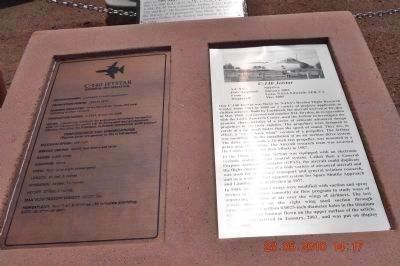
4. C-140 Jetstar Markers
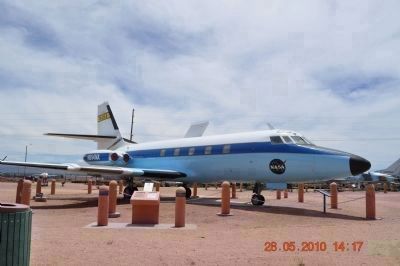
Photographed by Sandra Hughes, May 28, 2010
5. Stanley P Butchart and C-140 Jetstar Markers with the Jetstar in the Background
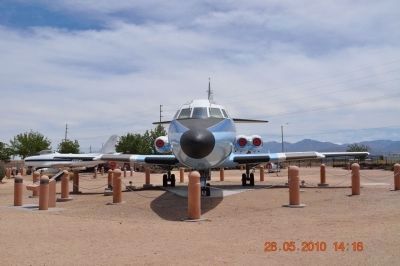
Photographed by Sandra Hughes, May 28, 2010
6. C-140 JetStar
Credits. This page was last revised on January 30, 2023. It was originally submitted on September 30, 2011, by Sandra Hughes Tidwell of Killen, Alabama, USA. This page has been viewed 846 times since then and 21 times this year. Photos: 1, 2, 3, 4, 5, 6. submitted on September 30, 2011, by Sandra Hughes Tidwell of Killen, Alabama, USA. • Syd Whittle was the editor who published this page.
