Superintendent’s House
“Silver Queen City”
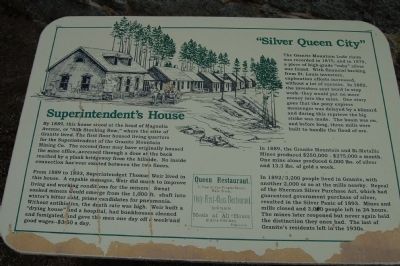
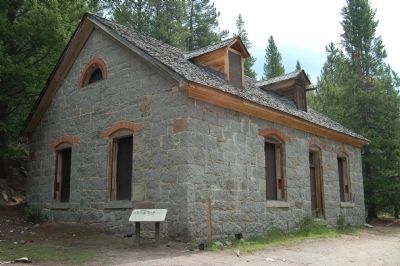
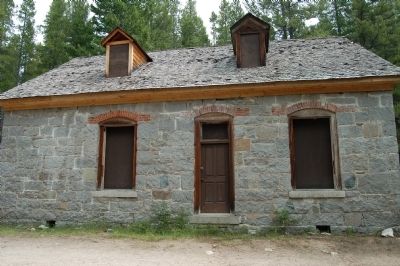
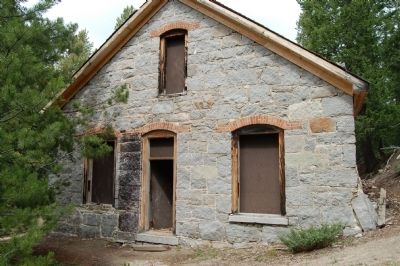
From 1889 to 1893, Superintendent Thomas Weir lived in this house. A capable manager, Weir did much to improve living and working conditions for the miners. Sweat soaked miners would emerge from the 1,000 ft shaft into winter’s bitter cold, prime candidates for pneumonia. Without antibiotics, the death rate was high. Weir built a “drying house” and a hospital, had bunkhouses cleaned and fumigated, and gave his men one day off a week and good wages--$3.50 a day.
“Silver Queen City”
The Granite Mountain Lode claim was recorded in 1875, and in 1879 a piece of high-grade “ruby” silver was found. With financial backing from St. Louis investors, exploration efforts
this page online
In 1892, 3,200 people lived in Granite, with another 2,000 or so at the mills nearby. Repeal of the Sherman Silver Purchase Act, which had guaranteed government purchase of silver resulted in the Silver Panic of 1893. Mines and mills closed and 3,000 people left in 24 hours. The mines later reopened but never again held the distinction they once had. The last of Granite’s residents left in the 1930s
Topics. This historical marker is listed in this topic list: Settlements & Settlers. A significant historical year for this entry is 1899.
Location. 46° 18.97′ N, 113° 14.762′ W. Marker is near Philipsburg, Montana, in Granite County. It is on Magnolia

Regionally, this marker is in andspecifically outhwest Montana, in Gold West Country, in Mining Country. It is also in the American Mountain West and in the Lewis & Clark Corridor. Globally, it is in North America, the Rocky Mountains, the Western Hemisphere, the Western World, and the Anglosphere. Historically, it finds itself in what was once Rupert’s Land and also the Louisiana Purchase.
Other nearby markers. At least 8 other markers are within 3 miles of this marker, measured as the crow flies: Granite Mountain Mining Company Office (about 500 feet away, measured in a direct line); Mill A and B (about 600 feet away);
Additional commentary.
1. Pony Express Messenger
Marker refers to the Pony Express messenger in 1882. The Pony Express ceased operation in 1861.
Credits. This page was last revised on June 16, 2016. It was originally submitted on November 15, 2011, by Barry Swackhamer of Brentwood, California. This page has been viewed 689 times since then and 29 times this year. Photos: 1, 2, 3, 4. submitted on November 15, 2011, by Barry Swackhamer of Brentwood, California. • Bill Pfingsten was the editor who published this page.
