Princeton in Mercer County, New Jersey — The American Northeast (Mid-Atlantic)
Princeton Battle Monument
Photographed by R. C.
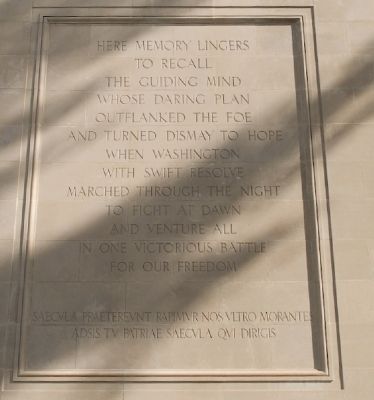
1. Main Marker on Rear of Monument
Here memory lingers to recall the guiding mind whose daring plan outflanked the foe and turned dismay to hope when Washington, with swift resolve, marched through the night to fight at dawn and venture all in one victorious battle for our freedom.
ADSIS TV PATRIAE SAECVLA QVI DIRIGIS
(translation: The ages pass away. We too, yet lingering, are hurried on. Oh Thou who guidest the ages, guard our land!)
A nearby sign (see picture below) gives a brief history of the Princeton Monument and identifies recent efforts to permanently illuminate it. It reads:
this page online
In 2006 the Princeton Parks Alliance, in carrying out the vision of Princeton Borough Major Joseph O’Neill, undertook a project to permanently illuminate the Monument. As with the original construction of the Monument, local citizens responded with generous donations. The Monument lighting was funded with gifts from Princeton University, Sara and Alexander Buck, Randy and Herb Hobler, Betty Johnson, Douglas F. Bushnell, Marie and Edward Matthews, Barbara and Art Morgan, The Gordon and Llura Gund Foundation, Betsy and Tod Peyton, Joan and Bill Schreyer, Charles C. Townsend Jr., Andrew Kootz and Laurie Harmon, Wendy and Peter Benchley, Sherry MacLean, and many more. Additional funding from the State of New Jersey was made possible through the efforts of Assemblyman Reed Gusciora.
Erected 1922.
Topics and series. This historical marker and monument is listed in these topic lists: Patriots & Patriotism • War, US Revolutionary. In addition, it is included in the Former U.S. Presidents: #01 George Washington, and the Former U.S. Presidents: #29 Warren G. Harding
Photographed by R. C.
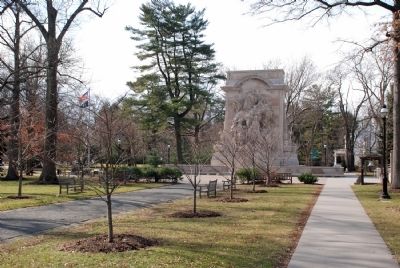
2. View of Monument from the Plaza
Location. 40° 20.867′ N, 74° 39.95′ W. Marker is in Princeton, New Jersey, in Mercer County. It is at the intersection of Stockton Street and Bayard Street on Stockton Street. Touch for map. Marker is in this post office area: Princeton NJ 08540, United States of America. Touch for directions.

Regionally, this marker and monument is in Central Jersey. It is also in the American Northeast and in the Mid-Atlantic. Globally, it is in North America, the Western Hemisphere, the Western World, and the Anglosphere. Historically, it finds itself in what was once New Netherland and also one of the original Thirteen Colonies.
Other nearby markers. At least 8 other markers are within walking distance of this marker: Colonel John Haslet (here, next to this marker); Campsite of The Army of Louis XVI, King of France (here, next to this marker); New Jersey Patriots (here, next to this marker); Marines in the Revolution (here, next to this marker); a different marker also named The Princeton Battle Monument (within shouting distance of this marker); Horse Chestnut Walk (within
Photographed by R. C.
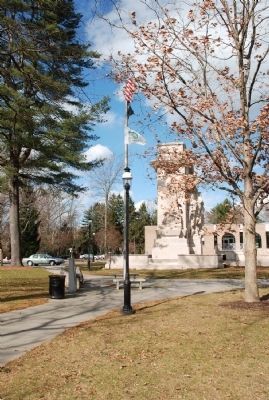
3. View from Left Side including the American Flag and Four Markers
Other markers no longer nearby. The House Front (was within shouting distance of this marker but has been replaced with another marker now near it); The Wash House (was within shouting distance of this marker but has been replaced with another marker now near it); a different marker also named The Horse Chestnut Walk (was within shouting distance of this marker but has been replaced with another marker now near it); The Front Garden (was about 300 feet away, measured in a direct line but has been replaced with another marker now near it); The Colonial Revival Garden (was about 300 feet away but has been replaced with another marker now near it).
Regarding Princeton Battle Monument. The monument was designed by sculptor Frederick MacMonnies and dedicated by President Harding.
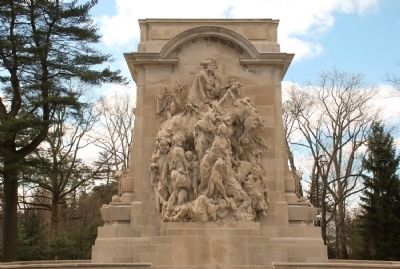
This monument has been well maintained by the State of New Jersey. However, many of the delicate, intricate carvings on the monument are starting
Photographed by R. C.
4. Gen. George Washington in His Victory
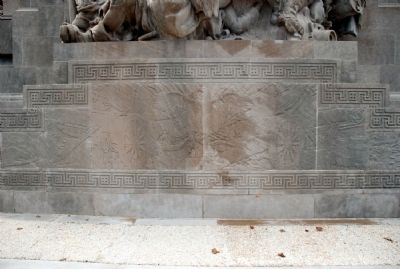
The wide mural at the front base of the monument has been particularly hard hit. Grout from the stones that make up the monument have caused discoloration and, apparently, some damage to the main stones themselves.
Maintenance patches to other parts of the monument are easily seen by the naked eye as well as widespread stains and chemical reaction to the elements all over the monument.
Also see . . .
1. The Princeton Battle Monument: Honoring Washington's First Great Victory. American Battlefield Trust website entry (Submitted on November 21, 2021, by Larry Gertner of New York, New York.)
2. Announcement of Harding's visit to Princeton for the dedication of the Princeton Battle Monument. Harding will Visit Princeton tomorrow; Dedication of Revolutionary Battle Monument to Be Followed by Degree.
An article about the dedication of the monument originally published in The New York Times on June 8, 1922.
Of note, the final cost of the monument was $300,000, as opposed to the $60,000 estimated in 1892. (Submitted on February 14, 2008, by Kevin W. of Stafford, Virginia.)
Additional commentary.
1.
Photographed by R. C.
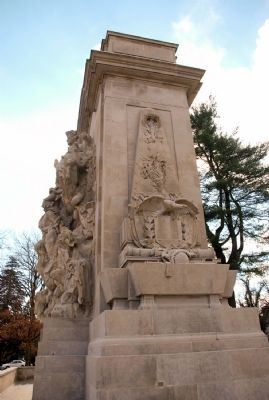
5. Right Side and Front of Princeton Battle Monument
I found a picture of the monument from around the time of its construction. Originally, it was in a heavily wooded area and the road appears to run directly in front of it. There was also a flight of stairs up to the monument. The stairs appear to be mostly gone with the exception of one or two that are now used to step up from the plaza pavement.
— Submitted February 14, 2008, by Ronald Claiborne of College Station, Texas.
Photographed by R. C.
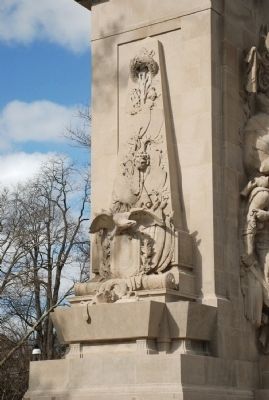
6. Left Side of Princeton Battle Monument
Photographed by R. C.
7. Mural at Base of Monument
Rain, sleet, snow and ice have ravished the delicate mural at the base of the monument. One can only wonder what will be left of it in another hundred years.
Photographed by R. C.
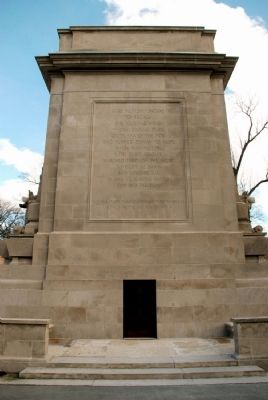
8. Rear of Monument and Monument Inscription
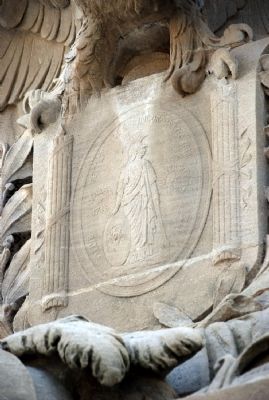
Photographed by R. C.
9. Crest Detail on Battle Monument Beneath the Eagle's Talons
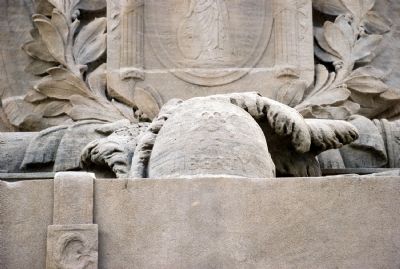
Photographed by R. C.
10. Death or Liberty!
The detail on this piece of the monument depicts a human skull with the words "Or Liberty" beneath.
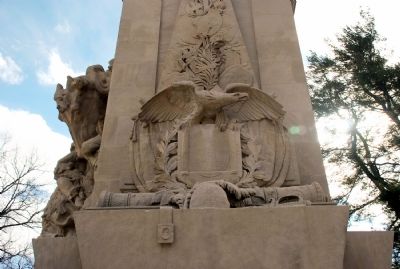
Photographed by R. C.
11. Artillery Piece on Monument
The "<Death> Or Liberty" element of the monument is incorporated into an artillery piece and saber beneath a war eagle on the side of the monument. Many other symbols of America and the Revolution are also present.
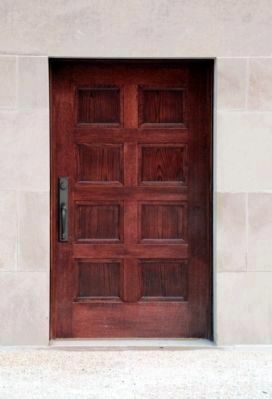
Photographed by R. C.
12. Door of Mystery!
This approximately five-foot tall door is on the rear of the Princeton Battle Monument and can be seen as a dark rectangle in the photo of the monument’s inscription at the top of this page is PERMANENTLY LOCKED! You won’t find mention of it on any of the brochures about the monument nor will any tour guide even acknowledge its presence.
What mysterious, magical, or wonderful object could reside behind the door? Perhaps a hidden chamber that contains the spare pair of Washington’s wooden teeth or a version of the Declaration of Independence full of spelling errors that is unknown to historians. It might be the entrance to a cavern beneath the monument that contains all of the Freemasons' gold! Maybe, it is a trans-dimensional gateway into another universe!
I have “sources” in New Jersey who I am contacting to find out its true purpose. In actuality, it is likely an entry into the monument for performing maintenance on the steel structure that supports it. A second possibility though unlikely given the monument’s height, is that visitors were once able to climb a ladder and stand on the small deck on top. Many more of the monuments of previous centuries than those built today were designed for visitors to stand on top of.
What mysterious, magical, or wonderful object could reside behind the door? Perhaps a hidden chamber that contains the spare pair of Washington’s wooden teeth or a version of the Declaration of Independence full of spelling errors that is unknown to historians. It might be the entrance to a cavern beneath the monument that contains all of the Freemasons' gold! Maybe, it is a trans-dimensional gateway into another universe!
I have “sources” in New Jersey who I am contacting to find out its true purpose. In actuality, it is likely an entry into the monument for performing maintenance on the steel structure that supports it. A second possibility though unlikely given the monument’s height, is that visitors were once able to climb a ladder and stand on the small deck on top. Many more of the monuments of previous centuries than those built today were designed for visitors to stand on top of.
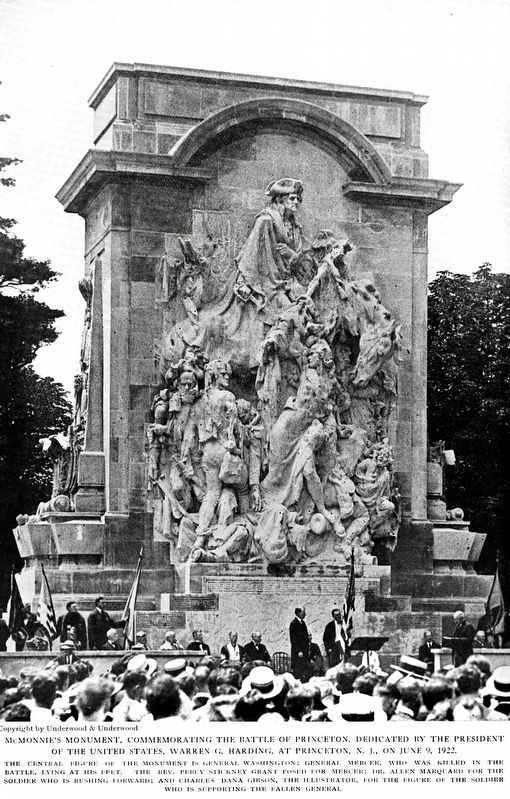
Underwood and Underwood (via the Internet Archive), June 9, 1922
13. Princeton Battle Monument
McMonnie's Monument, Commemorating the Battle of Princeton, dedicated by the President of the United States, Warren G. Harding, at Princeton. N. J., On June 9, 1922.
The central figure of the monument is General Washington: General Mercer, who was killed in the battle, lying at his feet. The Rev. Percy Stickney Grant posed for Mercer: Dr. Allen Marquard for the soldier who is rushing forward; and Charles Dana Gibson, the illustrator, for the figure of the soldier who is supporting the fallen general.
Copyright by Underwood &. Underwood
This photo of the monument appeared in The Daughters of the American Revolution Magazine, Vol. LVI, No. 8, August 1922.
The central figure of the monument is General Washington: General Mercer, who was killed in the battle, lying at his feet. The Rev. Percy Stickney Grant posed for Mercer: Dr. Allen Marquard for the soldier who is rushing forward; and Charles Dana Gibson, the illustrator, for the figure of the soldier who is supporting the fallen general.
Copyright by Underwood &. Underwood
This photo of the monument appeared in The Daughters of the American Revolution Magazine, Vol. LVI, No. 8, August 1922.
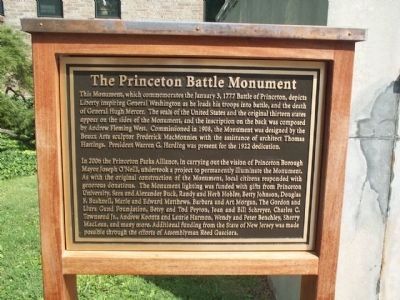
Photographed by Gary Nigh, August 2008
14. Princeton Battle Monument Marker
Credits. This page was last revised on November 21, 2021. It was originally submitted on February 14, 2008, by Ronald Claiborne of College Station, Texas. This page has been viewed 4,938 times since then and 116 times this year. Photos: 1, 2, 3, 4, 5, 6, 7, 8, 9, 10, 11, 12. submitted on February 14, 2008, by Ronald Claiborne of College Station, Texas. 13. submitted on February 23, 2019, by Allen C. Browne of Silver Spring, Maryland. 14. submitted on August 17, 2008, by Gary Nigh of Trenton, New Jersey. • Kevin W. was the editor who published this page.
