
Near Carefree in Maricopa County, Arizona — The American Mountains (Southwest)
The Old Verde River Sheep Bridge
Photographed by Wyndfire, March 11, 2012
1. The Old Verde River Sheep Bridge - Marker 1
Main Marker
Marker 1 - (Main Marker):
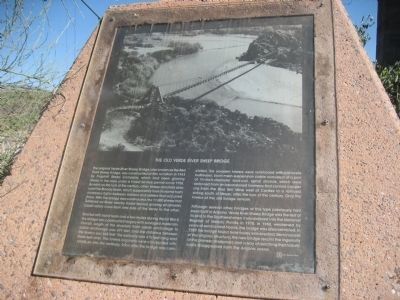
The original Verde River Sheep Bridge, also known as the Red Point Sheep Bridge, was constructed at this location in 1943 by Flagstaff Sheep Company, which had been grazing sheep in the area under a Forest Service permit since 1926. As early as the turn of the century, other sheep ranchers also used the Bloody Basin, which supposedly took its name from numerous fights between Indians and settlers that occurred there. After the bridge was constructed, the 11,000 sheep that wintered on three nearby Forest Service grazing allotments could safely cross from one side of the Verde to the other.
Erected with hand tools and a few mules during World War II, the bridge was constructed largely with salvaged materials. Overall length of the structure from cable anchorage to cable anchorage was 691 feet, and the distance between the two towers was 568 feet. The walkway was 476 feet long and three feet wide. The towers originally were constructed with wood, as was the walkway. Soon after the bridge was complete, the wooden towers were reinforced with concrete buttresses. Each main suspension cable consisted
this page online
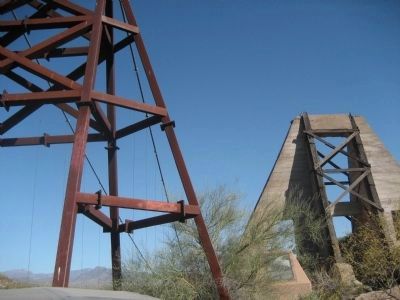
Although several other bridges of this type previously had been built in Arizona, Verde River Sheep Bridge was the last of its kind in the Southwest when it was entered into the National Register of Historic Places in 1978. In 1988, weakened by years of service and floods, the bridge was disassembled. In 1989, the bridge found here today was erected. Reminiscent of the original structure, the new bridge recalls the ingenuity of the pioneer sheepmen and a way of ranching that has virtually disappeared from the Arizona scene.
Marker 2 - (Middle Marker):
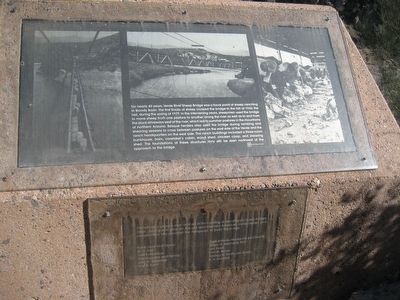
For nearly 40 years, Verde River Sheep Bridge was a focal point of sheep ranching in Bloody Basin. The first flocks of sheep crossed the bridge in the fall of 1943; the last, during the spring of 1979. In the intervening years, sheepmen used the bridge to move sheep from one pasture to another along the
Photographed by Wyndfire, March 11, 2012
2. The Old Verde River Sheep Bridge - Marker 2
Lower plaque:
The following were involved in the building or use of the old sheep bridge. Other participants were the Basque and Mexican-American sheepherders and camptenders who provided the manpower to build the bridge
Frank Auza and Family • M. O. Best • José Echenique • Tony Gonzalo and Family • John W. Hennessy • Tony A. Koch • José Antonio Manterola and Family • Ralph O. Raymond, M.D. • Levi Reed • Emil M. Rovey • George W. Smith and Family • W. B. Spurlock
The following were involved in the building or use of the old sheep bridge. Other participants were the Basque and Mexican-American sheepherders and camptenders who provided the manpower to build the bridge
Frank Auza and Family • M. O. Best • José Echenique • Tony Gonzalo and Family • John W. Hennessy • Tony A. Koch • José Antonio Manterola and Family • Ralph O. Raymond, M.D. • Levi Reed • Emil M. Rovey • George W. Smith and Family • W. B. Spurlock
Marker 3 - (Marker on the East Side of Bridge)
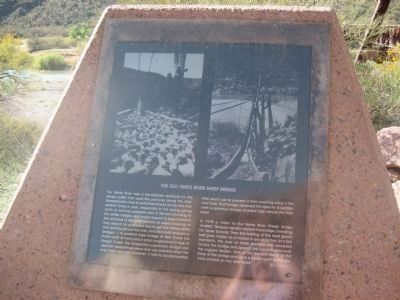
The Verde River was a formidable obstacle for the sheep outfits that used the pastures along the river. Sheepherders had to swim their flocks across the river several times a year, especially in the spring going north to summer pastures and in the fall returning to the winter ranges, and could expect to lose at least a few animals to the swift currents at every crossing. In their search for a reliable way to get the sheep safely and quickly across the river, ranchers built temporary bridges - a pontoon-type bridge at Red Creek (six miles north of here) and a small suspension
Photographed by Wyndfire, March 11, 2012
3. The Old Verde River Sheep Bridge - Marker 3
In 1978, a visitor to the Verde River Sheep Bridge related, "Basque herders walked the bridge, checking for loose boards. Then the tinkling of the lead goat's bell grew louder as it moved in our direction. In a few moments, the river of white animals was funneled across the bridge and spread like liquid fingers over the rugged terrain. One of the herders stood at the base of the bridge and took a head count as the animals arrived on the west bank."
Erected by National Forest Service - Tonto National Forest Division.
Topics. This historical marker is listed in these topic lists: Animals • Bridges & Viaducts • Industry & Commerce. A significant historical year for this entry is 1943.
Location. 34° 4.674′ N, 111° 42.489′ W. Marker is near Carefree, Arizona, in Maricopa County. It can be reached from Bloody
Photographed by Wyndfire, March 11, 2012
4. The Old Verde River Sheep Bridge
New Bridge on the left, Remains of Original Bridge on the right

Regionally, this marker is in Arizona’s Sonoran Desert, in the Phoenix Metropolitan Area, and in the Tohono O’odham Nation. It is also in the American Southwest. Globally, it is in North America, the Western Hemisphere, the Western World, and the Anglosphere. Historically, it finds itself in what was once New Spain, the Gadsden Purchase, and Mexico’s Alta California.
More about this marker. Markers are located on either end of the bridge.
Also see . . .
1. Verde River Sheep Bridge. Photos taken in 2007 of the the new bridge, remnants of the old bridge, markers and the surrounding area. (Submitted on April 4, 2012.)
2. Historic Photos of the Old Bridge. (Submitted on April 4, 2012.)
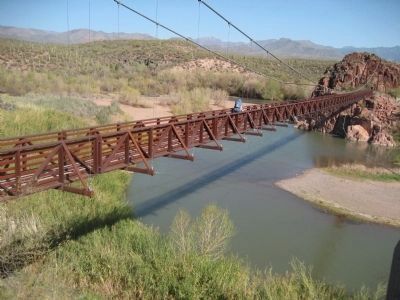
Photographed by Wyndfire, March 11, 2012
5. New Bridge, Spanning the Verde River
Credits. This page was last revised on June 16, 2016. It was originally submitted on March 29, 2012, by Jennifer W. of Las Cruces, New Mexico. This page has been viewed 3,870 times since then and 52 times this year. It was the Marker of the Week April 8, 2012. Photos: 1, 2, 3, 4, 5. submitted on March 29, 2012, by Jennifer W. of Las Cruces, New Mexico. • Syd Whittle was the editor who published this page.
Editor’s want-list for this marker. Photos of the ranch headquarters foundations. • Can you help?
