Tarpon Springs in Pinellas County, Florida — The American South (South Atlantic)
Tarpon Springs Sponge Industry
Photographed by Paul Crumlish, March 18, 2012
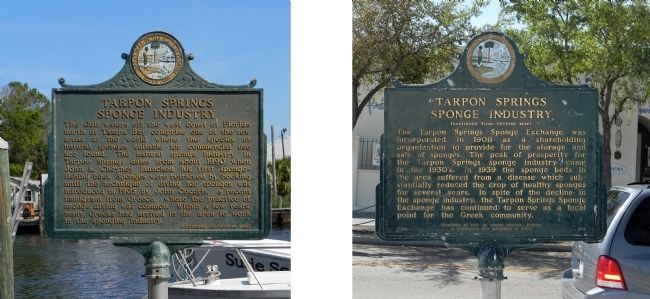
1. Tarpon Springs Sponge Industry Marker
The Gulf waters off the west coast of Florida north of Tampa Bay comprise one of the few areas of the world where the species of natural sponges suitable for commercial use are found. The natural sponge industry in Tarpon Springs dates from about 1890 when John K. Cheyney launched his first sponge-fishing boat. Sponges were retrieved by hooking until the technique of diving for sponges was introduced in 1905 by John Cocoris, a recent immigrant from Greece, where the practice of sponge diving was common. Within a few years, many Greeks had arrived in the area to work in the sponging industry.
Reverse:
The Tarpon Springs Sponge Exchange was incorporated in 1908 as a shareholding organization to provide for the storage and sale of sponges. The peak of prosperity for the Tarpon Springs sponge industry came in the 1930's. In 1939 the sponge beds in the area suffered from a disease which substantially reduced the crop of healthy sponges for several years. In spite of the decline in the sponge industry, the Tarpon Springs Sponge Exchange has continued to serve as a focal point for the Greek Community.
Erected 1973 by City
this page online
Topics. This historical marker is listed in this topic list: Industry & Commerce. A significant historical year for this entry is 1890.
Location. 28° 9.34′ N, 82° 45.669′ W. Marker is in Tarpon Springs, Florida, in Pinellas County. It is on Dodecanese Boulevard ¼ mile west of North Pinellas Avenue (Alternate U.S. 19), on the right when traveling west. The marker is located on the Tarpon Springs Sponge Docks, across the street from the Sponge Exchange. Touch for map. Marker is at or near this postal address: 735 Dodecanese Boulevard, Tarpon Springs FL 34689, United States of America. Touch for directions.

Regionally, this marker is on Florida’s Gulf Coast and on Tampa Bay. It is also in the American South and on the Gulf Coast. Globally, it is in the North Atlantic Region, North America, a Gulf of Mexico state, the Western Hemisphere, the Western World, and the Anglosphere. Historically, it finds itself in what was once New Spain, the territory of the Mississippian Culture, one of the Confederate States of America, and the
Photographed by Paul Crumlish, March 18, 2012
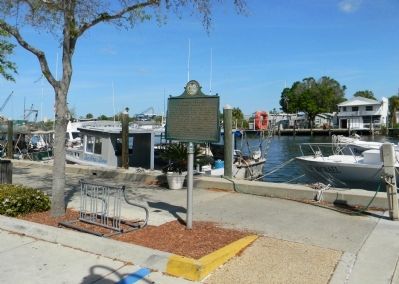
2. Wide view of the Tarpon Springs Sponge Industry Marker
The marker stands at the busy Tarpon Springs Sponge Docks.
Other nearby markers. At least 8 other markers are within walking distance of this marker: 42 Ft. Sponge Diving Boat (within shouting distance of this marker); St. Nicholas Boat Line (about 300 feet away, measured in a direct line); Greektown Historic District (about 400 feet away); Unitarian Universalist Church of Tarpon Springs (approx. half a mile away); Anson P.K. Safford House (approx. half a mile away); Hennig House (approx. half a mile away); Old Tarpon Springs High School (approx. 0.6 miles away); Craig Park War Memorial (approx. 0.6 miles away). Touch for a list and map of all markers in Tarpon Springs.
Also see . . . Sponge fishing in Key West and Tarpon Springs. At the end of the 19th century the sponge fishing industry, and later sponge diving industry, was established due to John Corcosis and John Cheyney. Corcosis, a born Greek, came to New York in 1895 to work in the sponge trade. There he met John Cheyney, one of the early settlers in Tarpon Springs who sent out the first "hooker boat" from Tarpon Springs. (Submitted on March 29, 2012, by PaulwC3 of Northern, Virginia.)
Photographed by Paul Crumlish, March 18, 2012
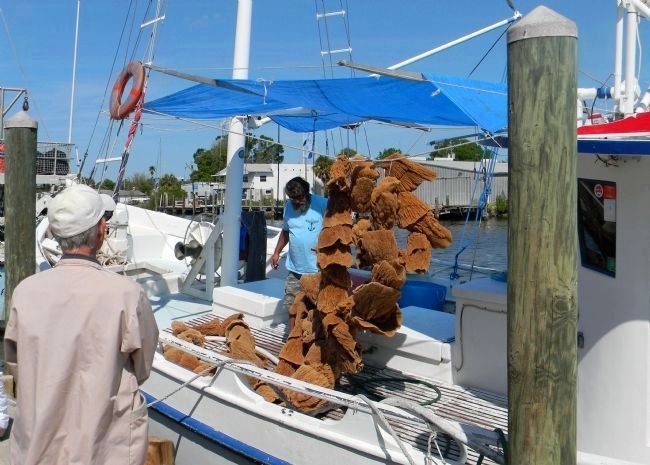
3. The Tarpon Springs Sponge Fisherman
Like his ancestors, the contemporary fisherman hangs out the day's harvest to dry upon returning to port.
Photographed by Paul Crumlish, March 18, 2012
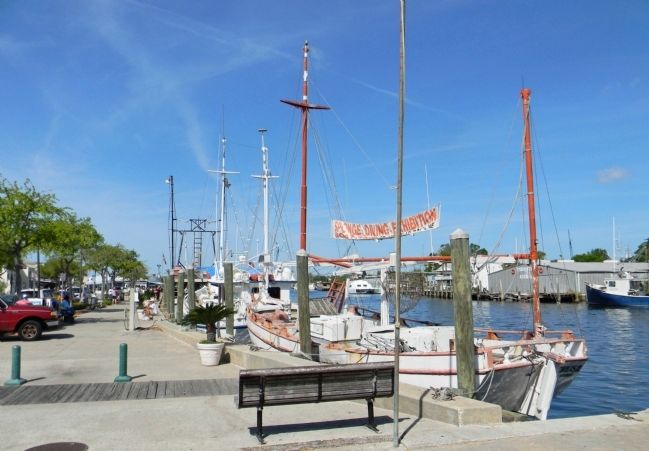
4. Tarpon Springs Sponge Docks
Once the "Sponge Capital of the World", employing thousands, today the docks are a popular tourist attraction.
Photographed by Paul Crumlish, March 18, 2012
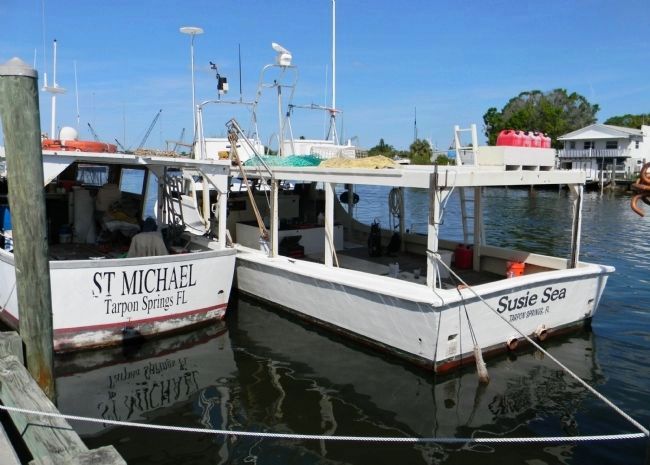
5. Some of the Tarpon Springs Sponge fleet
While the fleet may be smaller these days, sponge fisherman still head into the Gulf of Mexico to harvest sponges.
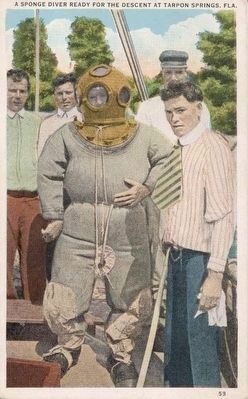
circa 1930
6. A Sponge Diver Ready for the Descent, Tarpon Springs, Fla.
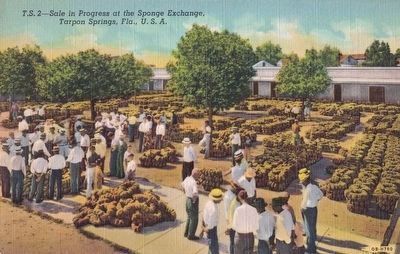
circa 1940
7. Sale in Progress at the Sponge Exchange, Tarpon Springs, Fla., U.S.A.
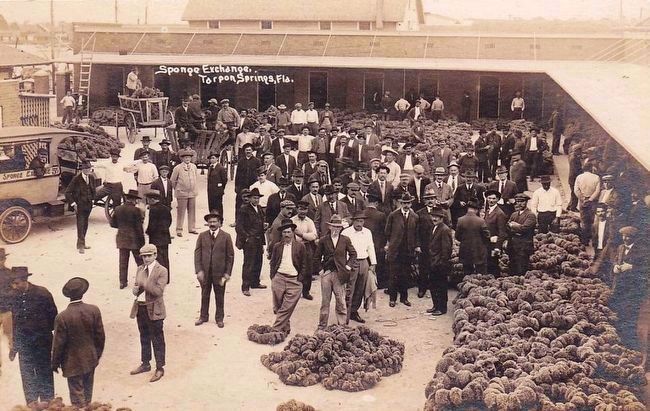
circa 1920
8. Sponge Exchange, Tarpon Springs, Fla.
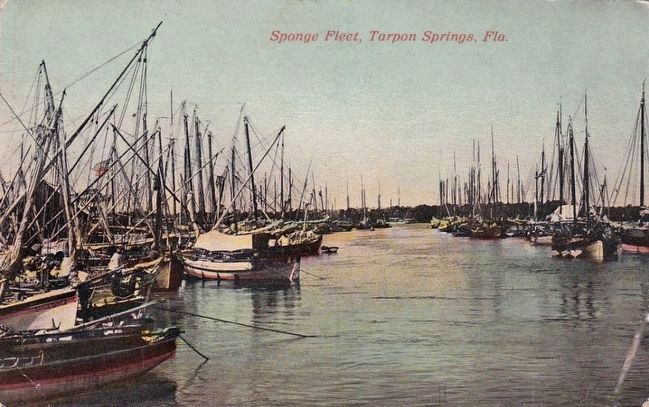
circa 1920
9. Sponge Fleet, Tarpon Springs, Fla.
Credits. This page was last revised on April 12, 2018. It was originally submitted on March 29, 2012, by PaulwC3 of Northern, Virginia. This page has been viewed 1,565 times since then and 95 times this year. Photos: 1, 2, 3, 4, 5. submitted on March 29, 2012, by PaulwC3 of Northern, Virginia. 6, 7, 8, 9. submitted on October 30, 2015.
