Sanford in Seminole County, Florida — The American South (South Atlantic)
Georgetown
Photographed by AGS Media, December 30, 2011
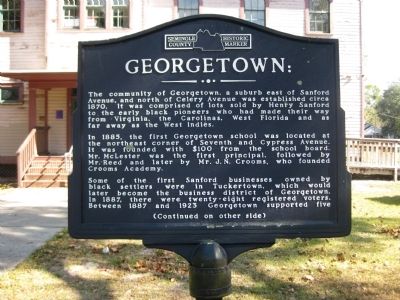
1. Georgetown Marker
The community of Georgetown, a suburb east of Sanford Avenue, and north of Celery Avenue was established circa 1870. It was comprised of lots sold by Henry Sanford to the early black pioneers who had made their way from Virginia, the Carolinas, West Florida and as far away as the West Indies.
In 1885, the first Georgetown school was located at the northeast corner of Seventh and Cypress Avenue. It was founded with $100 from the school board. Mr. McLester was the first principal, followed by Mr. Reed and later by Mr. J. N. Crooms, who founded Crooms Academy.
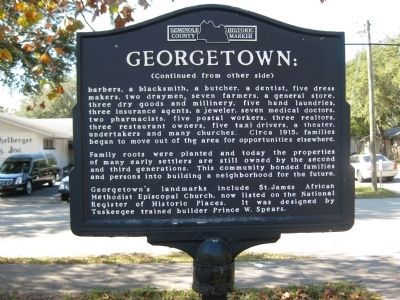
Some of the first Sanford businesses owned by black settlers were in Tuckertown, which would later become the business district of Georgetown. In 1887, there were twenty-eight registered voters. Between 1887 and 1923 Georgetown supported five barbers, a blacksmith, a butcher, a dentist, five dress makers, two draymen, seven farmers, a general store, three dry goods and millinery, five hand laundries, three insurance agents, a jeweler, seven medical doctors, two pharmacists, five postal workers, three realtors, three restaurant owners, five taxi drivers, a theater, undertakers,
this page online
Family roots were planted and today the properties of many early settlers are still owned by the second and third generations. This community bonded families and persons into building a neighborhood for the future.
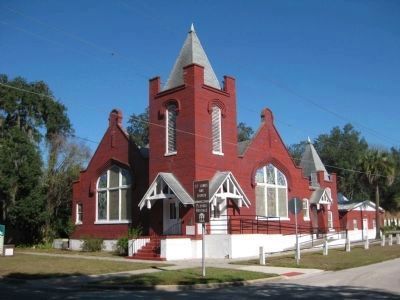
Georgetown's landmarks include St. James African Methodist Episcopal Church, now listed on the National Register of Historic Places. It was designed by Tuskeegee trained builder Prince W. Spears.
Topics and series. This historical marker is listed in these topic lists: African Americans • Education • Industry & Commerce • Religion & Religious Structures. In addition, it is included in the African Methodist Episcopal (AME) Church series list. A significant historical year for this entry is 1870.
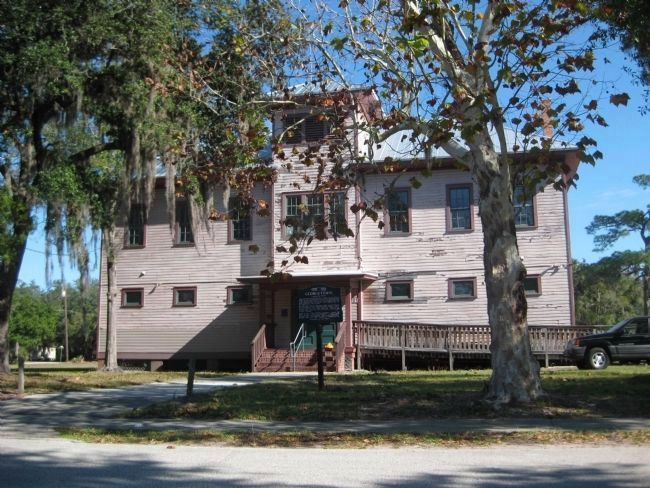
Location. 28° 48.13′ N, 81° 15.762′ W. Marker is in Sanford, Florida, in Seminole County. It is on Pine Avenue north of Celery Avenue (County Road 415), on the right when traveling north. The marker stands in front of a large, wooden, former school house, the old Hopper Academy. Touch for map. Marker is at or near this postal
Photographed by AGS Media, December 30, 2011
2. Georgetown Marker

Regionally, this marker is in Greater Orlando and in Central Florida. It is also in the American South. Globally, it is in the North Atlantic Region, North America, a Gulf of Mexico state, the Western Hemisphere, the Western World, and the Anglosphere. Historically, it finds itself in what was once New Spain, the territory of the Mississippian Culture, one of the Confederate States of America, and the Antebellum South.
Other nearby markers. At least 8 other markers are within walking distance of this marker: Hopper Academy (a few steps from this marker); St. James African Methodist Episcopal Church (approx. 0.2 miles away); Historical Figures (approx. half a mile away); Sanford Avenue (approx. half a mile away); Businesses (approx. half a mile away); Vanished Sanford (approx. half a mile away); Sanford High School / Sanford Grammar / Student Museum (approx. 0.6 miles away); History of George W. Touhy Park (approx. 0.6 miles away). Touch for a list and map of all markers in Sanford.
More about this marker. The double-sided
Photographed by AGS Media, December 30, 2011
3. Georgetown Marker and the old Hopper Academy
Regarding Georgetown. Founded in 1926 in the nearby African American town of Goldsboro, Crooms Academy was Seminole County's high school for African American students. It continued in this capacity until schools were desegregated in 1970. Today, it is Crooms Academy of Information Technology, a technology magnet school.
Related markers. Click here for a list of markers that are related to this marker.
Also see . . . Sanford honoring historic Georgetown community with street sign toppers. Click Orlando website entry (Submitted on July 25, 2024, by Larry Gertner of New York, New York.)
Photographed by AGS Media, December 30, 2011
4. St. James A.M.E. Church
Credits. This page was last revised on July 25, 2024. It was originally submitted on April 8, 2012, by Glenn Sheffield of Tampa, Florida. This page has been viewed 4,213 times since then and 207 times this year. Photos: 1, 2, 3, 4. submitted on April 8, 2012, by Glenn Sheffield of Tampa, Florida. • Bill Pfingsten was the editor who published this page.
