Near Ponce de Leon in Walton County, Florida — The American South (South Atlantic)
Knox Hill Academy
1848
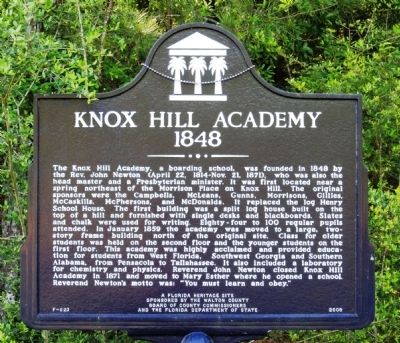
Photographed by Paul Fehrenbach, April 10, 2012
1. Knox Hill Academy Marker
this page online
A Florida Heritage Site
Erected 2008 by Walton County Board of Commissioners and the Florida Department of State. (Marker Number F-623.)
Topics. This historical marker is listed in this topic list: Education. A significant historical month for this entry is January 1859.
Location. 30° 38.497′ N, 85° 57.461′ W. Marker is near Ponce de Leon, Florida, in Walton County. It is at the intersection of Knox Hill Road and Pulsey Hill Road, on the right when traveling north on Knox Hill Road. Marker is located one half mile north of County Hwy 183, one mile west of State Hwy 81. Touch for map. Marker is in this post office area: Ponce de Leon FL 32455, United States of America. Touch for directions.

Regionally, this marker is on the Florida Panhandle. It is also in the American South, specifically in the Deep South, and on the Gulf Coast. Globally, it is in the North Atlantic Region, North America, a Gulf of Mexico state, the Western Hemisphere, the Western World, and the Anglosphere. Historically, it finds itself in what was once New Spain, the territory
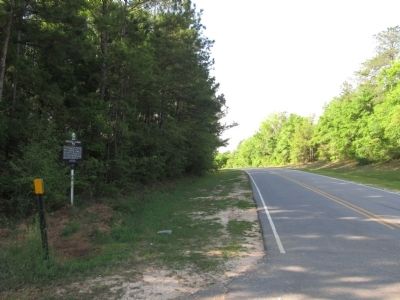
Photographed by Paul Fehrenbach, April 10, 2012
2. Knox Hill Academy Marker
This view is looking south along Knox Hill Road.
Other nearby markers. At least 8 other markers are within 11 miles of this marker, measured as the crow flies: Euchee Valley Presbyterian Church And Cemetery (approx. 2.8 miles away); Florida Honors and Remembers our POW’s and MIA’s (approx. 5.2 miles away); Eucheeanna Community (approx. 5.2 miles away); Hinson's Crossroads (approx. 7.1 miles away); Dream Cottage (approx. 10½ miles away); Pansy Cottage (approx. 10½ miles away); Walton County Confederate Monument (approx. 10.7 miles away); Florida's First Confederate Monument (approx. 10.7 miles away).
Credits. This page was last revised on June 30, 2020. It was originally submitted on April 24, 2012, by Paul Fehrenbach of Richfield, Wisconsin. This page has been viewed 1,676 times since then and 52 times this year. Photos: 1, 2. submitted on April 24, 2012, by Paul Fehrenbach of Richfield, Wisconsin. • Craig Swain was the editor who published this page.
