Bloomington in McLean County, Illinois — The American Midwest (Great Lakes)
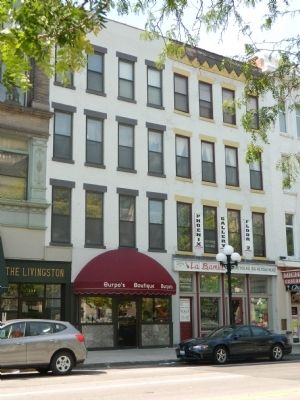
The Phoenix Block
Looking for Lincoln
| — | 1859 | — |

Photographed by Jason Voigt, February 16, 2026
1. The Phoenix Block Marker
"Herewith is a little sketch...there is not much of it...I suppose, that there is not much of me." Lincoln thus fulfilled Jesse Fell's 1858 request for an autobiography. Catching Lincoln as he emerged from the courthouse, Fell invited Lincoln to meet in his brother's law office on the second floor of the Phoenix Block. Lincoln had gained national attention because of the 1858 Lincoln-Douglas senatorial election debates, a race which he lost. Fell told Lincoln that if his views became better known "...you can be made a formidable, if not a successful, candidate for the presidency." Lincoln protested, insisting the services of William A. Seward and Salmon P. Chase made them more deserving. They had, he insisted rendered greater service to the new Republican Party. Fell replied that they needed a man who could be elected, not one with more party service. Fell's travels, as corresponding secretary of the Republican Party, had convinced him that Lincoln was the most acceptable presidential candidate. By late December 1859, Fell had persuaded Lincoln to write his first autobiography.
Kersey Fell's desk was used in his Phoenix office, the site where Jesse Fell first asked Lincoln to write and autobiography. The autobiography would provide information about the man who so ably debated the nation's leading Democrat, Illinois Senator Stephen A. Douglas. The autobiography was enhanced by Jesse Fell, of Bloomington, and Joseph W. Lewis, of Westchester, Pennsylvania. Lewis' brother was the editor of the Bloomington Pantagraph. It was originally published in Pennsylvania and provided the nation with the first details of Lincoln's life.
"Mr. Lincoln is probably the fairest and most
this page online
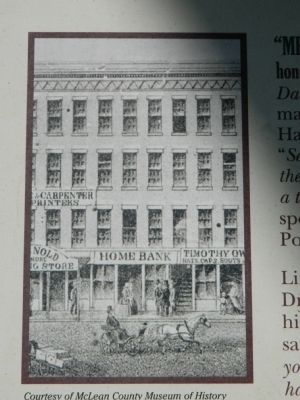
Lincoln represented Dr. Crothers (at right) and Dr. Rogers in the "Chicken Bone Case," named for his use of such bones in his plea to the jury. Lincoln said to the plaintiff, "I would advise you to get down on your knees and thank your Heavenly Father...that you have any legs to stand on..." Dr. Crothers' office was in the building on the far left.
Erected 2009 by the City of Bloomington, Looking for Lincoln Heritage Coalition and the McLean County Museum of History.
Topics and series. This historical marker is listed in these topic lists: Arts, Letters, Music • Communications. In addition, it is included in the Former U.S. Presidents: #16 Abraham Lincoln, and the Looking for Lincoln series lists. A significant historical month for this entry is April 1857.
Location. 40° 28.78′ N,
Photographed by Beverly Pfingsten, June 10, 2012
2. The Phoenix Building
The McLean County Museum of History.

Regionally, this marker is in Central Illinois. It is also in the American Midwest and in the Corn Belt. Globally, it is in North America, the Western Hemisphere, the Western World, and the Anglosphere. Historically, it finds itself in what was once the territory of the Mississippian Culture and also the Northwest Territory.
Other nearby markers. At least 8 other markers are within walking distance of this marker: McLean County Korean War Memorial (here, next to this marker); McLean County Vietnam War Memorial (here, next to this marker); Sigmund Livingston (a few steps from this marker); Lincoln The Lawyer (a few steps from this marker); Lincoln's Courthouse (within shouting distance of this marker);
Photographed by Beverly Pfingsten, June 10, 2012
3. The Phoenix Building

Photographed by Jason Voigt, February 16, 2026
4. The Phoenix Block Marker
Marker is at the southeast corner of McLean County Museum of History (formerly a courthouse), across from the Phoenix building
Credits. This page was last revised on February 16, 2026. It was originally submitted on July 16, 2012, by Bill Pfingsten of Bel Air, Maryland. This page has been viewed 951 times since then and 40 times this year. Photos: 1. submitted on February 16, 2026, by Jason Voigt of Glen Carbon, Illinois. 2, 3. submitted on July 16, 2012, by Bill Pfingsten of Bel Air, Maryland. 4. submitted on February 16, 2026, by Jason Voigt of Glen Carbon, Illinois.
