Downtown in Asheville in Buncombe County, North Carolina — The American South (South Atlantic)
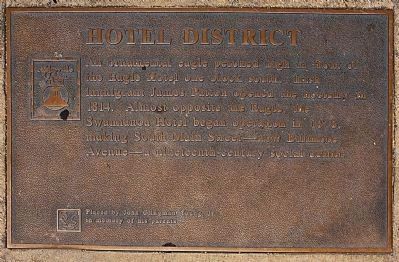
Hotel District
(of Asheville, N.C.)
Photographed by Mike Stroud, May 19, 2012
1. Hotel District Marker
Erected by Asheville Urban Trail, John Clingman Young, Jr. in memory of his parents.
Topics. This historical marker is listed in this topic list: Notable Buildings. A significant historical year for this entry is 1814.
Location. 35° 35.63′ N, 82° 33.075′ W. Marker is in Asheville, North Carolina, in Buncombe County. It is in Downtown. It is at the intersection of Biltmore Avenue (U.S. 25) and Eagle Street, on the right when traveling north on Biltmore Avenue. Touch for map. Marker is in this post office area: Asheville NC 28801, United States of America. Touch for directions.

Regionally, this marker is in the Mountains. It is also in the American South, specifically in the Upper South, in Appalachia, and specifically in Southern Appalachia. Globally, it is in North America, the Western Hemisphere, the Western World,
this page online
Other nearby markers. At least 8 other markers are within walking distance of this marker: Cornerstone of Culture (here, next to this marker); Oscar Wong (within shouting distance of this marker); The YMI & William and Georgia Roland (about 300 feet away, measured in a direct line); "The Block" (about 300 feet away); The Early Years In Asheville's Historic Central Square (about 400 feet away); Walk Into History (about 400 feet away); Crossroads of Commerce (about 400 feet away); Catholic Hill School / Stephen’s – Lee High School (about 400 feet away). Touch for a list and map of all markers in Asheville.
Another marker is no longer nearby. Asheville (was a few steps from this marker but has been permanently removed).
Regarding Hotel District. James Patton, the developer and namesake of Asheville's first east-west road through what is today downtown Asheville, established
Photographed by Mike Stroud, May 19, 2012
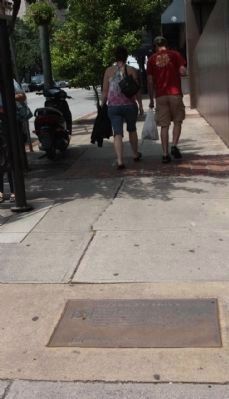
2. Hotel District Marker, sidewalk inlaid
At the forefront of this building boom was the construction of the Grand Central Hotel, followed by the 1880 opening of the four-story brick Swannanoa Hotel boasting Asheville's first bathroom.
Photographed by Mike Stroud, May 19, 2012
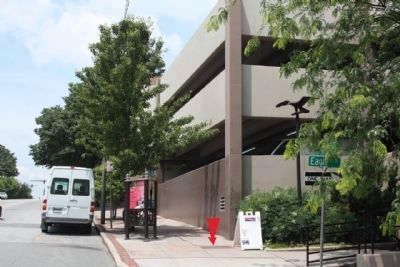
3. Hotel District Marker and Eagle (as mentioned) moved to this present location
Red arrow indicates Marker
Photographed by Mike Stroud, May 19, 2012
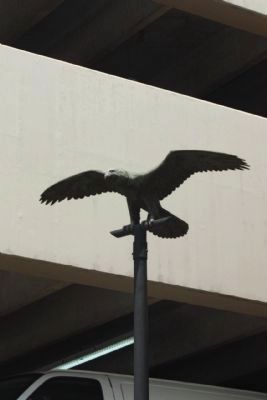
4. Hotel District, Eagle

Photographed by Mike Stroud, May 19, 2012
5. Hotel District Eagle as mentioned
Credits. This page was last revised on June 1, 2025. It was originally submitted on July 17, 2012, by Mike Stroud of Bluffton, South Carolina. This page has been viewed 1,464 times since then and 80 times this year. Photos: 1, 2, 3, 4, 5. submitted on July 17, 2012, by Mike Stroud of Bluffton, South Carolina.
