
Sainte-Mère-Église in Manche, Normandy, France — Western Europe
82nd and 101st Airborne on D-Day
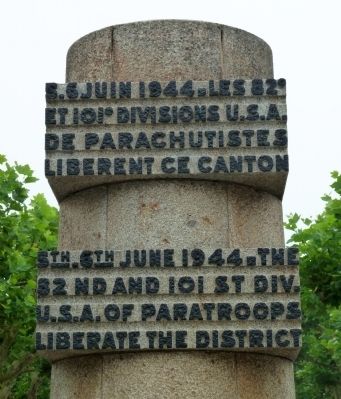
Photographed by Roger W. Sinnott, August 19, 2012
1. 82nd and 101st Airborne on D-Day Marker

Topics. This historical marker is listed in this topic list: War, World II. A significant historical date for this entry is June 6, 1944.
Location. 49° 24.51′ N, 1° 19.041′ W. Marker is in Sainte-Mère-Église, Normandie (Normandy), in Manche. It is on Rue Général de Gaulle just south of Rue Général Koenig, on the left when traveling south. Marker is in the town square. Touch for map. Marker is in this post office area: Sainte-Mère-Église, Normandie 50480, France. Touch for directions.

Regionally, it is in the North Atlantic Region, Europe, the European Union, Atlantic Europe, the Schengen Area, Western Europe, a coastal Mediterranean country, and the Western World. Historically, it finds itself in what was once a French colony and also the Roman Empire.
Other nearby markers. At least 8 other markers are within walking distance of this marker: Film « Jour le plus Long » / Film "The Longest Day" (here, next to this marker);
this page online
Regarding 82nd and 101st Airborne on D-Day. Lying 8 km (5 miles) inland from the Normandy coast, the small town of Sainte-Mère-Église was well behind German coastal defenses on D-Day, June 6, 1944. As part of the overall Allied landing, code-named Overlord, this town was a major objective and drop zone for U.S. paratroopers of the 82nd and 101st Airborne Divisions. They arrived en masse between midnight and 2 a.m. on the 6th, suffering many casualties
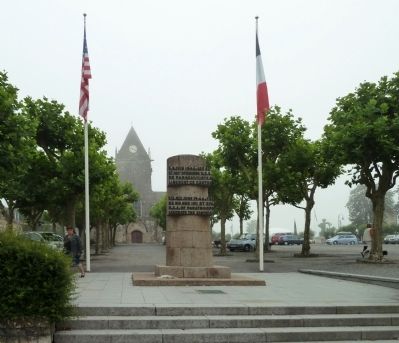
Photographed by Roger W. Sinnott, August 19, 2012
2. Marker with Church
In the background, on the other side of the square, stands the church that gave the town its name. High up on a spire (beside the upper part of the inscription in this view) can be seen the silhouette of a parachute and mannequin commemorating Pvt. John Steele (click to enlarge). For a close-up see Fig. 3.
A lucky exception was Pvt. John Steele of the 82nd’s 505 Paratrooper Infantry Regiment. His chute caught on a spire of the town’s church, leaving him dangling helplessly, but he managed to survive by playing dead for several hours. He was briefly taken prisoner by the German occupying troops but later escaped. His ordeal was portrayed by actor Red Buttons in The Longest Day, the classic D-Day movie (20th Century Fox, 1962).
By late morning on the 6th the town was essentially in Allied hands, although heavy fighting continued for several more days. Many residents consider Sainte-Mère-Église the first town in occupied France to be liberated during World War II (although similar claims are made by two towns nearby).
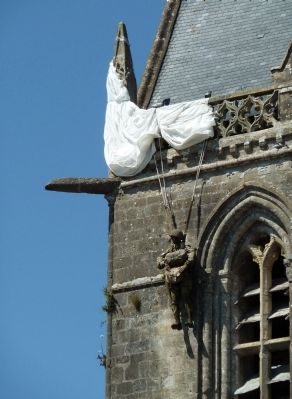
Photographed by Roger W. Sinnott, August 18, 2012
3. Predicament of Pvt. John Steele
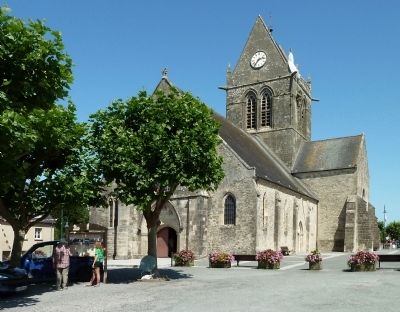
Photographed by Roger W. Sinnott, August 18, 2012
4. Church from the West
Above the main entrance is a stained-glass window (behind tree here, but see Fig. 5).
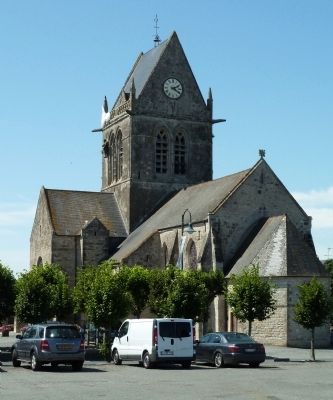
Photographed by Roger W. Sinnott, August 18, 2012
5. Church from the East
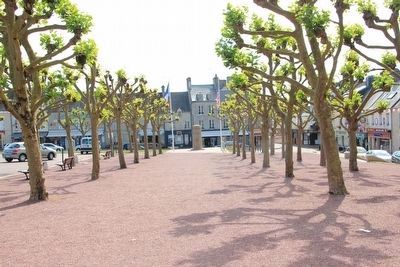
Photographed by Kevin W., July 2, 2015
6. 82nd and 101st Airborne on D-Day Marker
View from the church.
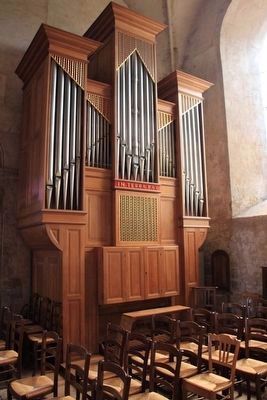
Photographed by Kevin W., July 2, 2015
7. Sainte-Mère-Église Church Organ
This organ inside the church was dedicated on the 40th Anniversary of the liberation of the town. It is dedicated to "the civilian and military victims of W.W. II."
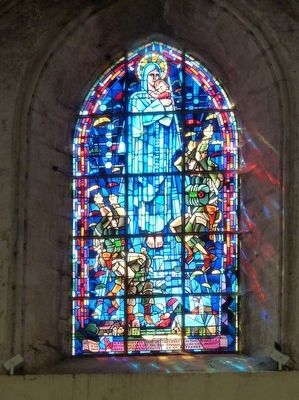
Photographed by Roger W. Sinnott, August 18, 2012
8. Stained-Glass Window of Church
To either side of the Virgin Mary and baby Jesus are stained-glass renderings of U.S. paratroopers, honoring their arrival in this town on D-Day.
Photographed by Kevin W., July 2, 2015
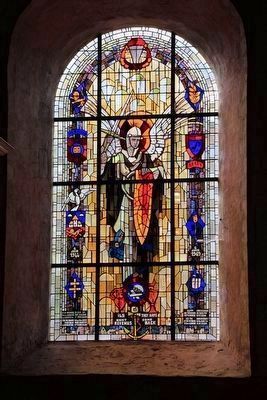
9. Stained-Glass Window of Church
This stain glass window was dedicated on the 25th anniversary of D-Day. It honors the veterans of the 505th, 82nd Airborne Division.
Credits. This page was last revised on September 10, 2018. It was originally submitted on September 25, 2012, by Roger W. Sinnott of Norwell, Massachusetts. This page has been viewed 1,191 times since then and 42 times this year. Photos: 1, 2, 3, 4, 5. submitted on September 25, 2012, by Roger W. Sinnott of Norwell, Massachusetts. 6, 7. submitted on September 26, 2015, by Kevin W. of Stafford, Virginia. 8. submitted on September 25, 2012, by Roger W. Sinnott of Norwell, Massachusetts. 9. submitted on September 26, 2015, by Kevin W. of Stafford, Virginia. • Bill Pfingsten was the editor who published this page.
