Near Hodgenville in Larue County, Kentucky — The American South (East South Central)
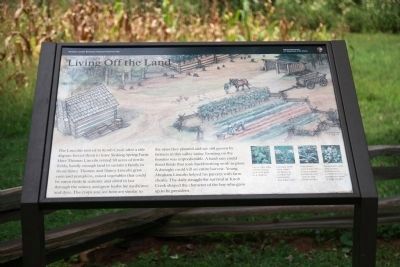
Living Off the Land
| — | Lincoln Family at Knob Creek | — |
Photographed by Courtesy:: Ginger L. Drenning, September 5, 2012
1. Living Off the Land Marker
The crops you see here are similar to the ones they planted and are still grown by farmers in this valley today. Farming on the frontier was unpredictable. A hard rain could flood fields that took backbreaking work to plow. A drought could kill an entire harvest. Young Abraham Lincoln helped his parents with farm chores. The daily struggle for survival at Knob Creek shaped the character of the boy who grew up to be president.
Erected by National Park Service Dept. of the Interior.
Topics. This historical marker is listed in this topic list: Notable Places.
Location. 37° 36.699′ N, 85° 38.319′ W. Marker is near Hodgenville, Kentucky, in Larue County. It can be reached from Bardstown
this page online

Regionally, this marker is in the American South and specifically in the Upper South. Globally, it is in North America, the Western Hemisphere, the Western World, and the Anglosphere. Historically, it finds itself in what was once the territory of the Mississippian Culture and also the Antebellum South.
Other nearby markers. At least 8 other markers are within 3 miles of this marker, measured as the crow flies: The Lincoln Tavern (within shouting distance of this marker); Slavery in the Valley (within shouting distance of this marker); My earliest recollection. . .is of the Knob Creek place (within shouting distance of this marker); The Lincolns at Knob Creek (within shouting distance of this marker); Down by Knob Creek (about 300 feet away, measured in a direct line); a different marker also named Lincoln Knob Creek Farm (about
Photographed by Duane Hall, November 26, 2011
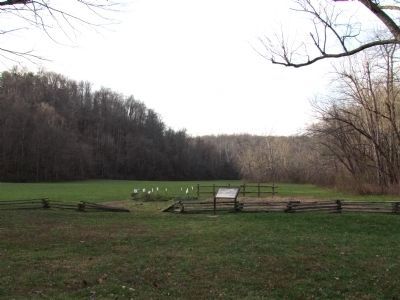
2. Living Off the Land Marker
Another marker is no longer nearby. Lincoln Knob Creek Farm (was within shouting distance of this marker but has been permanently removed).
Also see . . . National Park Service - Knob Creek::. (Submitted on October 4, 2012, by Al Wolf of Veedersburg, Indiana.)
Photographed by Courtesy:: Ginger L. Drenning, September 5, 2012
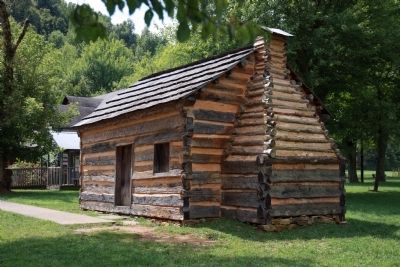
3. Replica Cabin
Photographed by Courtesy:: Ginger L. Drenning, September 5, 2012
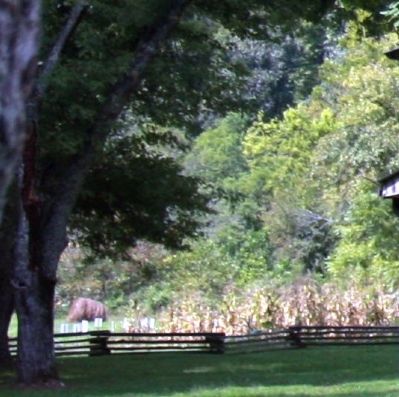
4. Crops - - Living Off the Land Marker
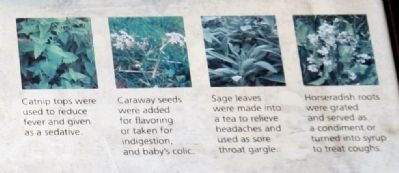
Photographed by Courtesy:: Ginger L. Drenning, September 5, 2012
5. Herbs & Their Uses.
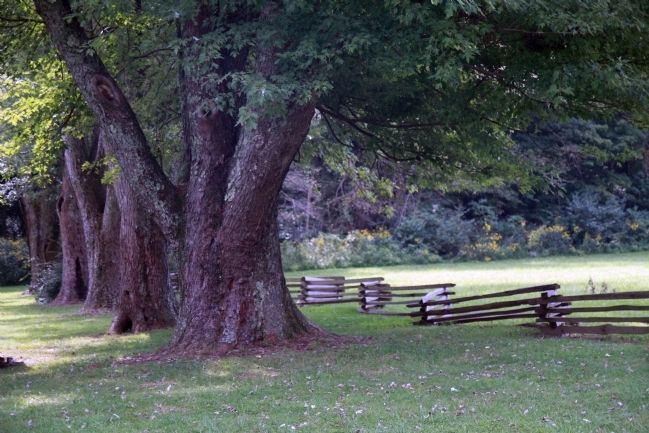
Photographed by Courtesy:: Ginger L. Drenning, September 5, 2012
6. Between Cabin and Crops
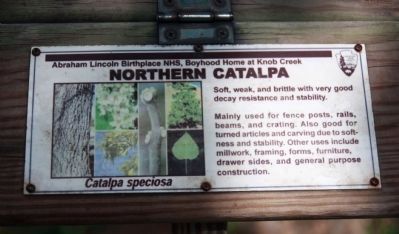
Photographed by Courtesy:: Ginger L. Drenning, September 5, 2012
7. Marker for a Tree
(Text of sign):
Northern Catalpa “Soft, weak, and brittle with very good
decay resistance and stability.
Mainly used for fence posts, rails,
beams, and crating. Also good for
turned articles and carving due to soft-
ness and stability. Other uses include
millwork, framing, forms, furniture,
drawer sides, and general purpose
construction.”
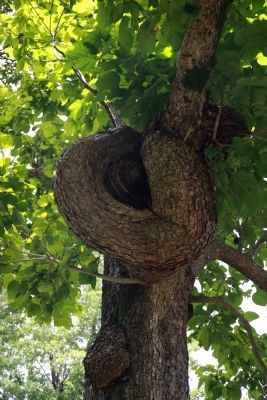
Photographed by Courtesy:: Ginger L. Drenning, September 5, 2012
8. A Northern Catalpa - - Note Un-usual Growth!
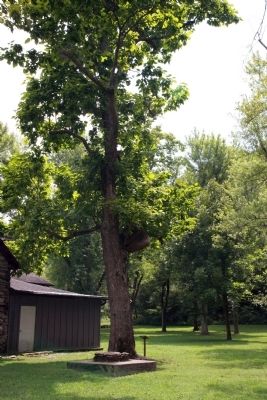
Photographed by Courtesy:: Ginger L. Drenning, September 5, 2012
9. Other View - - Northern Catalpa Tree
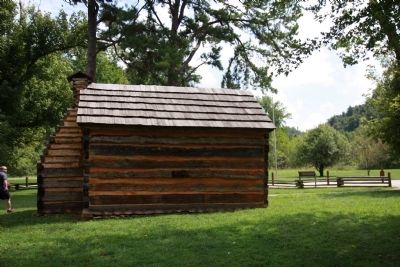
Photographed by Courtesy:: Ginger L. Drenning, September 5, 2012
10. Other View - - Replica Cabin
Credits. This page was last revised on June 16, 2016. It was originally submitted on October 4, 2012, by Al Wolf of Veedersburg, Indiana. This page has been viewed 676 times since then and 18 times this year. Photos: 1. submitted on October 4, 2012, by Al Wolf of Veedersburg, Indiana. 2. submitted on February 7, 2014, by Duane Hall of Abilene, Texas. 3, 4, 5, 6, 7, 8, 9, 10. submitted on October 4, 2012, by Al Wolf of Veedersburg, Indiana.
