Whitingham in Windham County, Vermont — The American Northeast (New England)
Brigham Young Birthplace
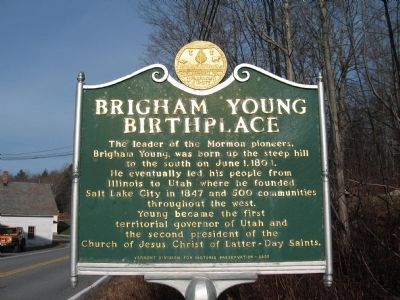
Photographed by Tony Farrick, November 15, 2012
1. Brigham Young Birthplace Marker
Erected 2000 by Vermont Division for Historic Preservation.
Topics and series. This historical marker is listed in this topic list: Religion & Religious Structures. In addition, it is included in the Vermont Division for Historic Preservation Markers series list. A significant historical month for this entry is June 1904.
Location. 42° 47.343′ N, 72° 53.04′ W. Marker is in Whitingham, Vermont, in Windham County. It is on Vt. Route 100 (Vermont Route 100), on the right when traveling south. Touch for map. Marker is at or near this postal address: 6677 Vt Route 100, Whitingham VT 05361, United States of America. Touch for directions.

Regionally, this marker is in the Connecticut River Valley, in the Green Mountains, and in Southern Vermont. It is also in the American
this page online
Other nearby markers. At least 8 other markers are within 6 miles of this marker, measured as the crow flies: Green Mountain Hall (within shouting distance of this marker); Wilmington Veterans Monument (approx. 5½ miles away); Crafts Inn (approx. 5½ miles away); Elizabeth Page “Molly” Stark, 1737 – 1814 (approx. 5½ miles away); Wilmington Veterans Memorial (approx. 5.6 miles away); 7 West Main Street (approx. 5.6 miles away); Lyman House (approx. 5.6 miles away); The Norton House (approx. 5.6 miles away).
Additional keywords. Mormonism, Church of Jesus Christ of Latter-Day Saints
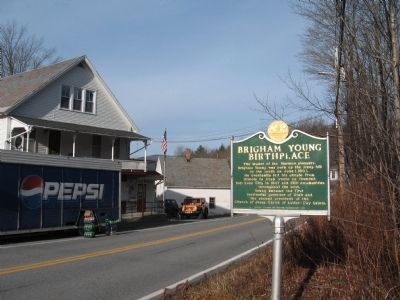
Photographed by Tony Farrick, November 15, 2012
2. Brigham Young Birthplace Marker
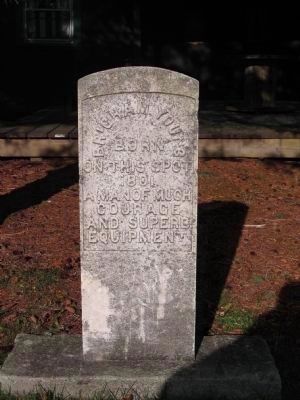
Photographed by Tony Farrick, November 15, 2012
3. Marker for the actual birthplace of Brigham Young
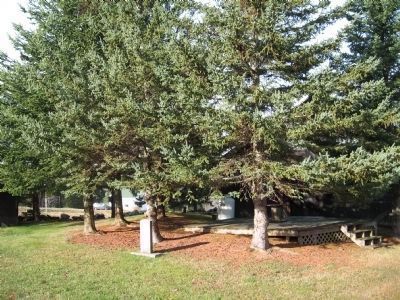
Photographed by Tony Farrick, November 15, 2012
4. Birthplace of Brigham Young
Photographed by Allen C. Browne, August 9, 2015
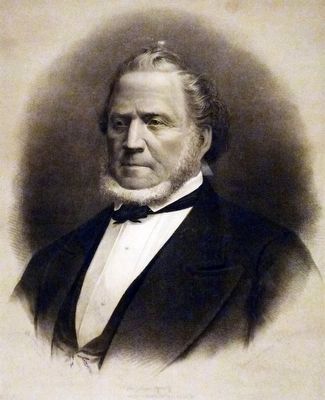
5. Brigham Young
This c. 1875 lithograph of Brigham Young by Hartwig Bornemann hangs in the National Portrait Gallery in Washington, DC.
“Brigham Young converted to Mormonism in 1832 and gradually rose in the leadership structure until he became the head of the Twelve Apostles under Joseph Smith. After Smith's murder by an antiMormon mob in 1844, Young assumed leadership of the larger portion of the church. In 1847 he led the Mormons from Nebraska to the Great Basin, where he founded Salt Lake City as the new church headquarters. He oversaw the migration of tens of thousands of Mormon converts to the West and the founding of hundreds of settlements. The Mormon majority elected Young as governor, but he was soon replaced by an appointed territorial governor. Political conflicts and challenges to the Mormons' separatist communal and theocratic venture led the United States to dispatch troops to Utah in 1857 and assert federal authority.” — National Portrait Gallery
“Brigham Young converted to Mormonism in 1832 and gradually rose in the leadership structure until he became the head of the Twelve Apostles under Joseph Smith. After Smith's murder by an antiMormon mob in 1844, Young assumed leadership of the larger portion of the church. In 1847 he led the Mormons from Nebraska to the Great Basin, where he founded Salt Lake City as the new church headquarters. He oversaw the migration of tens of thousands of Mormon converts to the West and the founding of hundreds of settlements. The Mormon majority elected Young as governor, but he was soon replaced by an appointed territorial governor. Political conflicts and challenges to the Mormons' separatist communal and theocratic venture led the United States to dispatch troops to Utah in 1857 and assert federal authority.” — National Portrait Gallery
Credits. This page was last revised on December 24, 2019. It was originally submitted on November 15, 2012, by Tony Farrick of Shelburne Falls, Ma.. This page has been viewed 2,738 times since then and 226 times this year. Last updated on November 23, 2012, by Tony Farrick of Shelburne Falls, Ma.. Photos: 1, 2. submitted on November 15, 2012, by Tony Farrick of Shelburne Falls, Ma.. 3, 4. submitted on November 23, 2012, by Tony Farrick of Shelburne Falls, Ma.. 5. submitted on October 17, 2015, by Allen C. Browne of Silver Spring, Maryland. • Bill Pfingsten was the editor who published this page.
