Wynnehaven Beach in Okaloosa County, Florida — The American South (South Atlantic)
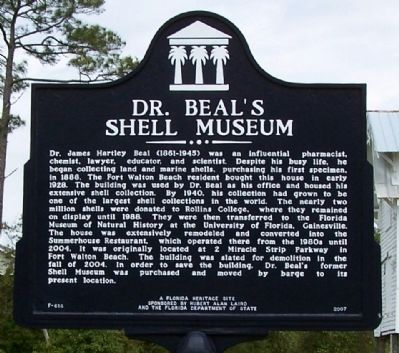
Dr. Beal's Shell Museum
Photographed by David J Gaines, April 8, 2013
1. Dr. Beal's Shell Museum Marker
Erected 2007 by Hubert Alan Laird and the Florida Department of State. (Marker
this page online
Topics. This historical marker is listed in this topic list: Notable Buildings. A significant historical year for this entry is 1888.
Location. Marker is missing. It was located near 30° 24.646′ N, 86° 46.568′ W. Marker was in Wynnehaven Beach, Florida, in Okaloosa County. It was on U.S. 98, on the right when traveling west. Touch for map. Marker was in this post office area: Mary Esther FL 32569, United States of America. Touch for directions.

Regionally, this marker was on the Florida Panhandle. It was also in the American South, specifically in the Deep South, and on the Gulf Coast. Globally, it was in the North Atlantic Region, North America, a Gulf of Mexico state, the Western Hemisphere, the Western World, and the Anglosphere. Historically, it found itself in what was once New Spain, the territory of the Mississippian Culture, one of the Confederate States of America, and the Antebellum South.
Other nearby markers. At least 8 other markers are within 5 miles of this location, measured as the crow flies: In Memory of UH-60M Crew "Mojo 69" (approx. 3.6 miles away); C-46 Commando (approx. 4½ miles
Photographed by David J Gaines, April 8, 2013
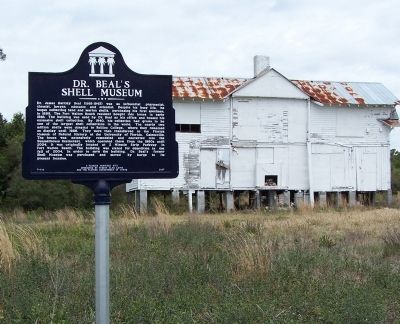
2. Dr. Beal's Shell Museum Marker
Additional commentary.
1. Sign no longer in place…
Sign has been gone for sometime now. The house is in terrible shape and has been for sale the last several years.
— Submitted May 10, 2025, by Frank Hardy of Navarre, Florida.
Credits. This page was last revised on May 10, 2025. It was originally submitted on April 9, 2013, by David J Gaines of Pinson, Alabama. This page has been viewed 2,093 times since then and 161 times this year. Last updated on April 21, 2013. Photos: 1, 2. submitted on April 9, 2013, by David J Gaines of Pinson, Alabama. • Bill Pfingsten was the editor who published this page.
