Galax, Virginia — The American South (Mid-Atlantic)
Galax
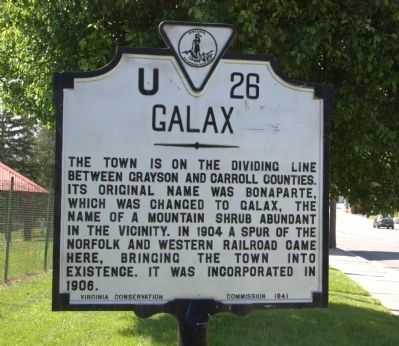
Photographed by J. J. Prats, May 26, 2013
1. Galax Marker
Erected 1941 by Virginia Conversation Commission. (Marker Number U-26.)
Topics and series. This historical marker is listed in this topic list: Political Subdivisions. In addition, it is included in the Virginia Department of Historic Resources (DHR) series list. A significant historical year for this entry is 1904.
Location. 36° 39.45′ N, 80° 55.362′ W. Marker is in Galax, Virginia. It is on South Main Street (Virginia Route 89) near the entrance to Felts Park, on the left when traveling south. Touch for map. Marker is in this post office area: Galax VA 24333, United States of America. Touch for directions.

Regionally, this marker is in Southwest Virginia and in the Blue Ridge Highlands. It is also in the American South and specifically in the Upper South. Globally, it is in North America, the Western
this page online
Other nearby markers. At least 8 other markers are within walking distance of this marker: Veterans Memorial (approx. 0.4 miles away); An Early Water System Before Electricity Was Available (approx. 0.4 miles away); Galax: Home of Traditional Mountain Music (approx. 0.4 miles away); Furniture Manufacturing: A Firm Seat (approx. half a mile away); Carroll County / Grayson County (approx. 0.6 miles away); The Railroad: Lifeline to the World (approx. 0.7 miles away); a different marker also named Galax (approx. ¾ mile away); Galax: Nature's Influence (approx. 0.8 miles away). Touch for a list and map of all markers in Galax.
Also see . . . Wikipedia Entry. “Located in the Appalachian region of the United States, Galax has long been famous for its traditional, or ‘old-timey’ music and musicians. Although the entire Appalachian region is known for its music, the region
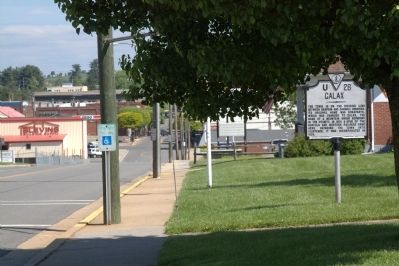
Photographed by J. J. Prats, May 26, 2013
2. Galax Marker
“Galax was founded along the watercourse of Chesnut Creek which has provided an abundant water supply for the city as well as furnishing an early source of power. The Norfolk and Western Railway extended a spur into the village, then called Blairs, with the first train arriving in 1904. The town itself was incorporated in 1906. It was named after Galax, an evergreen plant growing in the area.[6] The railroad provided both freight and passenger transportation that facilitated the growth of industry and provided many of the necessities of life for the people. The manufacture of furniture, textiles,
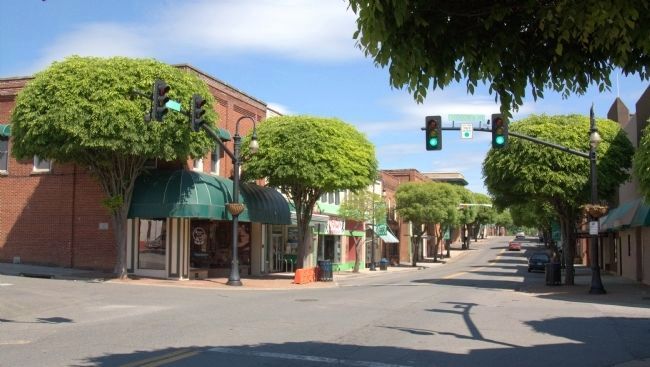
Photographed by J. J. Prats, May 26, 2013
3. Downtown Galax
“During the 1950s, Galax chose to separate from the two counties into whose territory it extended and became an independent city. That status fueled initial economic growth and provided a strong tax base for a number of years. While cooperating with both Grayson and Carroll Counties, Galax was able to chart an independent course to better respond to the needs of its citizens. With the decline in economy, Galax has seen the closing of all but one of its furniture factories leaving much of the population unemployed. Galax has been claimed as the ‘bluegrass capital of the world’.” (Submitted on June 3, 2013.)
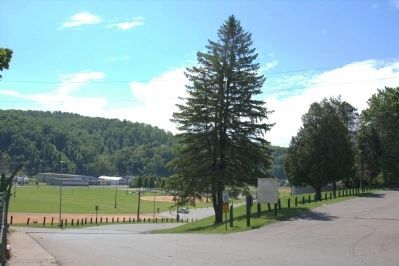
Photographed by J. J. Prats, May 26, 2013
4. Felts Park
This view is from the marker. Felts Park is the location for the Old Fiddlers’ Convention.
Photographed by J. J. Prats, May 26, 2013
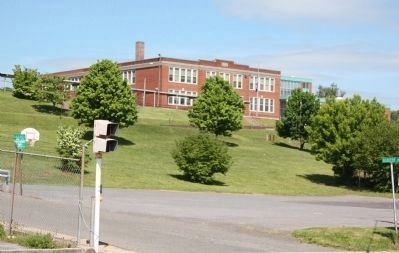
5. Galax Elementary School
This view is from the marker. Galax High School is nearby.
Photographed by Ted Bodner, Southern Weed Science Society, Bugwood.org, May 13, 2005
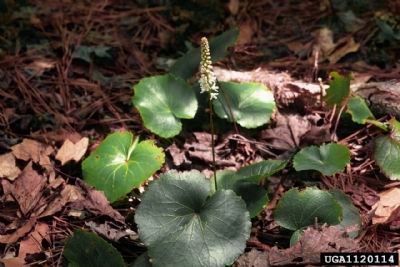
6. Galax Urceolata—Galax Leaf
From Wikipedia entry: Galax (Wandplant, Wandflower, or Beetleweed) is a genus in the flowering plant family Diapensiaceae, containing a single species, Galax urceolata (syn. G. rotundifolia, G. aphylla). It is native to the southeastern United States from Massachusetts and New York south to northern Alabama, growing mainly in the Appalachian Mountains at altitudes of up to 1,500 m, where it grows in shaded places in forests. . . . The leaves are often harvested for the floristry industry. . . (Photo courtesy of Wikimedia Commons.)
Credits. This page was last revised on November 3, 2024. It was originally submitted on June 3, 2013, by J. J. Prats of Powell, Ohio. This page has been viewed 2,144 times since then and 125 times this year. Photos: 1, 2, 3, 4, 5, 6. submitted on June 3, 2013, by J. J. Prats of Powell, Ohio.
