La Grange in Lenoir County, North Carolina — The American South (South Atlantic)
William Dunn Moseley
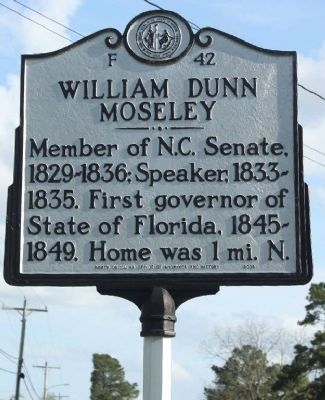
Photographed by Mike Stroud, April 18, 2013
1. William Dunn Moseley Marker
Erected 2005 by North Carolina Office of Archives and History. (Marker Number F-42.)
Topics and series. This historical marker is listed in this topic list: Government & Politics. In addition, it is included in the North Carolina Division of Archives and History series list. A significant historical year for this entry is 1835.
Location. 35° 17.838′ N, 77° 47.415′ W. Marker is in La Grange, North Carolina, in Lenoir County. It is on South Caswell Street (State Highway 903) near Lake Pines Drive, on the right when traveling north. Touch for map. Marker is in this post office area: La Grange NC 28551, United States of America. Touch for directions.

Regionally, this marker is in North Carolina’s Coastal Plain. It is also in the American South and specifically in the Upper South. Globally, it is in North America, the Western Hemisphere, the Western World, and the Anglosphere. Historically, it finds itself in what was once the territory of the Mississippian Culture, one of the original Thirteen
this page online
Other nearby markers. At least 8 other markers are within 8 miles of this marker, measured as the crow flies: James Y. Joyner (approx. half a mile away); Dobbs County Court House (approx. 3.7 miles away); Dobbs County (approx. 3.7 miles away); a different marker also named Dobbs County Court House (approx. 4.3 miles away); The Battle of Whitehall (approx. 5.7 miles away); Engagement at Whitehall (approx. 5.8 miles away); a different marker also named Battle of Whitehall (approx. 5.8 miles away); Wheat Swamp Church (approx. 8 miles away). Touch for a list and map of all markers in La Grange.
Regarding William Dunn Moseley.
Born at the family home, "Moseley Hall," in Lenoir County, in 1795, William Dunn Moseley was one of many public servants in his family. To begin his career, Moseley graduated from the University of North Carolina in 1821 and pursued a career in law, opening an office in Wilmington. Moseley then became involved in politics and represented Lenoir County in the state senate from 1829 to 1837, serving as speaker for four terms from
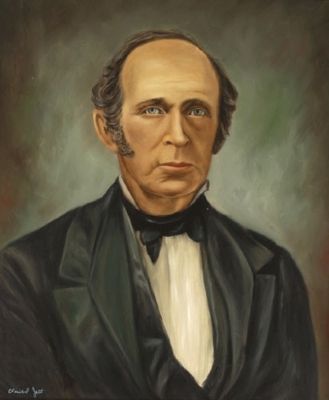
Photographed by Oil over photograph, Claribel Jett, ca. 1960. State of Florida
2. William Dunn Moseley
Political differences lead to a decline in Moseley’s fortunes toward the end of his tenure in the senate and, and after losing a heated election campaign in 1837, he left state politics. Moseley moved to Florida where he previously had purchased a plantation on Lake Miccosukee. He was then elected to the Florida Territorial House of Representatives in 1840 and the Territorial Senate in 1844. The following year he won election to the Governor’s office in the first election since Florida gained statehood, making him the state’s first governor. As governor, Moseley encouraged agriculture in the state, was a strong supporter of states' rights, and favored the establishment of state-funded public schools. Moseley’s term coincided with the start of the Mexican War and skirmishes with the Seminoles. The State Capitol was completed and fully occupied in the first year of his administration. After his term of office, Moseley returned

Photographed by Mike Stroud, April 18, 2013
3. William Dunn Moseley Marker looking northward along South Caswell Street
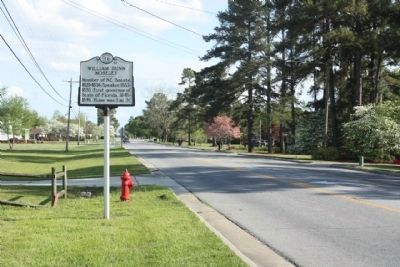
Photographed by Mike Stroud, April 18, 2013
4. William Dunn Moseley Marker looking south along South Caswell Street
Credits. This page was last revised on March 8, 2021. It was originally submitted on July 3, 2013, by Mike Stroud of Bluffton, South Carolina. This page has been viewed 1,375 times since then and 61 times this year. Photos: 1, 2, 3, 4. submitted on July 3, 2013, by Mike Stroud of Bluffton, South Carolina.
