Round Rock in Williamson County, Texas — The American South (West South Central)
Education in Round Rock
Photographed by Keith Peterson
1. Education in Round Rock Marker
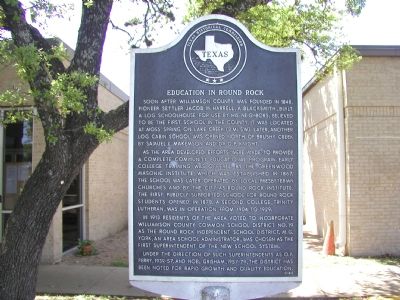
Soon after Williamson County was founded in 1848, pioneer settler Jacob M. Harrell, a blacksmith, built a log schoolhouse for use by his neighbors. Believed to be the first school in the county, it was located at Moss’ Spring on Lake Creek (2 mi. SW). Later, another log cabin school was opened north of Brushy Creek by Samuel L. Makemson and Dr. D. F. Knight.
As the area developed, efforts were made to provide a complete community educational program. Early college training was offered by the Greenwood Masonic Institute, which was established in 1867. The school was later operated by local Presbyterian churches and by the city as Round Rock Institute. The first publicly-supported school for Round Rock students opened in 1878. A second college, Trinity Lutheran, was in operation from 1904 to 1929.
In 1913 residents of the area voted to incorporate Williamson County Common School District No. 19 as the Round Rock Independent School District. M. G. York, an area school administrator, was chosen as the first Superintendent of the new school system. Under the direction of such superintendents as O. F. Perry, 1939-57,
this page online
Erected 1981 by Texas Historical Commission. (Marker Number 9095.)
Topics. This historical marker is listed in these topic lists: Education • Religion & Religious Structures. A significant historical year for this entry is 1848.
Location. 30° 30.692′ N, 97° 41.833′ W. Marker is in Round Rock, Texas, in Williamson County. It is on Round Rock Avenue. Touch for map. Marker is at or near this postal address: 1311 Round Rock Ave, Round Rock TX 78681, United States of America. Touch for directions.

Regionally, this marker is in Central Texas and in the Austin Metropolitan Area. It is also in the American South. Globally, it is in North America, a Gulf of Mexico state, the Western Hemisphere, the Western World, and the Anglosphere. Historically, it finds itself in what was once New Spain, the Republic of Texas, one of the Confederate States of America, and the Antebellum South.
Other nearby markers. At least 8 other markers are within 2 miles of this marker, measured as the crow flies: Barker House (approx. 0.3 miles away);
Photographed by Keith Peterson, October 6, 2013
2. Education in Round Rock Marker
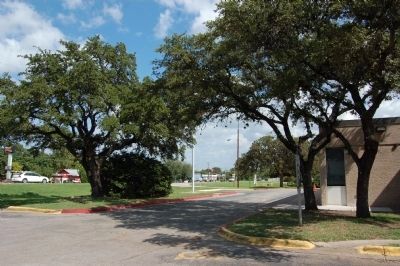
Looking East from marker.
Other markers no longer nearby. The Round Rock (was approx. half a mile away but has been confirmed missing); Sam Bass' Death Site (was approx. 1.1 miles away but has been confirmed missing).
Also see . . . Education in Round Rock. Williamson County Texas History website entry (Submitted on September 11, 2023, by Larry Gertner of New York, New York.)
Photographed by Keith Peterson, October 6, 2013
3. Education in Round Rock Marker
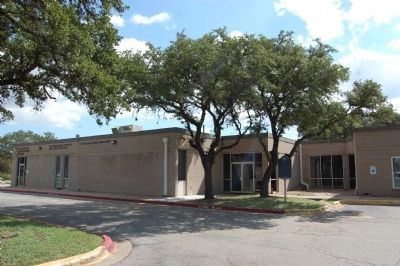
Wide-area view of marker.
Photographed by Keith Peterson, October 6, 2013
4. Education in Round Rock Marker
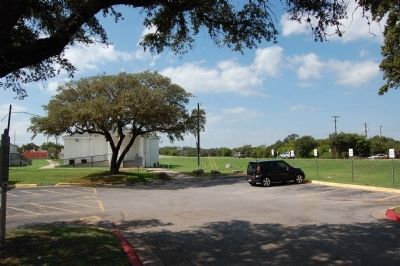
Looking West from marker.
Photographed by Keith Peterson, October 6, 2013
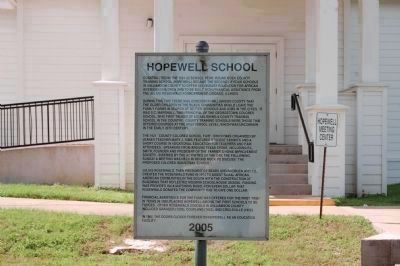
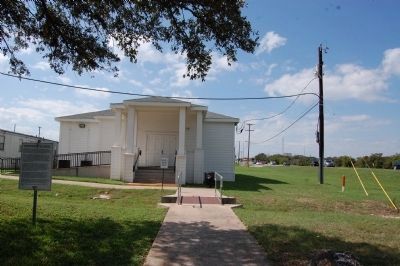
5. Hopewell School
Constructed in the 1921-22 school year, Round Rock County Training School (Hopewell) became the second of four schools in Williamson County to offer secondary education for African American children and to be built with financial assistance from the Julius Rosenwald Foundation of Chicago, Illinois.
During this time there was concern in Williamson Country that the older children in the black communities would leave the family farms in search of better schools and jobs in the cities. It was S.C. Marshall, then principal of the Georgetown Colored School, who first talked of establishing a country training school in the country. County training schools were those that offered courses at the high school level, which was uncommon in the early 20th century.
The 1921 "County Colored School Fair", which was organized by Jeanes teacher Mary J. Sims, featured student exhibits and a short course in vocational education for teachers and fair attendees. Speakers from around Texas spoke, including R.L. Smith, founder and President of the Farmer's Home Improvement Society. Inspired by the activities of the day, the following Sunday a meeting was held in Round Rock to discuss "The Proposed Colored Industrial School".
Julius Rosenwald, then President of Sears and Roebuck and Co. created the Rosenwald Fun in 1914 to assist rural African American communities in the south with the construction of buildings that reflected modern schoolhouse design. Funding was provided on a matching basis - for every dollar that Rosenwald donated the community had to give one dollar.
Financial assistance for the fund was offered for the first time in Texas in 1920. Placing Hopewell among the first schools to be funded. Other Rosenwald schools in Williamson County included Granger (1920), Coupland (1923), and Circleville (1926).
In 1966, the doors closed forever on Hopewell as an education facility.
During this time there was concern in Williamson Country that the older children in the black communities would leave the family farms in search of better schools and jobs in the cities. It was S.C. Marshall, then principal of the Georgetown Colored School, who first talked of establishing a country training school in the country. County training schools were those that offered courses at the high school level, which was uncommon in the early 20th century.
The 1921 "County Colored School Fair", which was organized by Jeanes teacher Mary J. Sims, featured student exhibits and a short course in vocational education for teachers and fair attendees. Speakers from around Texas spoke, including R.L. Smith, founder and President of the Farmer's Home Improvement Society. Inspired by the activities of the day, the following Sunday a meeting was held in Round Rock to discuss "The Proposed Colored Industrial School".
Julius Rosenwald, then President of Sears and Roebuck and Co. created the Rosenwald Fun in 1914 to assist rural African American communities in the south with the construction of buildings that reflected modern schoolhouse design. Funding was provided on a matching basis - for every dollar that Rosenwald donated the community had to give one dollar.
Financial assistance for the fund was offered for the first time in Texas in 1920. Placing Hopewell among the first schools to be funded. Other Rosenwald schools in Williamson County included Granger (1920), Coupland (1923), and Circleville (1926).
In 1966, the doors closed forever on Hopewell as an education facility.
Photographed by Keith Peterson, October 6, 2013
6. Education in Round Rock Marker
Credits. This page was last revised on September 11, 2023. It was originally submitted on October 26, 2007, by Keith Peterson of Cedar Park, Texas. This page has been viewed 1,499 times since then and 37 times this year. Last updated on October 6, 2013, by Keith Peterson of Cedar Park, Texas. Photos: 1. submitted on October 26, 2007, by Keith Peterson of Cedar Park, Texas. 2, 3, 4, 5, 6. submitted on October 6, 2013, by Keith Peterson of Cedar Park, Texas. • Bernard Fisher was the editor who published this page.
