Fenner in San Bernardino County, California — The American West (Pacific Coastal)
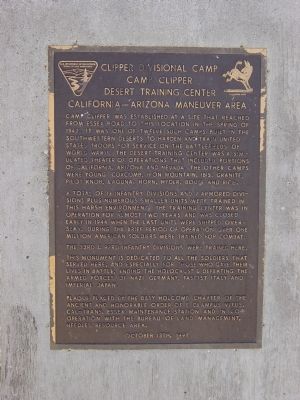
Clipper Divisional Camp
Camp Clipper - Desert Training Center
| — | California-Arizona Maneuver Area | — |
Photographed by Joseph Beeman, April 18, 2006
1. Clipper Divisional Camp Marker
A total of 13 infantry divisions and 7 armored divisions plus numerous smaller units were trained in this harsh environment. The training center was in operation for almost two years and was closed early in 1944 when the last units were shipped overseas. During the brief period of operation over one million American soldiers were trained for combat.
The 33rd & 93rd Infantry Divisions were trained here.
This monument is dedicated to all the soldiers that served here, and especially those who gave their lives in battle, ending the Holocaust & defeating the armed forces of Nazi Germany, Fascist Italy and Imperial Japan.
Erected 1991
this page online
Topics and series. This historical marker is listed in this topic list: War, World II. In addition, it is included in the Desert Training Center, and the E Clampus Vitus series lists. A significant historical year for this entry is 1942.
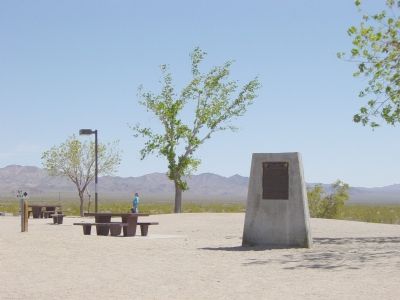
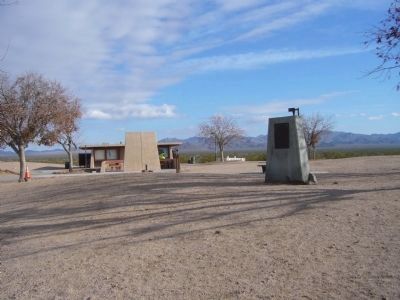
Location. 34° 48.49′ N, 115° 13.185′ W. Marker is in Fenner, California, in San Bernardino County. It is on Interstate 40 6 miles east of the Essex Road Interchange, on the right when traveling east. The Plaque is located in the east-bound Fenner Rest Area on I-40 about 38 miles west of Needles. It is located to the west of the rest area buildings. Touch for map. Marker is in this post office area: Essex CA 92332, United States of America. Touch for directions.

Regionally, this marker is in Greater Los Angeles, in the Mojave Desert, in the Peninsular Ranges, and specifically in the Transverse Ranges. It is also in the American Southwest. Globally, it is in North
Photographed by Joseph Beeman, April 18, 2006
2. Clipper Divisional Camp Marker
Other nearby markers. At least 8 other markers are within 12 miles of this marker, measured as the crow flies: John Wilkie Safety Roadside Rest Area At Fenner (about 700 feet away, measured in a direct line); The Original Mojave Cross (approx. 11.6 miles away); Pah-Ute Creek (approx. 11.6 miles away); Dennis G. Casebier (approx. 11.7 miles away); Goffs Schoolhouse (approx. 11.7 miles away); Army Camp at Goffs (approx. 11.7 miles away); a different marker also named Goffs Schoolhouse (approx. 11.7 miles away); East Mojave History (approx. 11.7 miles away).
Also see . . . Historic California Posts: Camp Clipper (Camp Essex). (Submitted on December 30, 2011, by Michael Kindig of Elk Grove, California.)
Additional commentary.
1. Marker Dedication Weekend
Camp Clipper was the 7th of the Desert Training Center markers to commemorate desert training camps of World War II. A second marker was also dedicated
Photographed by Bill Kirchner, December 16, 2012
3. Clipper Divisional Camp Marker
SOURCE: Billy Holcomb Chapter 1069 35th Anniversary Plaque Book by Phillip Holdaway
— Submitted December 19, 2011, by Michael Kindig of Elk Grove, California.
2. Camps Essex’ and Clipper’s Locations
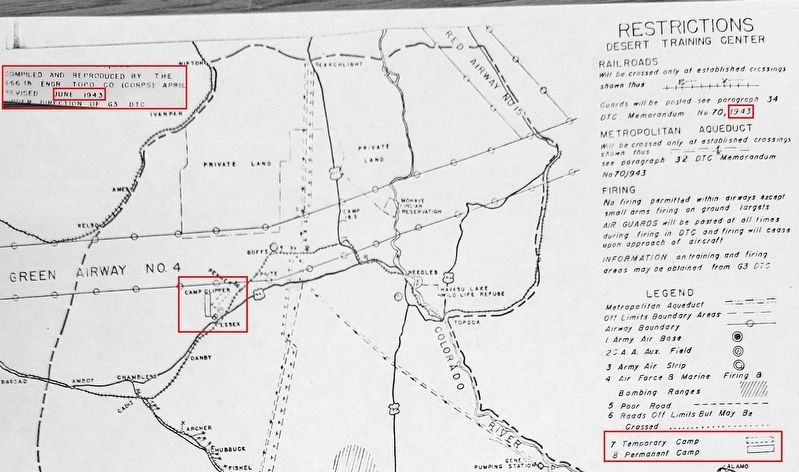
Camp Essex is the easternmost camp (near the airfield) while Camp Clipper is the western most camp.
Fact - The 93rd Division was a black unit and was stationed at Camp Clipper.
Fact – The 827th TDB (also black) was attached to the 93rd.
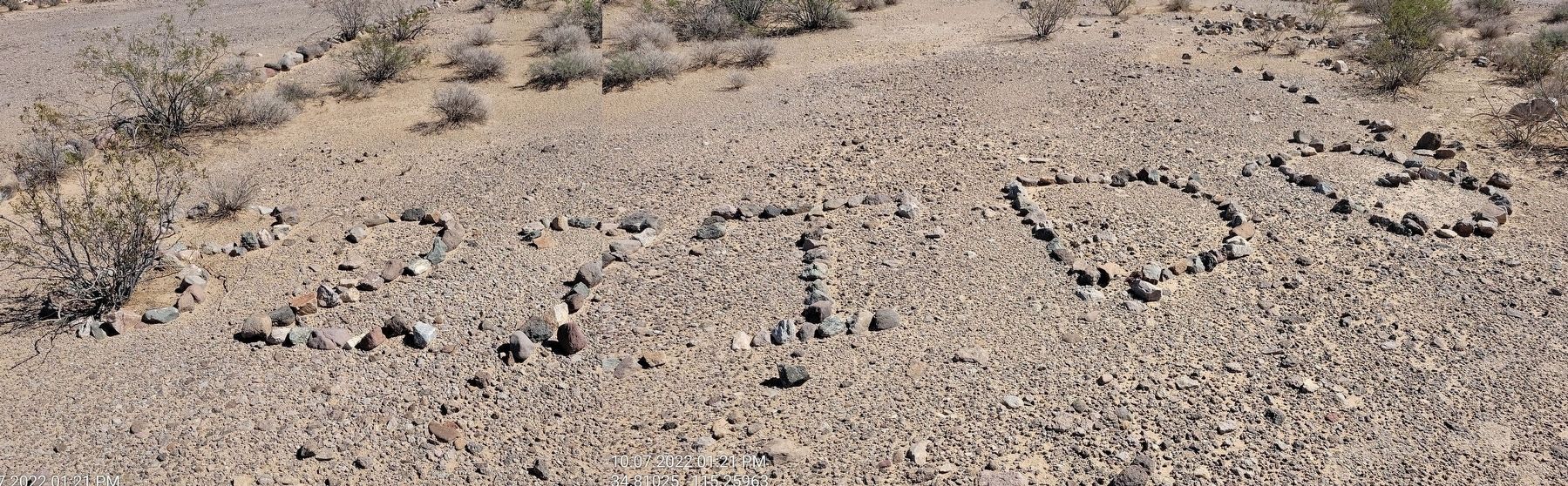
Fact - There’s a rock outline for the 827th TDB at the western most camp, hence the western most camp was Camp Clipper.
Twelve Newspaper.com articles from 1940 to 1945 mention black soldiers from Camp Clipper. There are no articles in that same period mentioning Camp Essex at all except for one in 4/1944 where it said Italian POW’s would be dismantling Camps
Courtesy National Archives and Records Administration, Pacific Region, Laguna Niguel, California., June 30, 2000
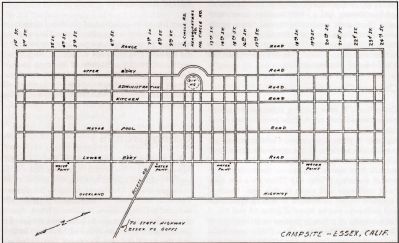
4. Original layout of Camp Essex
The easternmost camp has none of the rock lined infrastructure that every other camp has. A 1996 USACE report states that Camp Essex was established in Dec. 1943, so it was probably used very little or not at all. This is because it only had a 3-4 month lifespan and is the reason why it has no rock lined infrastructure. The camp that the rest stop is at is Camp Essex.
— Submitted March 12, 2023, by Rick Jackson of Santa Clarita, California.
Photographed by Rick Jackson, February 1, 2023
5. 827th Tank Destroyer Battalion rock display
Photographed by Rick Jackson, June 1, 1943
6. Army map showing Camp Clipper to the west and temporary camp (Essex) to the east
Credits. This page was last revised on September 23, 2024. It was originally submitted on April 30, 2006, by Joseph Beeman of Upland, California. This page has been viewed 3,971 times since then and 139 times this year. Last updated on March 12, 2014, by Michael Kindig of Elk Grove, California. Photos: 1, 2. submitted on April 30, 2006, by Joseph Beeman of Upland, California. 3. submitted on December 26, 2012, by Bill Kirchner of Tucson, Arizona. 4. submitted on December 30, 2011, by Michael Kindig of Elk Grove, California. 5. submitted on March 15, 2023, by Rick Jackson of Santa Clarita, California. 6. submitted on November 15, 2023, by Rick Jackson of Santa Clarita, California. • Bill Pfingsten was the editor who published this page.
