Pittman in Holmes County, Florida — The American South (South Atlantic)
Keith Cabin
Photographed by Paul Fehrenbach, April 22, 2014
1. Keith Cabin Marker
East side of two sided marker.
Inscription.
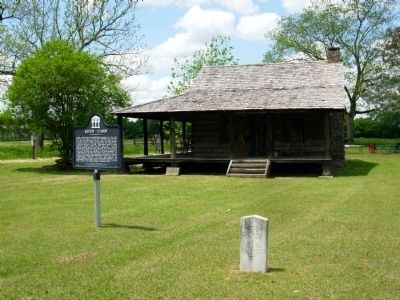
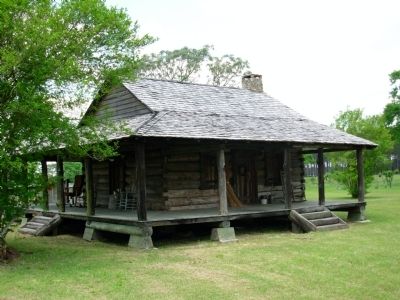
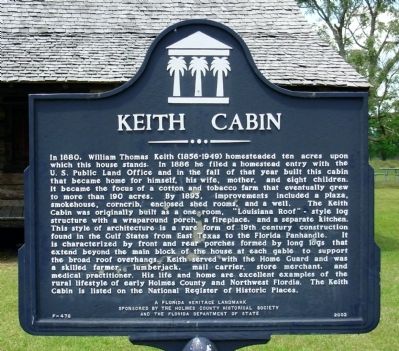
Keith Cabin. . In 1880, William Thomas Keith (1856-1949) homesteaded ten acres upon which this house stands. In 1886 he filed a homestead entry with the U.S. Public Land Office and in the fall of that year built this cabin that became home for himself, his wife, mother, and eight children. It became the focus of a cotton and tobacco farm that eventually grew to more than 190 acres. By 1893, improvements included a plaza, smokehouse, corn crib, enclosed shed rooms, and a well. The Keith Cabin was originally built as a one-room, “Louisiana Roof”- style log structure with a wraparound porch, a fireplace, and a separate kitchen. This style of architecture is a rare form of 19th century construction found only in the Gulf States from east Texas to the Florida Panhandle. It is characterized by front and rear porches formed by long logs that extend beyond the main block of the house at each gable to support the broad roof overhangs. Keith served with the Home Guard and was a skilled farmer, lumberjack, mail carrier, store merchant, and medical practitioner. His life and home are excellent examples of the rural lifestyle of early Holmes County and Northwest Florida. The Keith Cabin is listed on the National Register of Historic Places.
In 1880, William Thomas Keith (1856-1949) homesteaded ten acres upon which this house stands. In 1886 he filed a homestead entry with the U.S. Public Land Office and in the fall of that year built this cabin that became home for himself, his wife, mother, and eight children. It became the focus of a cotton and tobacco farm that eventually grew to more than 190 acres. By 1893, improvements included a plaza, smokehouse, corn crib, enclosed shed rooms, and a well. The Keith Cabin was originally built as a one-room, “Louisiana Roof”- style log structure with a wraparound porch, a fireplace, and a separate kitchen. This style of architecture is a rare form of 19th century construction found only in the Gulf States from east Texas to the Florida Panhandle. It is characterized by front and rear porches formed by long logs that extend beyond the main block of the house at each gable to support the broad roof overhangs. Keith served with the Home Guard and was a skilled farmer, lumberjack, mail carrier, store merchant, and medical practitioner. His life and home are excellent examples of the rural lifestyle of early Holmes County and Northwest Florida. The Keith Cabin is listed on the National Register of Historic Places.
Erected 2003 by The Holmes County Historical Society and The Florida
Click or scan to see this page online
Department of State. (Marker Number F-476.)
Topics. This historical marker is listed in this topic list: Notable Buildings. A significant historical year for this entry is 1880.
Location. 30° 56.237′ N, 85° 49.436′ W. Marker is in Pittman, Florida, in Holmes County. It is on County Road 179 half a mile south of State Road 2, on the right when traveling south. Touch for map. Marker is at or near this postal address: 1320 C.R 179, Bonifay FL 32425, United States of America. Touch for directions.

Regionally, this marker is on the Florida Panhandle. It is also in the American South and specifically in the Deep South. Globally, it is in the North Atlantic Region, North America, a Gulf of Mexico state, the Western Hemisphere, the Western World, and the Anglosphere. Historically, it finds itself in what was once New Spain, the territory of the Mississippian Culture, one of the Confederate States of America, and the Antebellum South.
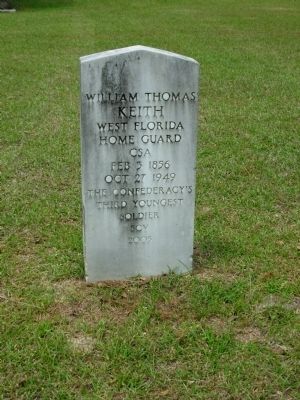
William Thomas Keith West Florida Home Guard CSA Feb 3 1856 Oct 27 1949 The Confederacy's Third Youngest Soldier SCV 2005
Credits. This page was last revised on August 19, 2017. It was originally submitted on April 28, 2014, by Paul Fehrenbach of Richfield, Wisconsin. This page has been viewed 4,371 times since then and 229 times this year. Photos:1, 2, 3, 4. submitted on April 28, 2014, by Paul Fehrenbach of Richfield, Wisconsin. • Bernard Fisher was the editor who published this page.