Morgantown in Monongalia County, West Virginia — The American South (Appalachia)
Seneca Glass Company
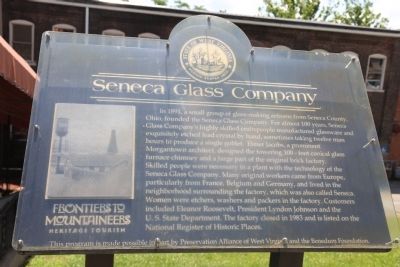
Photographed by J. J. Prats, June 20, 2014
1. Seneca Glass Company Marker
Erected by Pioneers to Mountaineers.
Topics and series. This historical marker is listed in this topic list: Industry & Commerce. In addition, it is included in the
this page online
Location. 39° 38.503′ N, 79° 57.76′ W. Marker is in Morgantown, West Virginia, in Monongalia County. It is on Beechurst Avenue (West Virginia Route 7) north of 7th Street when traveling north. Touch for map. Marker is at or near this postal address: 709 Beechurst Ave, Morgantown WV 26505, United States of America. Touch for directions.

Regionally, this marker is in North Central West Virginia. It is also in the American South, specifically in the Upper South, in Appalachia, and specifically in Northern Appalachia. Globally, it is in North America, the Western Hemisphere, the Western World, and the Anglosphere. Historically, it finds itself in what was once the territory of the Mississippian Culture.
Other nearby markers. At least 8 other markers are within walking distance of this marker: Monongalia High School (approx. 0.3 miles away); Mountaineer Field (approx. half a mile away); "The Hick House" (approx. half a mile away); Brooks Hall (approx. 0.6 miles away); Orville Eberly Plaza (approx.
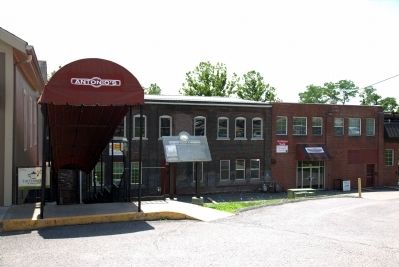
Photographed by J. J. Prats, June 20, 2014
2. Seneca Glass Company Marker
Another marker is no longer nearby. In Honor of Those Who Served (was approx. 0.6 miles away but has been reported to have been replaced with another marker now near it).
Also see . . . Wikipedia Entry. “In the Fall of 1896, it was announced that the company would move to Morgantown, West Virginia. Morgantown was a desirable location because of transportation, fuel, and raw materials—and a cash subsidy. River transportation between Pittsburgh and Morgantown improved during the 1890s because of a new river lock on the Monongahela River. Railroad transportation became available after the Baltimore & Ohio Railroad connected Morgantown to the nation’s railroad network. Oil and gas had recently been discovered in the area, providing more options for fuel in addition to the coal that was abundant in the area. Good quality sand, used as a raw material for glassmaking, was available nearby in both
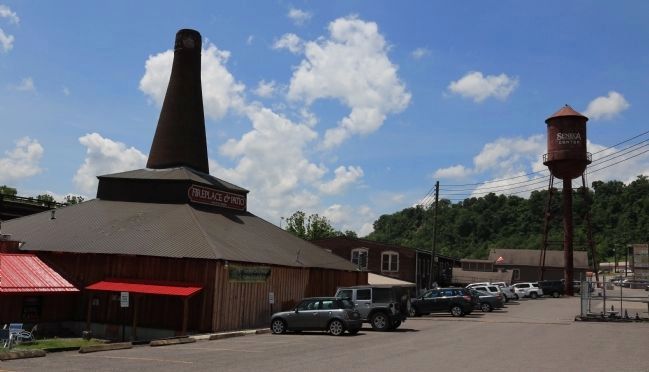
Photographed by J. J. Prats, June 20, 2014
3. Seneca Glass Company, Now Seneca Center
Glass furnace building, on the left, with the conical chimney. The factory complex is now Seneca Center, a collection of retail shops and offices. The hallways are a museum filled with Morgantown glass pieces and photographs of the glassworks.
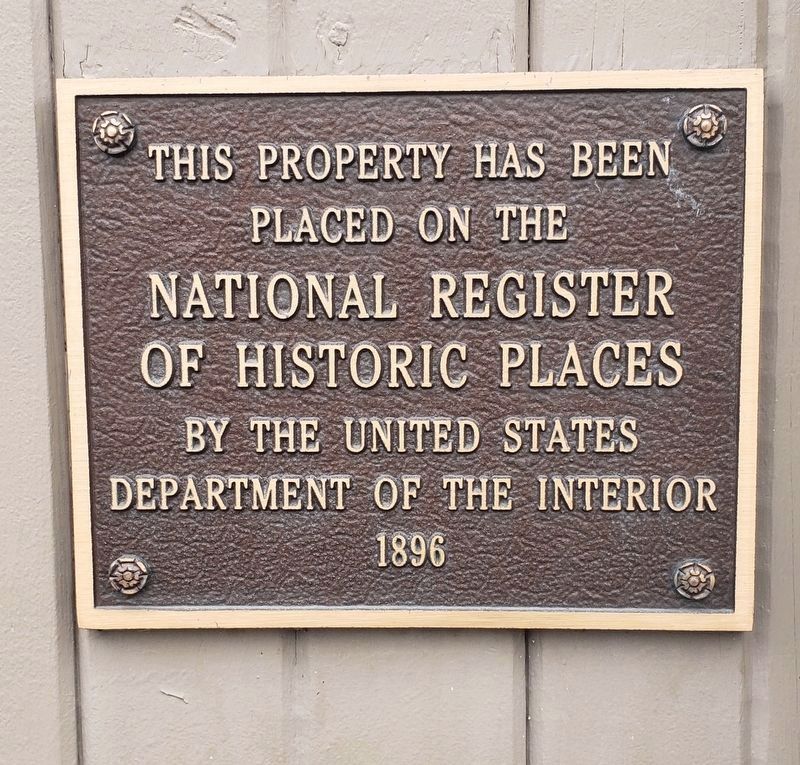
Photographed by Bradley Owen, November 30, 2020
4. Plate Displayed At Entrance To The Building
Credits. This page was last revised on November 30, 2020. It was originally submitted on June 20, 2014, by J. J. Prats of Powell, Ohio. This page has been viewed 1,267 times since then and 98 times this year. Photos: 1, 2, 3. submitted on June 20, 2014, by J. J. Prats of Powell, Ohio. 4. submitted on November 30, 2020, by Bradley Owen of Morgantown, West Virginia.
