Near Henrieville in Garfield County, Utah — The American Mountains (Southwest)
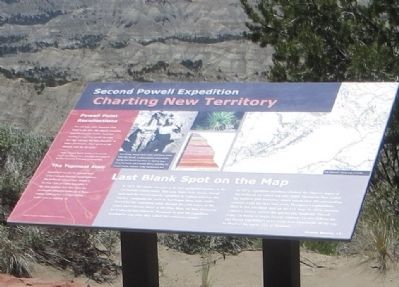
Second Powell Expedition
Charting New Territory
| — | Last Blank Spot on the Map | — |
Photographed by Bill Kirchner, June 13, 2014
1. Second Powell Expedition Marker
In 1872, the expedition members climbed the slippery slopes of the badlands on which you now stand. Thompson then scaled the brilliant pink formations above you to view the surrounding country. Over the next four years, Thompson's explorations filled in this last blank spot on the U.S. map. In 1879, surveyor Clarence Dutton named this spectacular landmark "Powell Point," in honor of Major Powell. Highway 12 now follows the 2nd Powell Expedition's exact route from Henrieville all the way to Head of the Rocks, east of Escalante.
Topics. This historical marker is listed in this topic list: Exploration. A significant historical year for this entry is 1871.
Location. 37° 38.373′ N,
this page online

Regionally, this marker is in Canyon Country and specifically in Color Country. It is also in the American Mountain West, on the Colorado Plateau, and at the Four Corners. Globally, it is in North America, the Western Hemisphere, the Western World, and the Anglosphere. Historically, it finds itself in what was once New Spain and also Mexico’s Alta California.

Other nearby markers. At least 4 other markers are within 12 miles of this marker, measured as the crow flies: Granary in the Cliffs (approx. 9.8 miles away); Loseeville (approx. 11.2 miles away); Minerals in the Mesas (approx. 11.3 miles away); Stories of Promise Rock (approx. 11.3 miles away).
Photographed by Bill Kirchner, June 13, 2014
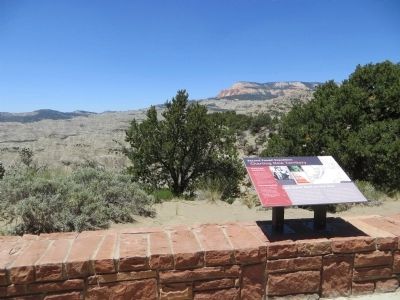
2. Second Powell Expedition Marker
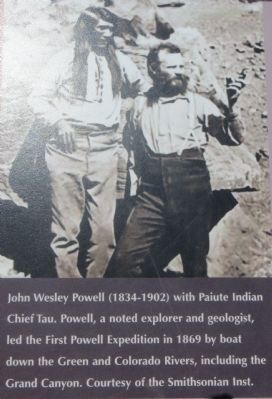
1869
3. Photo on the Second Powell Expedition Marker
Photographed by Bill Kirchner, June 13, 2014
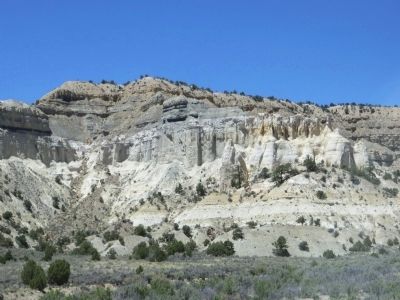
4. Utah Badlands

Photographed by Tom Bosse, June 12, 2025
5. Second Powell Expedition Marker
Marker is on the right.

Photographed by Tom Bosse, June 12, 2025
6. Utah Badlands

Photographed by Tom Bosse, June 12, 2025
7. Utah Badlands
Credits. This page was last revised on October 11, 2025. It was originally submitted on June 24, 2014, by Bill Kirchner of Tucson, Arizona. This page has been viewed 837 times since then and 60 times this year. Photos: 1, 2, 3, 4. submitted on June 24, 2014, by Bill Kirchner of Tucson, Arizona. 5, 6, 7. submitted on October 11, 2025, by Tom Bosse of Jefferson City, Tennessee. • Syd Whittle was the editor who published this page.
