Missouri Botanical Garden in St. Louis, Missouri — The American Midwest (Upper Plains)
Museum Building
Photographed by Barry Swackhamer, August 17, 2014
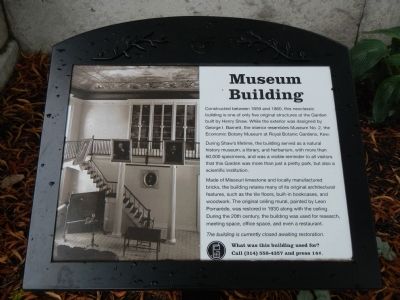
1. Museum Building Marker
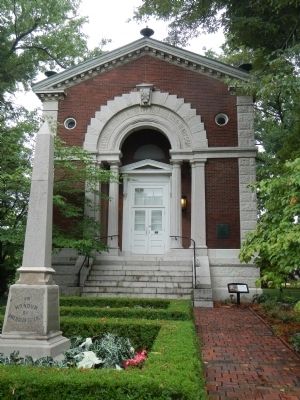
Constructed between 1859 and 1860, this neoclassic building is one of only five original structures at the Garden by Henry Shaw. While the exterior was designed by George l.Barnett, the interior resembles Museum No. 2, the Economic Botany Museum at the Royal Botanic Gardens, Kew.
During Shaw’s lifetime, the building served as a natural history museum, a library, and herbarium, with more than 60,000 specimens, and was a visible reminder to all visitors that this Garden was more than just a pretty park, but also a scientific institution.
Made of Missouri limestone and locally manufactured bricks, the building retains many of its original architectural features, such as the tile floors, built-in bookcases, and woodwork. The original ceiling mural, painted by Leon Pomaréde, was restored in 1930 along with the ceiling. During the 20th century, the building was used for research, meeting space, office space and even a restaurant.
Erected by Missouri Botanical Garden.
Topics. This historical marker is listed in these topic lists: Architecture • Education • Horticulture & Forestry. A significant historical year for this entry is 1859.
Location. 38° 36.74′ N,
this page online

Regionally, this marker is in the American Midwest, in the Lewis & Clark Corridor, in the Corn Belt, and in the Great River Road Region. Globally, it is in North America, the Western Hemisphere, the Western World, and the Anglosphere. Historically, it finds itself in what was once the territory of the Mississippian Culture, the Louisiana Purchase, and the Antebellum South.
Other nearby markers. At least 8 other markers are within walking distance of this marker: Stephen and Peter Sachs Museum (here, next to this marker); Herring House (a few steps from this marker); Golden Larch (a few steps from this marker); In Honor of American Science (within shouting distance of this marker); Victory of Science (within shouting distance of this marker); Botanical Museum & Library (within shouting distance of this marker); A Toast to Sassafras
Photographed by Barry Swackhamer, August 17, 2014
2. Museum Building Marker
More about this marker. The Museum Building is on the grounds of the Missouri Botanical Garden. The building is closed for renovation.
Also see . . .
1. Missouri Botanical Garden - Wikipedia. Founded in 1859, the Missouri Botanical Garden is one of the oldest botanical institutions in the United States and a National Historic Landmark. The Garden is a center for botanical research and science education of international repute, as well as an oasis in the city of St. Louis, with 79 acres (32 ha) of horticultural display. (Submitted on November 14, 2014, by Barry Swackhamer of Brentwood, California.)
2. Henry Shaw (philanthropist) - Wikipedia. Henry Shaw (July 24, 1800 in Sheffield, England – August 25, 1889 in St. Louis, Missouri) was a philanthropist and is best known as the founder of the Missouri Botanical Garden. (Submitted on November 14, 2014, by Barry Swackhamer of Brentwood, California.)
Photographed by Barry Swackhamer, August 17, 2014
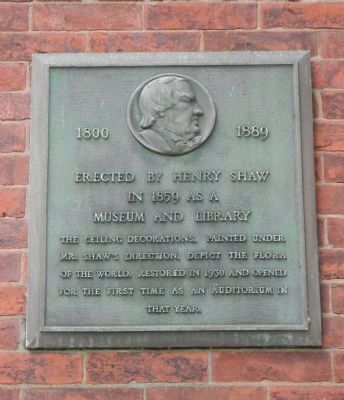
3. Museum Building plaque
Museum and Library
The ceiling decorations, pained under Mr. Shaw’s direction, depict the flora of the world. Restored in 1930 and opened for the first time as an auditorium in that year.
Photographed by Barry Swackhamer, August 17, 2014
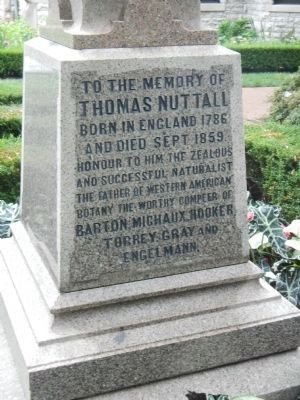
4. Obelisk in front of the Museum Building
Thomas Nuttall
Born in England 1789
and Died Sept 1859
Honour to him the zealous
and successful naturalist
the father of Western American
botany, The worthy compeer of
Barton, Michaux, Hooker,
Torrey, Gray and
Engelmann.
Public Domain, n.d.
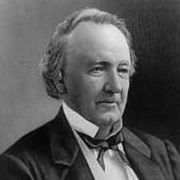
5. Henry Shaw
Credits. This page was last revised on July 18, 2023. It was originally submitted on November 14, 2014, by Barry Swackhamer of Brentwood, California. This page has been viewed 420 times since then and 8 times this year. Photos: 1, 2, 3, 4, 5. submitted on November 14, 2014, by Barry Swackhamer of Brentwood, California. • Al Wolf was the editor who published this page.
