Sylmar in Los Angeles in Los Angeles County, California — The American West (Pacific Coastal)
Loop Fire
El Cariso Park
Photographed by Chris English, March 29, 2014
1. Loop Fire Marker
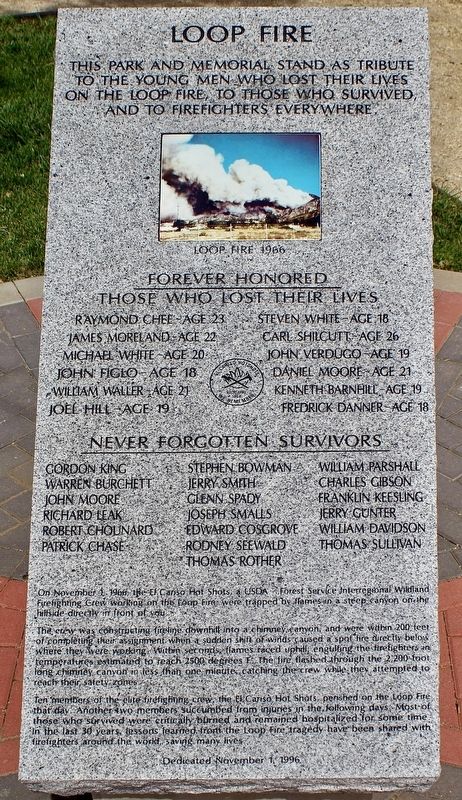
This park and memorial stand as a tribute to the young men who lost their lives on the Loop Fire, to those who survived, and to firefighters everywhere.
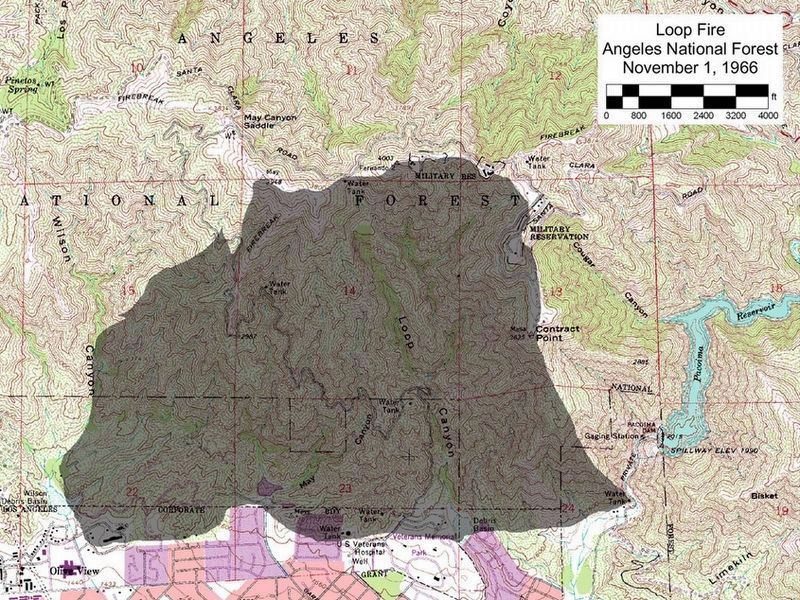
On November 1, 1966, the El Cariso Hot Shots, a USDA Forest Service Interregional Wildland Firefighting Crew working on the Loop Fire were trapped by flames in a steep canyon on a hillside directly in front of you.
The crew was constructing fireline downhill into a chimney canyon and were within 200 feet of completing their assignment when a sudden shift of winds caused a spot fire directly below where they were working. Within seconds, flames raced uphill, engulfing the firefighters in temperatures estimated to reach 2500 degree F. The fire flashed through the 2,200 foot chimney canyon in less than one minute, catching the crew while they attempted to reach their safety zones.
Ten members of the elite firefighting crew, the El Cariso Hot Shots, perished on the Loop Fire that day. Another two members succumbed from injuries in the following days. Most of those who survived were critically burned and remained hospitalized for some time. In the last 30 years, lessons learned from the Loop Fire tragedy have been shared with firefighters around the world, saving many lives.
Dedicated November 1, 1996
Forever Honored
Those Who Lost Their Lives
Raymond Chee - Age 23 • James Moreland - Age 22 • Michael White - Age 20 • John Figlo - Age 18 • William Waller - Age 21 • Joel Hill - Age 19 • Steven White - Age 18 • Carl Shilcutt - Age 26 • John Verdugo - Age 19 • Daniel Moore - Age 21 • Kenneth Barnhill - Age 19 • Fredrick Danner - Age 18
Never Forgotten
Survivors
Gordon King • Warren Burchett • John Moore • Richard Leak • Robert Chounard • Patrick Chase • Stephen Bowman • Jerry Smith • Glenn Spady • Joseph Smalls • Edward Cosgrove • Rodney Seewald • Thomas Rother • William Parshall • Charles Gibson • Franklin Keesling • Jerry Gunter • William
this page online
Erected 1996.
Topics. This historical marker is listed in these topic lists: Disasters • Horticulture & Forestry. A significant historical month for this entry is November 1966.
Location. 34° 18.986′ N, 118° 25.048′ W. Marker is in Los Angeles, California, in Los Angeles County. It is in Sylmar. It can be reached from Hubbard Street 0.8 miles north of Interstate 210, on the right when traveling north. Located in El Cariso Park, south of the Community Center building. Touch for map. Marker is at or near this postal address: 13100 Hubbard St, Sylmar CA 91342, United States of America. Touch for directions.

Regionally, this marker is in The Valley (the San Fernando Valley) and in the Transverse Ranges. It is also on the American Pacific Coast. Globally, it is in North America, on the Ring of Fire, on the Pacific Rim, in the Western Hemisphere, in the Western World, and in the Anglosphere. Historically, it finds itself in what was once New Spain and also Mexico’s Alta California.
Other nearby markers. At least 8 other markers are within 3 miles of this marker, measured as the crow flies: Irene Tovar Square (approx. 0.2 miles away); S.H.G.A. (approx. 0.6 miles away); 1971 Sylmar Earthquake (approx. 0.6 miles away); The San Fernando Pioneer Memorial Cemetery (approx. 1.8 miles away); The Griffith Ranch
Photographed by Chris English, March 29, 2014
2. Loop Fire Marker
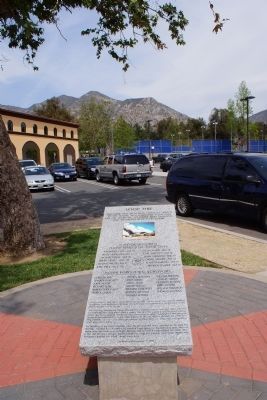
Facing Contractor Point on the horizon, the location of the Loop Fire fatalities.
Regarding Loop Fire. The El Cariso Hotshots were named in 1960 after El Cariso, a local geographic area and former camp location near the Ortega Highway in the Cleveland National Forest near the Orange-Riverside county line in Southern California, the location of the crew’s home base.
"El Cariso" translates to "The Reed", derived from the Spanish word carrizo (reed or tall grass).
Wildland fire crews first earned the general title "hotshot" in Southern California during the 1940s because they were routinely assigned to work the "hottest" and most dangerous parts of wildfires.
Originating in the late 1940s to late 1950s on regional forests like the Cleveland, the El Cariso crew became one of the pioneering elite handcrews in wildland firefighting history before officially launching under the Interregional Fire Suppression (IRFS) program in 1961.
Also see . . . Loop Fire - Wikipedia. (Submitted on January 4, 2024.)
Additional keywords. Hotshots, El Cariso, Watchout Situations, El Cariso Park

3. Loop Fire - 1966
This photo is on the marker.
Photographed by Craig Baker, February 3, 2018
4. Below the marker
via National Wildfire Coordinating Group
5. Loop Fire Location
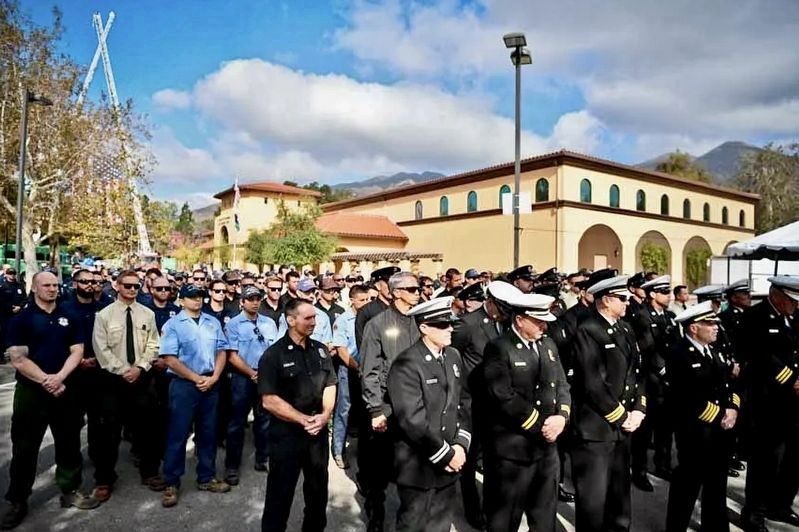
courtesy LAFD, November 1, 2016
6. Loop Fire 50th Anniversary Ceremony
Credits. This page was last revised on October 3, 2026. It was originally submitted on April 1, 2014, by Chris English of Phoenix, Arizona. This page has been viewed 3,112 times since then and 128 times this year. Last updated on November 26, 2014, by James King of San Miguel, California. Photos: 1. submitted on November 1, 2024. 2. submitted on April 1, 2014, by Chris English of Phoenix, Arizona. 3. submitted on October 3, 2026, by Craig Baker of Sylmar, California. 4. submitted on February 5, 2018, by Craig Baker of Sylmar, California. 5. submitted on January 4, 2024. 6. submitted on August 20, 2026, by Craig Baker of Sylmar, California. • Andrew Ruppenstein was the editor who published this page.
