Niagara Falls in Niagara Region, Ontario — Central Canada (North America)
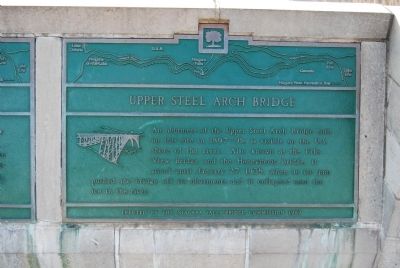
Upper Steel Arch Bridge
Photographed by Mike Wintermantel, April 21, 2013
1. Upper Steel Arch Bridge Marker
Erected 1989 by Niagara Falls Bridge Commission.
Topics. This historical marker is listed in this topic list: Bridges & Viaducts. A significant historical date for this entry is January 27, 1892.
Location. 43° 5.425′ N, 79° 4.244′ W. Marker is in Niagara Falls, Ontario, in Niagara Region. It can be reached from the intersection of River Road and Clifton Hill, on the right when traveling north. Touch for map. Marker is in this post office area: Niagara Falls ON L2G 3K9, Canada. Touch for directions.

Regionally, this marker is on the Golden Horseshoe and in Niagara Canada. It is also in Central Canada. Globally, it is in North America, on the Great Lakes, in the Western Hemisphere, in the Western World,
this page online
Other nearby markers. At least 8 other markers are within walking distance of this marker: Upper Suspension Bridge (here, next to this marker); Thomas Baker McQuesten (about 120 meters away, measured in a direct line); Rainbow Bridge (about 120 meters away); This Tablet Commemorates The Public Spirit And Generosity Of Sir Harry Oakes Bart (about 120 meters away); Oakes Garden Theatre (about 150 meters away); International Rainbow Bridge Commemoration (about 150 meters away); The Boundary Waters Treaty (approx. 0.3 kilometers away); To the Memory of Burrell Hecock (approx. 0.3 kilometers away). Touch for a list and map of all markers in Niagara Falls.
Related marker. Click here for another marker that is related to this marker.
Additional commentary.
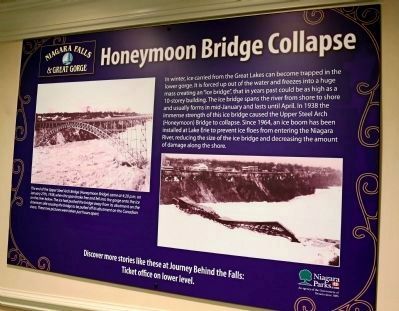
1. Text of Poster shown in Photo No. 3.
Honeymoon Bridge Collapse. In winter,
Photographed by Mike Wintermantel, April 21, 2013
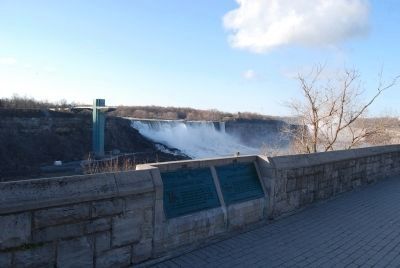
2. Upper Steel Arch Bridge Marker
Marker is on the right...Upper Suspension Bridge marker is on the left.
Photograph caption. The end of the Upper Steel Arch Bridge (Honeymoon Bridge) came at 4:20 p.m. on January 27, 1938, when the span broke free and fell into the gorge onto the ice on the river below. The ice had pushed the bridge away from its abutment on the American side, causing the bridge to be pulled off its abutment on the Canadian shore. These two pictures were taken just
Photographed by J. J. Prats, October 16, 2014
3. Honeymoon Bridge Collapse Poster
This poster is located in the Table Rock Welome Center at the upper level passageway beyond the gift shop.
— Submitted December 21, 2014.
Photographed by Detroit Publishing Company, circa 1900
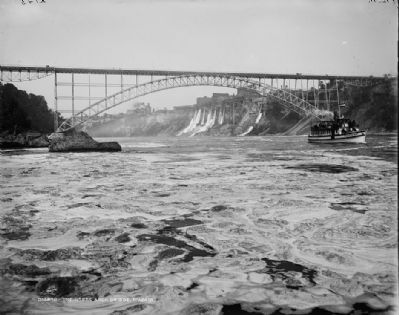
4. Upper Steel Arch Bridge, ca. 1900
Photo courtesy Library of Congress
Credits. This page was last revised on September 27, 2019. It was originally submitted on April 22, 2013, by Mike Wintermantel of Pittsburgh, Pennsylvania. This page has been viewed 860 times since then and 24 times this year. Last updated on December 9, 2014, by Anton Schwarzmueller of Wilson, New York. Photos: 1, 2. submitted on April 22, 2013, by Mike Wintermantel of Pittsburgh, Pennsylvania. 3. submitted on December 21, 2014, by J. J. Prats of Powell, Ohio. 4. submitted on April 22, 2013. • Bill Pfingsten was the editor who published this page.
