Euharlee in Bartow County, Georgia — The American South (South Atlantic)
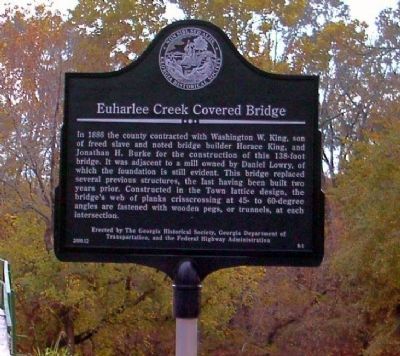
Euharlee Creek Covered Bridge
Photographed by David Seibert, October 28, 2000
1. Euharlee Creek Covered Bridge Marker
Erected 2000 by the Georgia Historical Society, Georgia Department of Transportation, and the Federal Highway Administration. (Marker Number 8-1.)
Topics and series. This historical marker is listed in these topic lists: African Americans • Bridges & Viaducts. In addition, it is included in the Covered Bridges, and the Georgia Historical Society series lists. A significant historical year for this entry is 1886.
Location. 34° 8.578′ N, 84° 55.898′ W. Marker is in Euharlee, Georgia, in Bartow County. It is on Covered Bridge Road SW 0.1 miles west of Covered Bridge-Stilesboro Road SW,
this page online

Regionally, this marker is in Georgia’s Mountains. It is also in the American South and specifically in the Deep South. Globally, it is in North America, the Western Hemisphere, the Western World, and the Anglosphere. Historically, it finds itself in what was once the original Cherokee Nation, the territory of the Mississippian Culture, one of the original Thirteen Colonies, one of the Confederate States of America, and the Antebellum South.
Other nearby markers. At least 8 other markers are within 5 miles of this marker, measured as the crow flies: Black Pioneers Cemetery (approx. 0.3 miles away); Milam's Bridge (approx. 1.4 miles away); The Army of the Cumberland at Stilesboro (approx. 2.9 miles away); Stilesboro Academy (approx. 2.9 miles away); The Story of Old Hardin Bridge (approx. 3.1 miles away); Raccoon Creek (approx. 3.2 miles away); Old Macedonia Church Organized 1847 (approx. 3½ miles away); Etowah Valley Plantation
Photographed by David Seibert, October 28, 2000
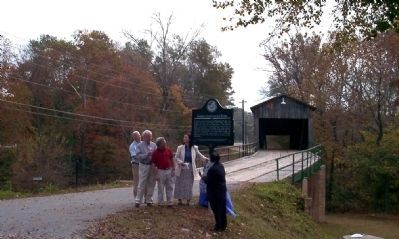
2. Dedication of Euharlee Creek Covered Bridge Marker
Dedication ceremony for the marker
Regarding Euharlee Creek Covered Bridge. Horace King (father of Washington King who built this bridge) was a freed slave who was the best known bridge builder in Georgia and Alabama in the 1840s through the 1880s. His sons carried on his business.
Photographed by David Seibert, October 28, 2000
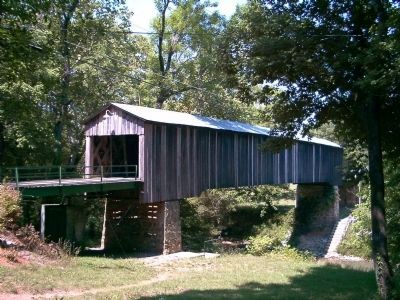
3. Euharlee Creek Covered Bridge
Photographed by David Seibert, November 9, 2008
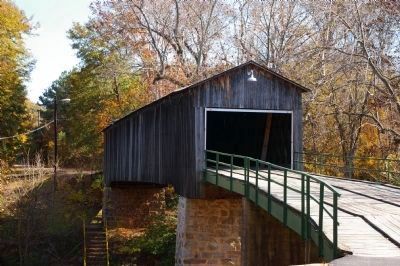
4. Euharlee Creek Covered Bridge
The Euharlee Covered Bridge in late 2008.
Photographed by David Seibert, October 28, 2000
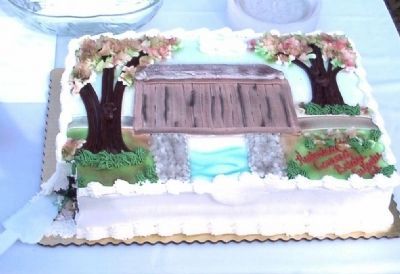
5. Euharlee Creek Covered Bridge Cake
This special Euharlee Covered Bridge Cake was prepared for and served at the dedication of the Euharlee Creek Covered Bridge historical marker.
Credits. This page was last revised on November 19, 2017. It was originally submitted on June 22, 2008, by David Seibert of Sandy Springs, Georgia. This page has been viewed 3,603 times since then and 76 times this year. Photos: 1, 2, 3. submitted on June 22, 2008, by David Seibert of Sandy Springs, Georgia. 4. submitted on November 28, 2008, by David Seibert of Sandy Springs, Georgia. 5. submitted on June 22, 2008, by David Seibert of Sandy Springs, Georgia. • Christopher Busta-Peck was the editor who published this page.
