Morristown in Morris County, New Jersey — The American Northeast (Mid-Atlantic)
Thomas Nast
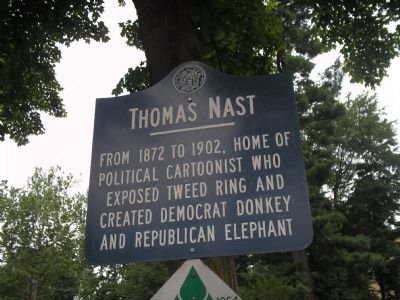
Photographed by Bill Coughlin, July 9, 2008
1. Thomas Nast Marker
political cartoonist who
exposed Tweed ring and
created Democrat donkey
and Republican elephant.
Erected 1964 by State of New Jersey.
Topics. This historical marker is listed in these topic lists: Arts, Letters, Music • Government & Politics • Notable Buildings. A significant historical year for this entry is 1872.
Location. 40° 47.51′ N, 74° 28.851′ W. Marker is in Morristown, New Jersey, in Morris County. It is at the intersection of MacCulloch Avenue and Miller Road, on the right when traveling north on MacCulloch Avenue. Touch for map. Marker is in this post office area: Morristown NJ 07960, United States of America. Touch for directions.

Regionally, this marker is in North Jersey and in the New York City Metropolitan Area. It is also in the American Northeast and in the Mid-Atlantic. Globally, it is in North America, the Western Hemisphere, the Western World, and the Anglosphere. Historically, it finds itself in what was once New Netherland and also one of the original Thirteen Colonies.
Other nearby markers. At least 8 other markers are within walking distance of
this page online
Another marker is no longer nearby. Macculloch Hall (was within shouting distance of this marker but has been confirmed missing).
Also see . . . Thomas Nast. Wikipedia entry (Submitted on August 27, 2026, by Larry Gertner of New York, New York.)

Photographed by Allen C. Browne, August 29, 2018
2. Thomas Nast
Self-Portrait, c. 1884
Self-Portrait, c. 1884
This self-portrait of Thomas Nast hangs in the Smithsonian Museum of American History in Washington, DC.
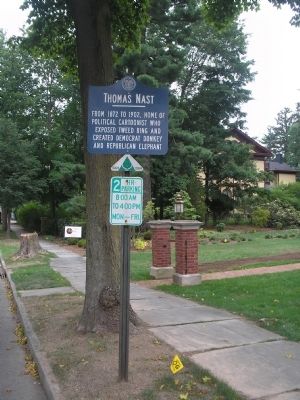
Photographed by Bill Coughlin, July 9, 2008
3. Marker on MacCulloch Avenue
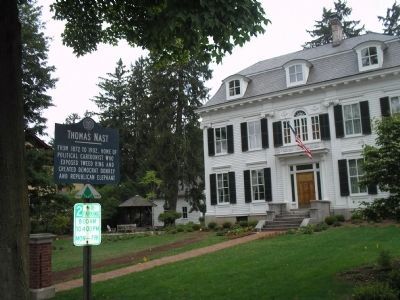
Photographed by Bill Coughlin, July 9, 2008
4. Thomas Nast Marker and Home
Thomas Nast was one of America’s most noted political cartoonists. Best known for his campaign against New York City’s “Boss” Tweed, Nast was also responsible for the creation of the elephant and donkey symbols for the Republican and Democrat parties, and the “modern” image of Santa Clause.
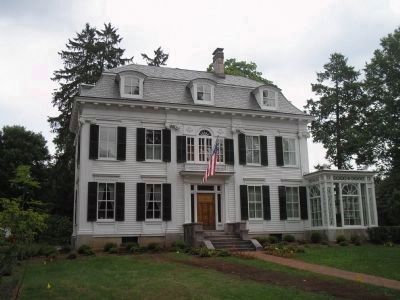
Photographed by Bill Coughlin, July 9, 2008
5. Thomas Nast House
Nast did much of his most famous work for Harper’s Weekly. He has been called “The Prince of Caricaturists” and “The Father of American Caricature." He lived in this house until his death on December 7, 1902.
Credits. This page was last revised on August 27, 2026. It was originally submitted on July 9, 2008, by Bill Coughlin of Woodland Park, New Jersey. This page has been viewed 1,942 times since then and 26 times this year. Photos: 1. submitted on July 9, 2008, by Bill Coughlin of Woodland Park, New Jersey. 2. submitted on August 30, 2018, by Allen C. Browne of Silver Spring, Maryland. 3, 4, 5. submitted on July 9, 2008, by Bill Coughlin of Woodland Park, New Jersey.
