Upper West Side in Manhattan in New York County, New York — The American Northeast (Mid-Atlantic)
Where Poe wrote The Raven
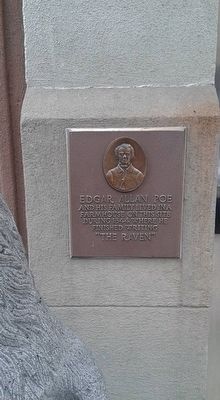
Photographed by Erik Lander
1. Where Poe wrote The Raven Marker
Topics. This historical marker is listed in these topic lists: Arts, Letters, Music • Entertainment. A significant historical year for this entry is 1844.
Location. 40° 47.214′ N, 73° 58.621′ W. Marker is in Manhattan, New York, in New York County. It is in the Upper West Side. It is on West 84 Street 0.1 miles west of Amsterdam Avenue, on the right when traveling west. Touch for map. Marker is at or near this postal address: 215 West 84 Street, New York NY 10024, United States of America. Touch for directions.

Regionally, this marker is in New York City. It is also in the American Northeast, in the Mid-Atlantic, and on the Eastern Seaboard. Globally, it is in the North Atlantic Region, North America, the Western Hemisphere, the Western World, and the Anglosphere. Historically, it finds itself in what was once New Netherland and also one of the original Thirteen Colonies.
Other nearby markers. At least 8 other markers are within walking distance of this marker: Where Poe Wrote “The Raven” (within shouting distance of this marker); Sergei Vassilevich Rachmaninoff (about 600 feet away, measured in a direct line); The Saxony (about 700 feet away); George Herman Ruth (approx. ¼ mile away); Dorothy Parker (approx. ¼ mile away); Volunteer of America Centennial Rose Garden (approx. ¼ mile away); Claremont Riding Academy (approx. ¼ mile away); Richard Rodgers (approx. ¼ mile away). Touch for a list and map of all markers in Manhattan.
Also see . . . The Lost Brennan House - 84th Street and Broadway. "Daytonian in Manhattan" entry. (Submitted on April 13, 2020, by Larry Gertner of New York, New York.)
this page online
Photographed by Samuel Stillman Osgood, 1845
2. Edgar Allan Poe
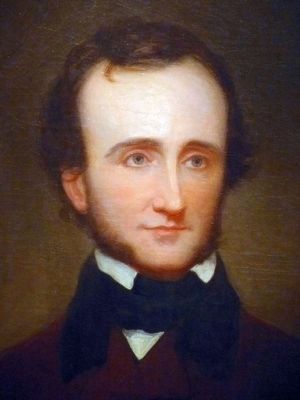
This 1845 portrait of Edgar Allan Poe by Samuel Stillman Osgood hangs in the National Portrait Gallery in Washington, DC.
“Edgar Allan Poe is popularly known for his poem ‘The Raven’ (1844), and like the raven itself, Poe was a dark presence amid the optimism of early American culture. Not for him was the glorification of the individual or the celebration of nature as life-giving. Poe peeled back the underside of America to sketch a world in which nothing, especially human motivation, was transparent, predictable, or even knowable. In their dark, hallucinatory imagery, Poe's writings profoundly influenced such European poets as Baudelaire and Rimbaud. In America, his voice is still singular for the strength with which it spoke against the spirit of the Romantic age in which he lived. Poe's great subject was death, and he seemed to court it in his life as well as art, dying early after proving himself unable to function in the society he dissected so remorselessly.” — National Portrait Gallery
“Edgar Allan Poe is popularly known for his poem ‘The Raven’ (1844), and like the raven itself, Poe was a dark presence amid the optimism of early American culture. Not for him was the glorification of the individual or the celebration of nature as life-giving. Poe peeled back the underside of America to sketch a world in which nothing, especially human motivation, was transparent, predictable, or even knowable. In their dark, hallucinatory imagery, Poe's writings profoundly influenced such European poets as Baudelaire and Rimbaud. In America, his voice is still singular for the strength with which it spoke against the spirit of the Romantic age in which he lived. Poe's great subject was death, and he seemed to court it in his life as well as art, dying early after proving himself unable to function in the society he dissected so remorselessly.” — National Portrait Gallery
Photographed by Larry Gertner, April 24, 2016
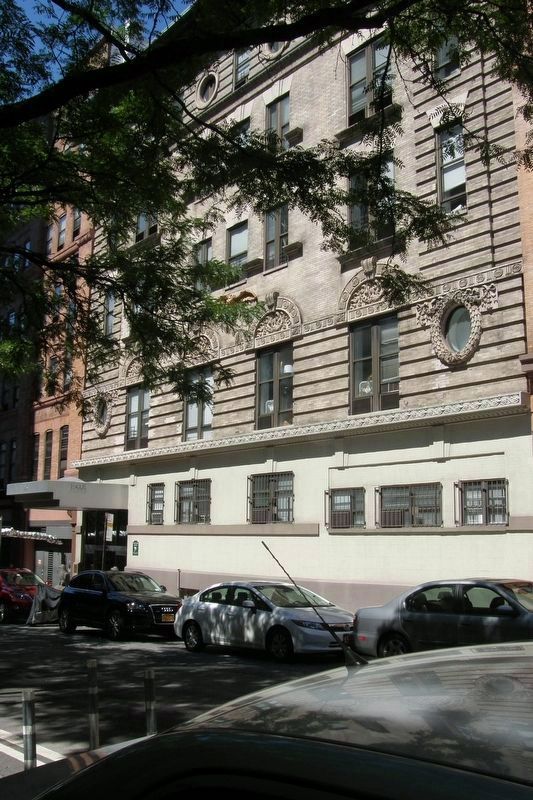
3. Where Poe wrote The Raven Marker's building
Oddly, the building is called "Eagle Court".
Photographed by Larry Gertner, April 24, 2016
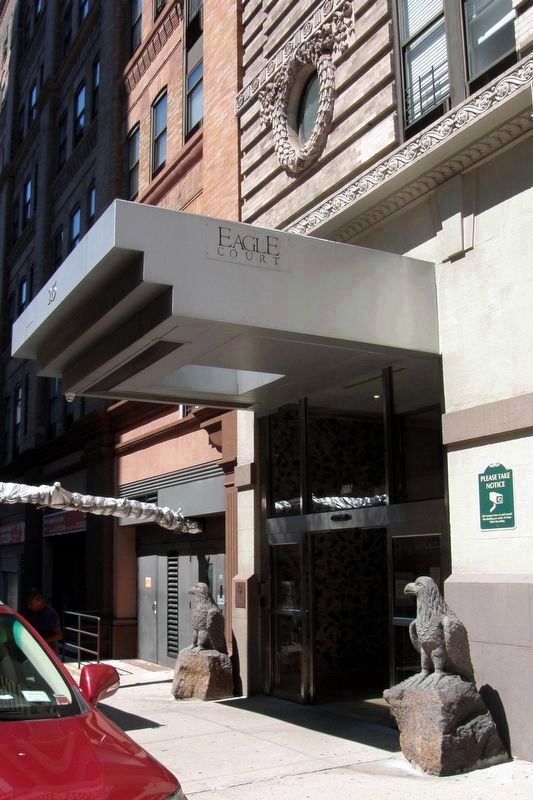
4. Where Poe wrote The Raven Marker's building entrance
The marker is visible to the left of the entrance, which is flanked by two eagle statues.
Credits. This page was last revised on January 31, 2023. It was originally submitted on November 22, 2015, by Erik Lander of Brooklyn, New York. This page has been viewed 2,059 times since then and 64 times this year. Photos: 1. submitted on November 22, 2015, by Erik Lander of Brooklyn, New York. 2. submitted on November 23, 2015, by Allen C. Browne of Silver Spring, Maryland. 3, 4. submitted on August 26, 2016, by Larry Gertner of New York, New York. • Bill Pfingsten was the editor who published this page.
