Estellville Glass Factory
Estell Manor Park
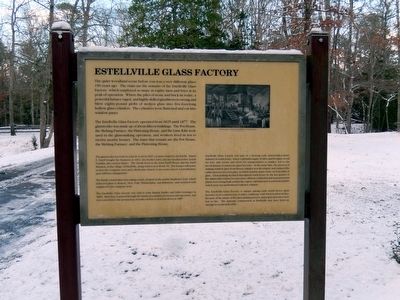
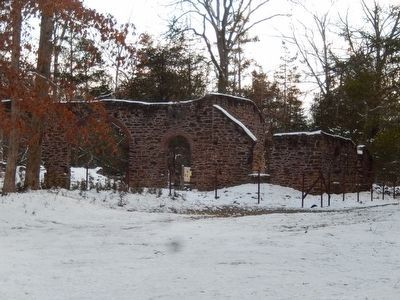
The Estellville Glass Factory operated from 1825 until 1877. The glassworks was made up of about fifteen buildings. The Pot House, the Melting Furnace, and the Flattening House, and Lime Kiln were used in the glass-making operation, and workers lived in ten to twelve nearby houses. The ruins that remain are the Pot House, the Melting Furnace, and Flattening House.
The glassworks was built by John H. Scott in 1825, on land owned by the Estells. Daniel E. Estell bought the business in 1834; his brother John and his brother-in-law Josiah Franklin also owned shares. The Estells lived in the John Estell House and the Estell Mansion in the village of Estellville, along
this page online
The Estells owned their own sailing vessels, docked on the nearby Stephens Creek, which delivered glass to Boston, New York, Philadelphia, and Baltimore, and returned with supplies for the company store. The Estellville Glass Factory was sold to John Baptist Stadler and John Getsinger in 1860. After that, it passed through the hands of a number of owners and operators, and was converted to the production of bottles before it closed in 1887. Estellville Glass Factory was part of a thriving early nineteenth-century industry in South Jersey, where a plentiful supply of silica sand for glass, wood for fuel, and creeks and rivers for transportation to market, led to the development of numerous glass factories. At the same time, the process of making window glass from blown cylinders was developed, and replaced the earlier process of crown glass, in which window panes were cut from disks of glass. Glass-making declined throughout South Jersey by the last quarter of the nineteenth
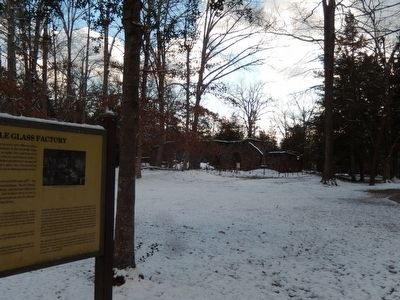
The Estellville Glass Factory is unique among early South Jersey glass factories in its construction of native sandstone with brick-headed arches. Because of the nature of the glass-making process, many glass factories were lost to fire. The masonry construction at Estellville may have been an attempt to avoid such a fate.
(Inscription under the image in the upper right)
Window glass cylinders being blown at a melting furnace
Topics. This historical marker is listed in this topic list: Industry & Commerce. A significant historical year for this entry is 1825.
Location. 39° 23.48′ N, 74° 44.51′ W. Marker is in Estell Manor, New Jersey, in Atlantic County. It is on New Jersey Route 50. The marker is located on Purple Heart Drive within the park. Touch for map. Marker is in this post office area: Estell Manor NJ 08319, United States of America. Touch for directions.
Regionally, this marker is in the American Northeast, in the Mid-Atlantic, and on the Eastern
Other nearby markers. At least 8 other markers are within walking distance of this marker: The Pot House (within shouting distance of this marker); The Flattening House (about 300 feet away, measured in a direct line); The Melting Furnace (about 300 feet away); The Daniel Estell House (approx. 0.4 miles away); Welcome to Atlantic County Park at Estell Manor! (approx. half a mile away); Ginkgo (approx. half a mile away); Introduction (approx. half a mile away); Belcoville 1917 (approx. half a mile away). Touch for a list and map of all markers in Estell Manor.
Another marker is no longer nearby. The John Estell House (circa 1750) (was approx. 0.4 miles away but has been confirmed missing).
Credits. This page was last revised on June 16, 2016. It was originally submitted on January 24, 2016, by Don Morfe of Baltimore, Maryland. This page has been viewed 1,363 times since then and 43 times this year. Photos: 1, 2, 3. submitted on January 24, 2016, by Don Morfe of Baltimore, Maryland. • Bill Pfingsten was the editor who published this page.
