Haymarket in Milwaukee in Milwaukee County, Wisconsin — The American Midwest (Great Lakes)
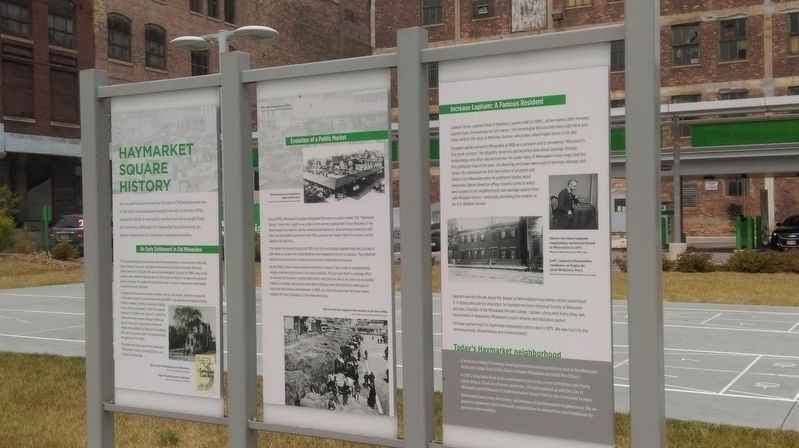
Haymarket Square History
Photographed by Devon Polzar, July 10, 2016
1. Haymarket Square History Marker
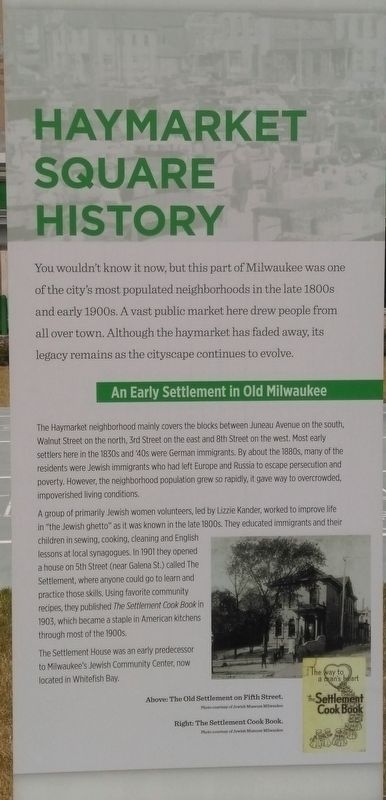
An Early Settlement in Old Milwaukee
The Haymarket neighborhood mainly covers the blocks between Juneau Avenue on the south, Walnut Street on the north, 3rd Street on the east and 8th Street on the west. Most early settlers here in the 1830s and '40s were German immigrants. By about the 1880s, many of the residents were Jewish immigrants who had left Europe and Russia to escape persecution and poverty. However, the neighborhood population grew so rapidly, it gave way to overcrowded, impoverished living conditions.
A group of primarily Jewish women volunteers, led by Lizzie Kander, worked to improve life in "the Jewish ghetto" as it was known in the late 1800s. They educated immigrants and their children in sewing, cooking, cleaning and English lessons at local synagogues. In 1901 they opened a house on 5th Street (near Galena
this page online
The Settlement House was an early predecessor to Milwaukee's Jewish Community Center, now located in Whitefish Bay.
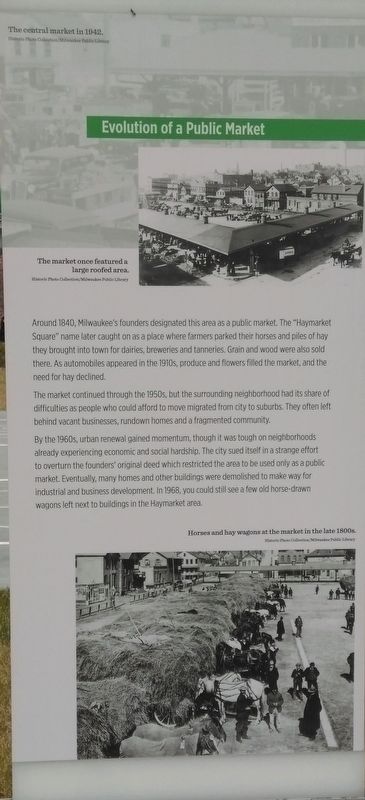
Evolution of a Public Market
Around 1840, Milwaukee's founders designated this area as a public market. The "Haymarket Square" name later caught on as a place where farmers parked their horses and piles of hay they brought into town for dairies, breweries and tanneries. Grain and wood were also sold there. As automobiles appeared in the 1910s, produce and flowers filled the market, and the need for hay declined.
The market continued through the 1950s, but the surrounding neighborhood had its share of difficulties as people who could afford to move migrated from city to suburbs. They often left behind vacant businesses, rundown homes and a fragmented community.
By the 1960s, urban renewal gained momentum, though it was tough on neighborhoods already experiencing economic
Photographed by Devon Polzar, July 10, 2016
2. Haymarket Square History Marker Panel 1
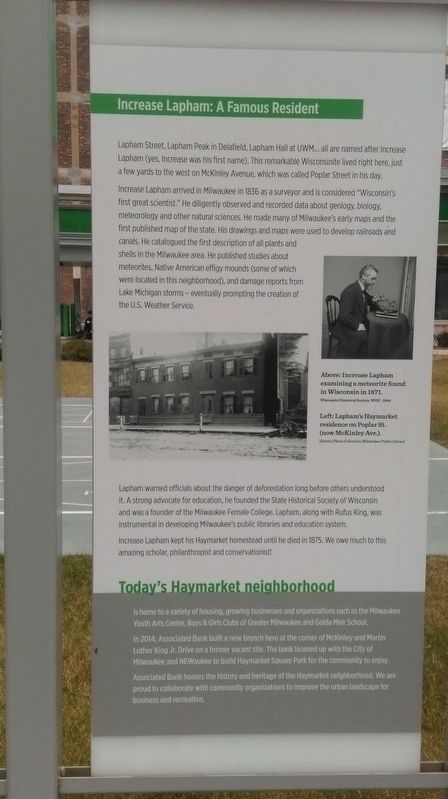
Increase Lapham: A Famous Resident
Lapham Street, Lapham Peak in Delafield, Lapham Hall at UWM... all are named after Increase Lapham (yes, Increase was his first name). This remarkable Wisconsinite lived right here, just a few yards to the west on McKinley Avenue, which was called Poplar Street in his day.
Increase Lapham arrived in Milwaukee in 1836 as a surveyor and is considered "Wisconsin's first great scientist." He diligently observed and recorded data about geology, biology, meteorology and other natural sciences. He made many of Milwaukee's early maps and the first published map of the state. His drawings and maps were used to develop railroads and canals. He catalogued the first description of all plants and shells in the Milwaukee area. He
Photographed by Devon Polzar, July 10, 2016
3. Haymarket Square History Marker Panel 2
Lapham warned officials about the danger of deforestation long before others understood it. A strong advocate for education, he founded the State Historical Society of Wisconsin and was a founder of the Milwaukee Female College. Lapham, along with Rufus King, was instrumental in developing Milwaukee's public libraries and education system.
Increase Lapham kept his Haymarket homestead until he died in 1875. We owe much to this amazing scholar, philanthropist and conservationist!
Today's Haymarket neighborhood
is home to a variety of housing, growing businesses and organizations such as the Milwaukee Youth Arts Center, Boys & Girls Clubs of Greater Milwaukee and Golda Meir School.
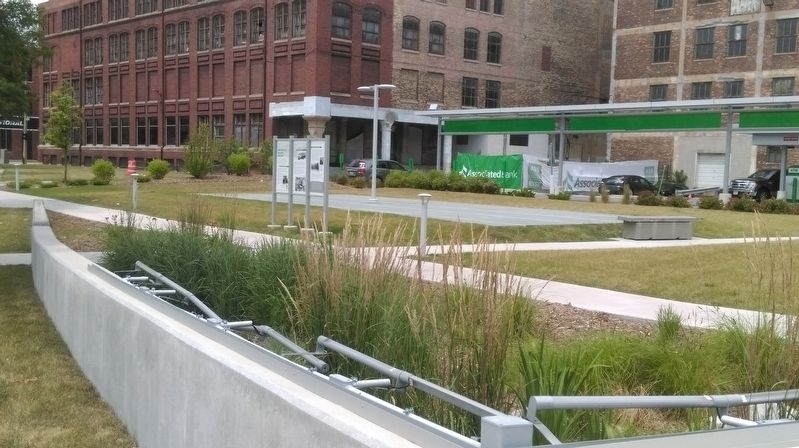
In 2014, Associated Bank built a new branch here at the corner of McKinley and Martin Luther King Jr. Drive on a former vacant site. The bank teamed up with the City of Milwaukee and NEWaukee to build Haymarket Square Park
Photographed by Devon Polzar, July 10, 2016
4. Haymarket Square History Marker Panel 3
Associated Bank honors the history and heritage of the Haymarket neighborhood. We are proud to collaborate with community organizations to improve the urban landscape for business and recreation.
Topics. This historical marker is listed in these topic lists: Industry & Commerce • Settlements & Settlers. A significant historical year for this entry is 1901.
Location. 43° 2.817′ N, 87° 54.883′ W. Marker is in Milwaukee, Wisconsin, in Milwaukee County. It is in Haymarket. It is at the intersection of West McKinley Avenue and North Doctor Martin Luther King Junior Drive, on the right when traveling west on West McKinley Avenue. Touch for map. Marker is in this post office area: Milwaukee WI 53212, United States of America. Touch for directions.

Regionally, this marker is in Southeast Wisconsin. It is also in the American Midwest and in the Corn Belt. Globally, it is in North America, on the Great Lakes, in the Western Hemisphere, in the Western World, and in the Anglosphere. Historically, it finds itself in what was once the territory of the Mississippian Culture and also the Northwest Territory.
Photographed by Devon Polzar, July 10, 2016
5. Haymarket Square Park
Other nearby markers. At least 8 other markers are within walking distance of this marker: Kilbourntown (about 800 feet away, measured in a direct line); a different marker also named Kilbourntown (about 800 feet away); Steinmeyer Building (approx. 0.2 miles away); The Beer Line Neighborhood's Amber Past / Through the Eyes of Milwaukee Kids (approx. 0.2 miles away); Turner Hall (approx. ¼ mile away); Prohibition Years (approx. ¼ mile away); Golda Meir 1898 - 1978 (approx. 0.3 miles away); Pere Marquette Historic Site (approx. 0.3 miles away). Touch for a list and map of all markers in Milwaukee.
More about this marker. The marker is located in Haymarket Square Park which is on the corner of W. McKinley Ave. and Dr. Martin Luther King Jr. Drive.
Credits. This page was last revised on December 8, 2024. It was originally submitted on July 14, 2016, by Devon Polzar of Port Washington, Wisconsin. This page has been viewed 2,118 times since then and 89 times this year. Photos: 1, 2, 3, 4, 5. submitted on July 14, 2016, by Devon Polzar of Port Washington, Wisconsin. • Bill Pfingsten was the editor who published this page.
