Boca Raton in Palm Beach County, Florida — The American South (South Atlantic)
F.E.C. Railway Depot, Boca Raton
Photographed by Tim Fillmon, August 2, 2016
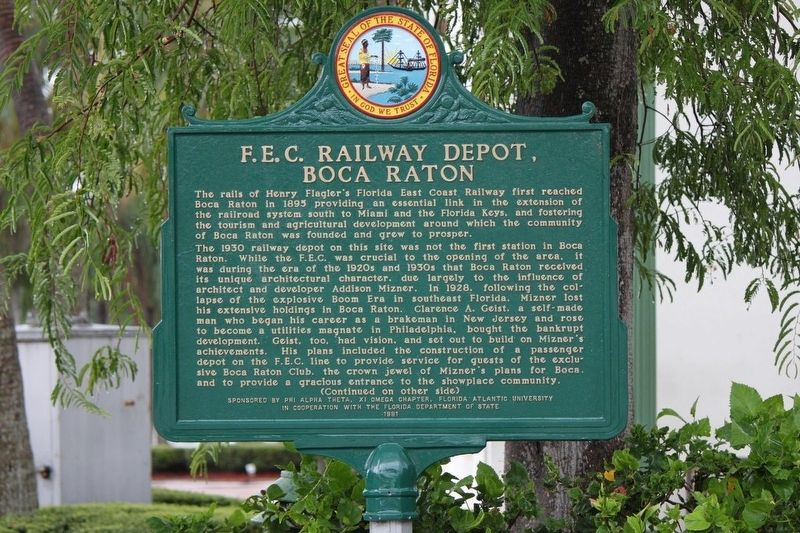
1. F.E.C. Railway Depot, Boca Raton Marker
The rails of Henry Flagler’s Florida East Coast Railway first reached Boca Raton in 1895 providing an essential link in the extension of the railroad system south to Miami and the Florida Keys, and fostering the tourism and agricultural development around which the community of Boca Raton was founded and grew to prosper.
The 1930 railway depot on this site was not the first station in Boca Raton. While the F.E.C. was crucial to the opening of the area, it was during the era of the 1920s and 1930s that Boca Raton received its unique architectural character, due largely to the influence of the architect and developer Addison Mizner. In 1928, following the collapse of the explosive Boom Era in southeast Florida, Mizner lost his extensive holdings in Boca Raton. Clarence A. Geist, a self-made man who began his career as a brakeman in New Jersey and rose to become a utilities magnate in Philadelphia, bought the bankrupt development. Geist, too, had vision, and set out to build on Mizner’s achievements. His plans included the construction of a passenger depot on the F.E.C. line to provide service for guests of the exclusive
this page online
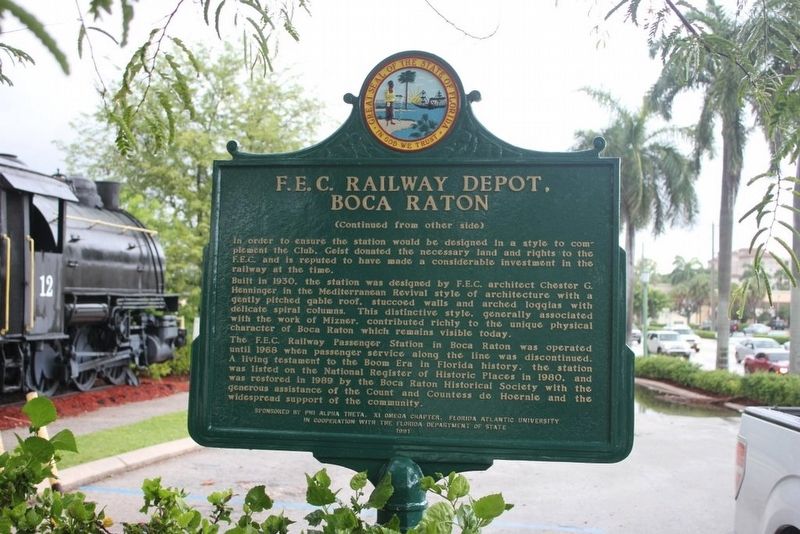
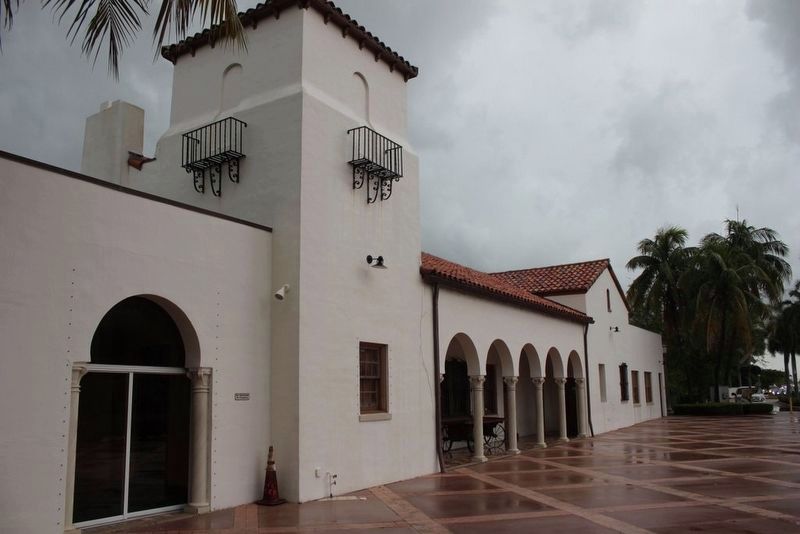
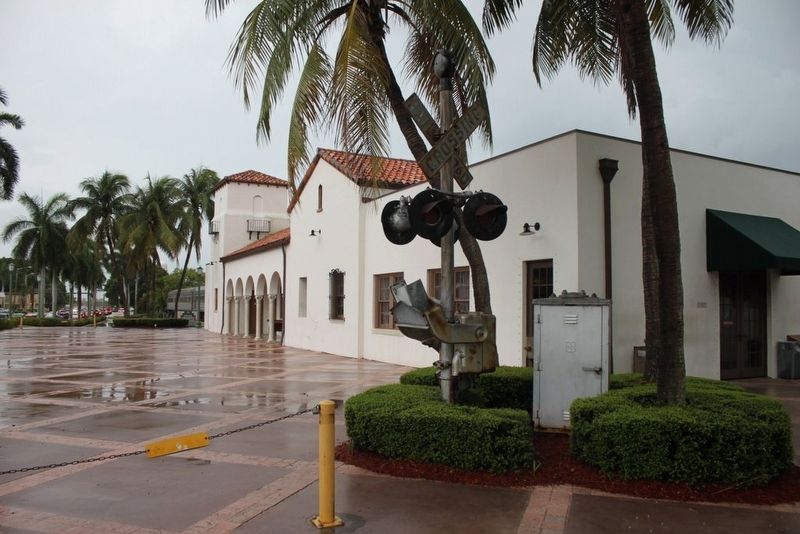
Built in 1930, the station was designed by F.E.C. architect Chester G. Henninger in the Mediterranean Revival style of architecture with a gently pitched gable roof, stuccoed walls and arched loggias with delicate spiral columns. This distinctive style, generally associated with the work of Mizner, contributed richly to the unique physical character of Boca Raton which remains visible today.
The F.E.C. Railway Passenger Station in Boca Raton was operated until 1968 when passenger service along the line was discontinued. A living testament to the Boom Era in Florida history, the station was listed on the National Register of Historic Places in 1980, and was restored in 1989 by the Boca Raton Historical Society with the
Photographed by Tim Fillmon, August 2, 2016
2. F.E.C. Railway Depot, Boca Raton Marker reverse
Erected 1991 by Phi Alpha Theta, Xi Omega Chapter, Florida Atlantic University in cooperation with the Florida Department of State. (Marker Number F-331.)
Topics and series. This historical marker is listed in these topic lists: Architecture • Railroads & Streetcars. In addition, it is included in the Florida East Coast Railroad and Hotels series list. A significant historical year for this entry is 1930.
Location. 26° 20.582′ N, 80° 5.338′ W. Marker is in Boca Raton, Florida, in Palm Beach County. It is at the intersection of South Dixie Highway and Southeast 8th Street, on the right when traveling south on South Dixie Highway. Touch for map. Marker is at or near this postal address: 747 South Dixie Highway, Boca Raton FL 33432, United States of America. Touch for directions.

Regionally, this marker is in South Florida, on the Gold Coast, on the Treasure Coast, and in Greater Miami. It is also in the American South and on the Eastern Seaboard. Globally, it is in the North Atlantic Region, North America, a Gulf of
Photographed by Tim Fillmon, August 2, 2016
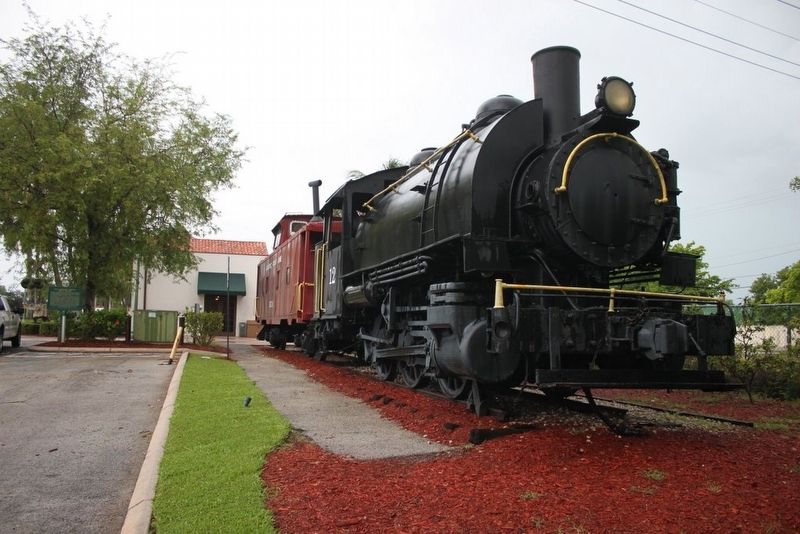
3. F.E.C. Railway Depot, Boca Raton Marker and part of depot and locomotive
Other nearby markers. At least 8 other markers are within 2 miles of this marker, measured as the crow flies: Sanborn Square (approx. 0.6 miles away); Boca Raton Town Hall (approx. 0.6 miles away); Old Floresta Historic District (approx. 1.1 miles away); The Sanborn Wall (approx. 1.2 miles away); Boca Raton Fire Engine No. 1 (approx. 1.2 miles away); South Beach Pavilion (approx. 1.3 miles away); William Stanley Beaumont Braithwaite School (approx. 1.8 miles away); First Zion Missionary Baptist Church (approx. 2 miles away). Touch for a list and map of all markers in Boca Raton.
Photographed by Tim Fillmon, August 2, 2016
4. F.E.C. Railway Depot, Boca Raton
Photographed by Tim Fillmon, August 2, 2016
5. F.E.C. Railway Depot, Boca Raton
Photographed by Tim Fillmon, August 2, 2016
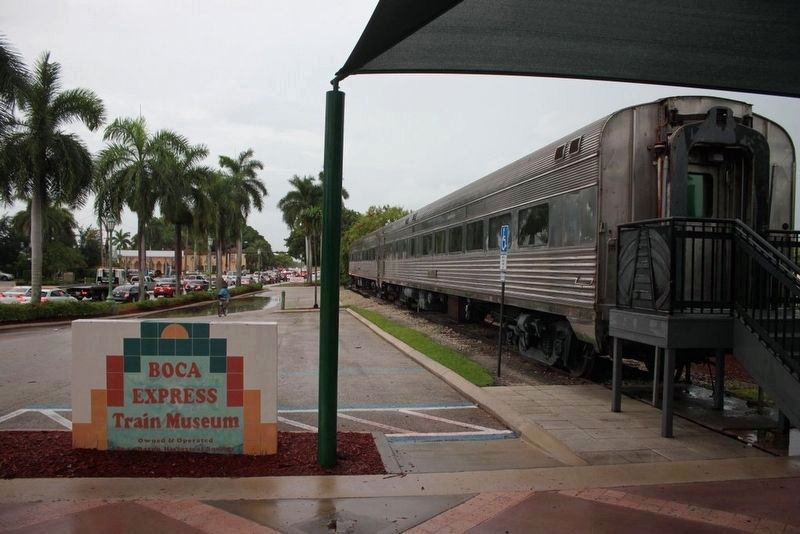
6. F.E.C. Railway Depot, Boca Raton Passenger Cars on south end of building
Credits. This page was last revised on March 4, 2018. It was originally submitted on August 15, 2016, by Tim Fillmon of Webster, Florida. This page has been viewed 1,406 times since then and 95 times this year. Photos: 1, 2, 3, 4, 5, 6. submitted on August 15, 2016, by Tim Fillmon of Webster, Florida. • Bernard Fisher was the editor who published this page.
