Old Sacramento in Sacramento County, California — The American West (Pacific Coastal)
First Transcontinental Railroad Groundbreaking Site
Photographed by Douglass Halvorsen, June 1, 2013
1. First Transcontinental Railroad Groundbreaking Site Marker
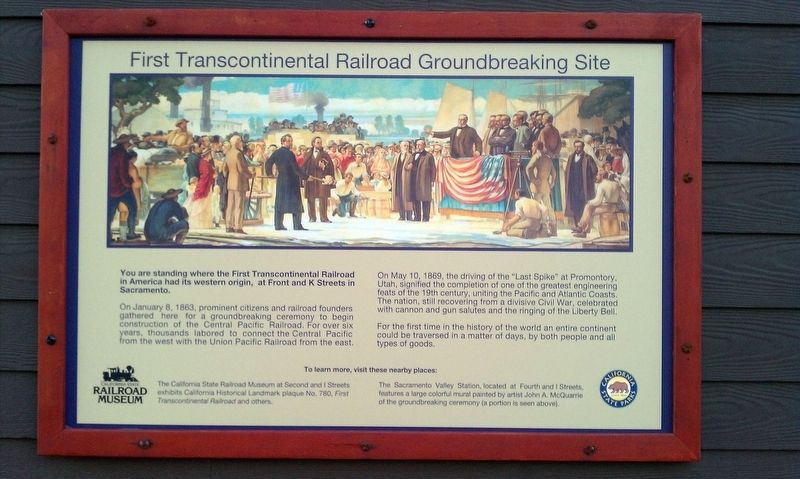
You are standing where the First Transcontinental Railroad in America had its western origin, at Front and K Streets in Sacramento.
On January 8, 1863, prominent citizens and railroad founders gathered here for a groundbreaking ceremony to begin construction of the Central Pacific Railroad. For over six years, thousands labored to connect the Central Pacific from the west with the Union Pacific Railroad from the east.
On May 10, 1869, the driving of the "Last Spike" at Promontory, Utah, signified the completion of one of the greatest engineering feats of the 19th century, uniting the Pacific and Atlantic Coasts. The nation, still recovering from a divisive Civil War, celebrated with cannon and gun salutes and the ringing of the Liberty Bell.
For the first time in the history of the world and entire continent could be traversed in a matter of days, by both people and all types of goods.
To learn more, visit these nearby places:
The California State Railroad Museum at Second and I Streets exhibits California Historical Landmark plaque No. 780, First Transcontinental Railroad and others.
The Sacramento Valley Station,
this page online
Erected by California State Railroad Museum and California State Parks. (Marker Number 780.)
Topics and series. This historical marker is listed in this topic list: Railroads & Streetcars. In addition, it is included in the California Historical Landmarks series list. A significant historical date for this entry is January 8, 1863.
Location. This marker has been replaced by another marker nearby. It was located near 38° 34.956′ N, 121° 30.37′ W. Marker was in Sacramento, California, in Sacramento County. It was in Old Sacramento. It was at the intersection of Front Street and K Street, on the left when traveling north on Front Street. Touch for map. Marker was in this post office area: Sacramento CA 95814, United States of America. Touch for directions.

Regionally, this marker was in the Sacramento Valley and specifically in the Central Valley. It was also on the American Pacific Coast. Globally, it was in North America, on the Ring of Fire, on the Pacific Rim, in the Western
Photographed by Douglass Halvorsen, June 1, 2013
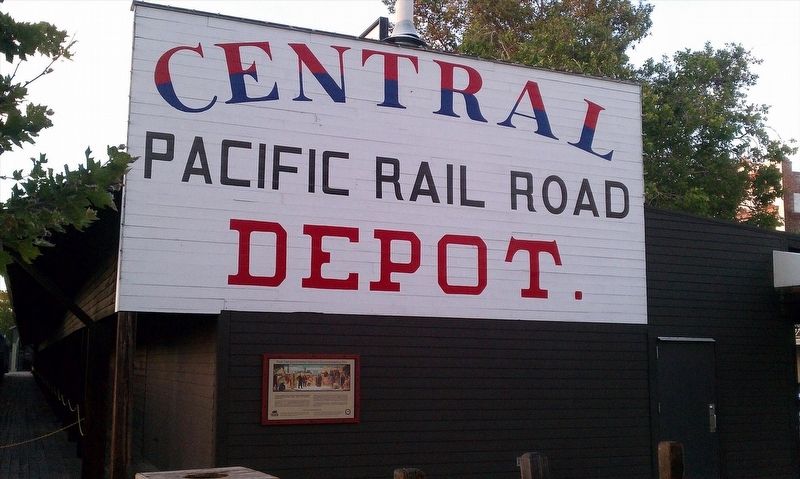
2. First Transcontinental Railroad Groundbreaking Site Marker
Other nearby markers. At least 8 other markers are within walking distance of this location: Mile Marker 0 (here, next to this marker); Pony Express River Steamer “Antelope” (a few steps from this marker); Lady Adams Building (about 300 feet away, measured in a direct line); Booth Building (about 300 feet away); Vernon-Brannan House (about 400 feet away); Sacramento's Early Waterfront (about 500 feet away); Eagle Theatre (about 500 feet away); New England Seed Store (about 500 feet away). Touch for a list and map of all markers in Sacramento.
Other markers no longer nearby. First Transcontinental Railroad Groundbreaking Site (was here, next to this marker but has been permanently removed); Freight on the Move (was here, next to this marker but has been permanently removed); Sacramento River Waterfront (was about 300 feet away but has been permanently removed); Pioneer Park (was about 400 feet away but has been confirmed missing).
More about this marker. This is the
Photographed by J. Makali Bruton, July 1, 2019
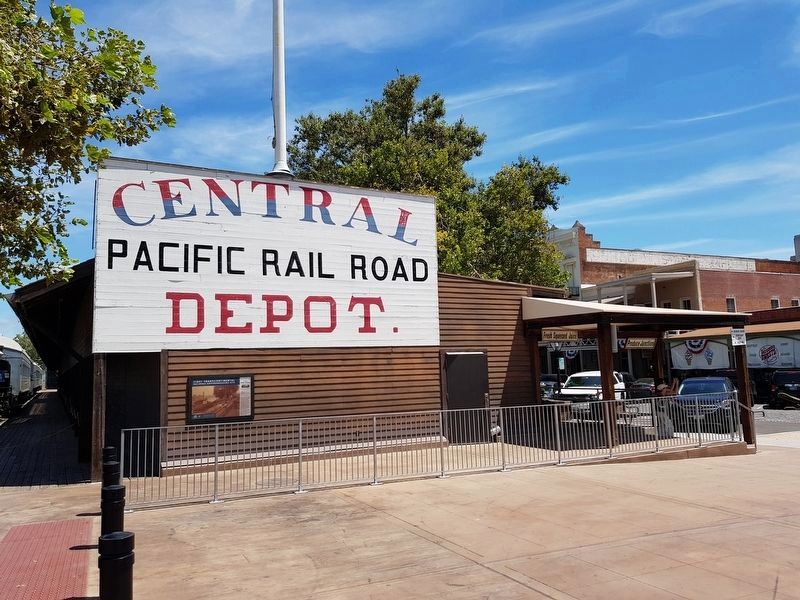
3. First Transcontinental Railroad Groundbreaking Site Marker
The featured marker has been replaced by a marker with the same name but substantially different text and supporting photograph.
Credits. This page was last revised on February 7, 2023. It was originally submitted on January 20, 2018, by Douglass Halvorsen of Klamath Falls, Oregon. This page has been viewed 1,026 times since then and 68 times this year. Last updated on July 4, 2022, by Joseph Alvarado of Livermore, California. Photos: 1, 2. submitted on January 20, 2018, by Douglass Halvorsen of Klamath Falls, Oregon. 3. submitted on July 7, 2019, by J. Makali Bruton of Washington, District of Columbia. • Syd Whittle was the editor who published this page.
