Near Virginia City in Madison County, Montana — The American West (Mountains)
The Mount Vernon Dredge
Photographed by Barry Swackhamer, August 6, 2009
1. The Mount Vernon Dredge Marker
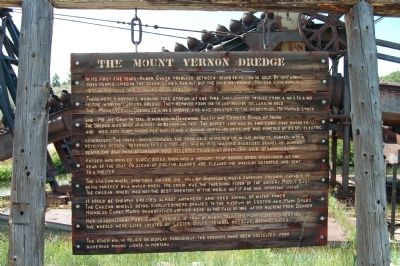
In its first five years, Alder Gulch produced between 30 and 60 million in gold. By 1874 about 35,000 people lived in the gulch. Times ran out but the gold never did. You can still find it here in the hills and streams of Alder Gulch.
There were 5 dredges working this stream at one time. They ranged in size fro a No. 2 to a No. 16, the world’s largest dredge. They removed from 150 to 200 million dollars in gold. The Mount Vernon Dredge is a No. 2 dredge and was donated to the museum by Mr. Harold Lynch and Mr. Joe Gray in 1985. It worked Deadwood Gulch and Crooked River of Idaho.
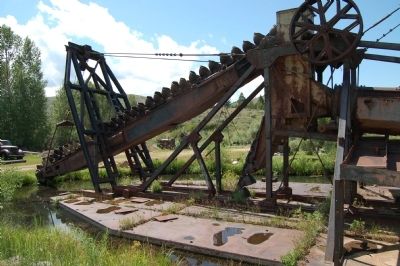
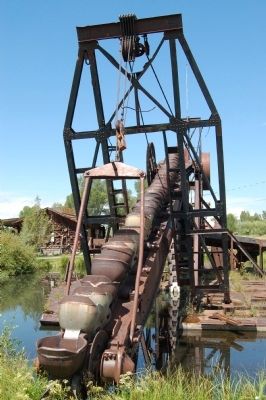
The dredge was built at a cost of $37,350 in 1937. The bucket line has 65 two cubic foot buckets and digs 2,000 cubic yards per day. It has a digging depth of 20 ft and was powered by diesel electric generators. The gravel, which contains the free gold, is picked up in the buckets, dumped into a revolving screen, referred to as a trommel, where it is washed. Oversize gravel is dumped behind the boat with a conveyer belt, referred to as a stacker. The gold bearing gravel passes into riffled sluice boxes, then into a mercury trap before being
this page online
The other mining relics on display throughout the grounds have been collected from numerous mining sights in Montana.
Topics. This historical marker is listed in these topic lists: Industry & Commerce • Natural Resources. A significant historical year for this entry is 1874.
Location. 45° 18.316′ N, 111° 57.93′ W.
Photographed by Barry Swackhamer, August 6, 2009
2. The Mount Vernon Dredge
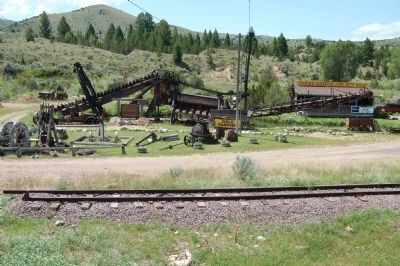
The marker is below the bucket line.

Regionally, this marker is in Southwest Montana, in Gold West Country, in Mining Country and in Greater Bozeman. It is also in the American Mountain West and in the Lewis & Clark Corridor. Globally, it is in North America, the Rocky Mountains, the Western Hemisphere, the Western World, and the Anglosphere. Historically, it finds itself in what was once Rupert’s Land and also the Louisiana Purchase.
Other nearby markers. At least 8 other markers are within walking distance of this marker: Dr. Don L. Byam Residence (about 700 feet away, measured in a direct line); Madison County Pioneers (approx. 0.2 miles away); An Important Era in Railroad History (approx. 0.2 miles away); History Wins! (approx. 0.2 miles away); Nevada City (approx. 0.2 miles away);
Photographed by Barry Swackhamer, August 6, 2009
3. The Mount Vernon Dredge - The Bucket Line
Also see . . . Virtual Tour of Gold Dredge #8 - Alaska Dreams. (Submitted on November 16, 2011, by Barry Swackhamer of Brentwood, California.)
Additional keywords. gold dredge
Photographed by Barry Swackhamer, August 6, 2009
4. The Mount Vernon Dredge - The Bucket Line

Photographed by Barry Swackhamer, August 6, 2009
5. The Mount Vernon Dredge - The Trommel and Riffle Boxes
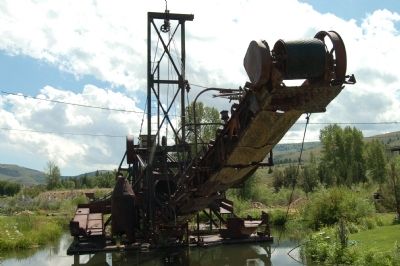
Photographed by Barry Swackhamer, August 6, 2009
6. The Mount Vernon Dredge - The Stacker
Credits. This page was last revised on February 14, 2026. It was originally submitted on November 16, 2011, by Barry Swackhamer of Brentwood, California. This page has been viewed 2,331 times since then and 47 times this year. Photos: 1, 2, 3, 4, 5, 6. submitted on November 16, 2011, by Barry Swackhamer of Brentwood, California. • Bill Pfingsten was the editor who published this page.
