Central Park's Ancient Egyptian Obelisk
Cleopatra’s Needle
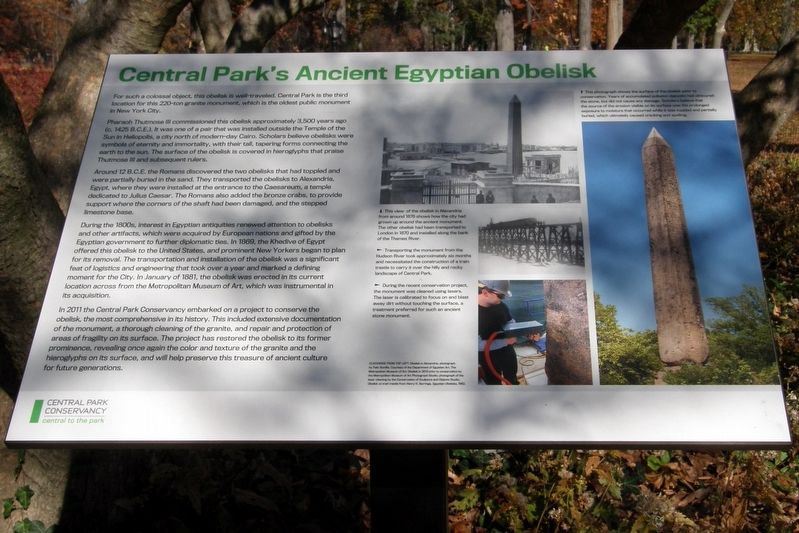
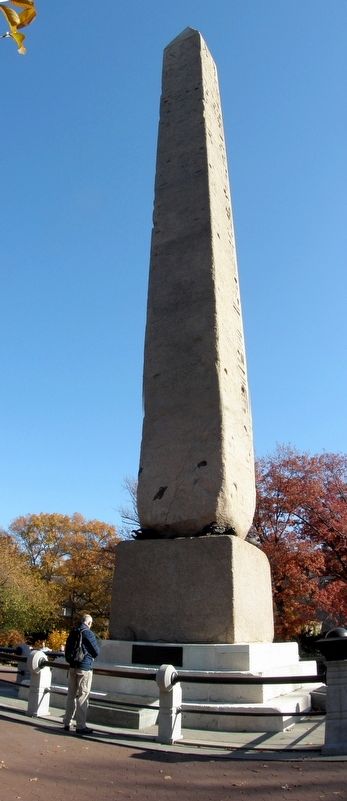
For such a colossal object, this obelisk is well-travelled. Central Park is the third location for this 220-ton granite monument, which is the oldest public monument in New York City.
Pharaoh Thutmose III commissioned this obelisk approximately 3500 years ago (c. 1425 B.C.E.). It was one of a pair that was installed outside the Temple of the Sun in Heliopolis, a city north of modern-day Cairo. Scholars believe that obelisks were symbols of eternity and immortality, with their tall, tapering forms connecting the earth to the sun. The surface of the obelisk is covered in hieroglyphics that praise Thutmose III and subsequent rulers.
Around 12 B.C.E. the Romans discovered the two obelisks that had toppled and were partially buried in the sand. They transported the obelisks to Alexandria, Egypt where they were installed at the entrance to the Caesareum, a temple dedicated to Julius Caesar. The Romans also added the bronze crabs, to provide support where the corners of the shaft had been damaged, and the stepped limestone base.
During the 1800s, interest in Egyptian antiquities renewed attention to obelisks and other artifacts,
this page online
In 2011 the Central Park Conservancy embarked on a project to conserve the obelisk, the most comprehensive in its history. This included extensive documentation of the monument, a thorough cleaning of the granite, and repair and protection of areas of fragility on its surface. The project has restored the obelisk to its former prominence, revealing once again the color and texture of the granite and the hieroglyphics on its surface, and will help preserve this treasure of ancient culture for future generations.
Erected by Central Park Conservancy.
Topics. This historical marker
Location. 40° 46.785′ N, 73° 57.928′ W. Marker is in Manhattan, New York, in New York County. It is in the Central Park West Historic District. It can be reached from East Drive. Behind the Metropolitan Museum of Art. Touch for map. Marker is in this post office area: New York NY 10024, United States of America. Touch for directions.

Regionally, this marker is in New York City. It is also in the American Northeast, in the Mid-Atlantic, and on the Eastern Seaboard. Globally, it is in the North Atlantic Region, North America, the Western Hemisphere, the Western World, and the Anglosphere. Historically, it finds itself in what was once New Netherland and also one of the original Thirteen Colonies.
Other nearby markers. At least 8 other markers are within walking distance of this marker: Cleopatra’s Needle (a few steps from this marker); King Wladyslaw Jagiello (about 500 feet away, measured in a direct line); The Metropolitan Museum of Art (approx. 0.2 miles away); Metropolitan Museum Historic District (approx. 0.2 miles away); Belvedere Tower (approx. 0.2 miles away); Receiving Reservoir (approx. 0.2 miles away); Cedar Hill and Glade Arch (approx. 0.2 miles away); Harry F. Sinclair House (approx. ¼ mile away). Touch for a list and map of all markers in Manhattan.
Regarding Central Park's Ancient Egyptian Obelisk. The inserts show: the obelisk in Alexandria, Egypt; its transportation across Manhattan, conservation in progress; the obelisk before conservation.
Also see . . . Cleopatra's Needle - Central Park. "Daytonian in Manhattan" entry. (Submitted on April 6, 2020, by Larry Gertner of New York, New York.)
Credits. This page was last revised on January 31, 2023. It was originally submitted on November 28, 2016, by Larry Gertner of New York, New York. This page has been viewed 746 times since then and 53 times this year. Photos: 1, 2, 3. submitted on November 28, 2016, by Larry Gertner of New York, New York. • Bill Pfingsten was the editor who published this page.
Editor’s want-list for this marker. Wide view photo of the marker showing its location in context. • Can you help?
