Innenstadt I in Frankfurt am Main, Hesse, Germany — Central Europe
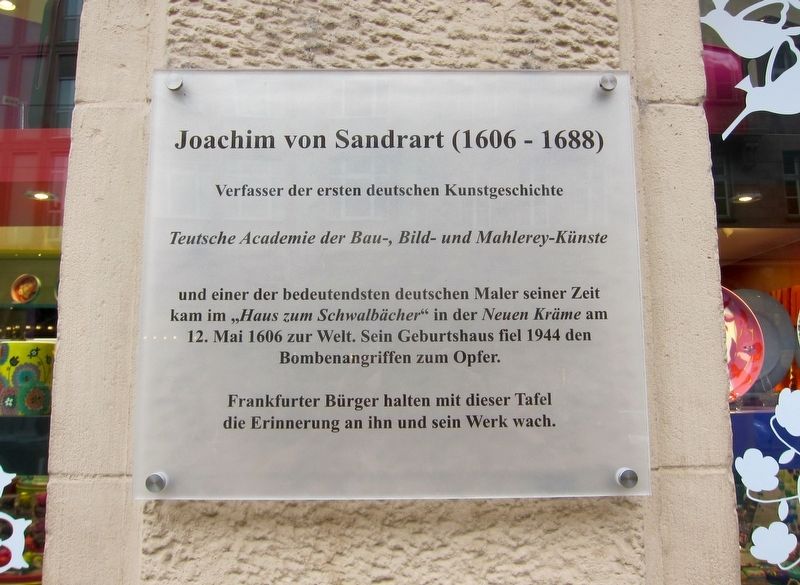
Joachim von Sandrart (1606 - 1688)
Photographed by Andrew Ruppenstein, November 22, 2016
1. Joachim von Sandrart (1606 - 1688) Marker
Teutsche Academie der Bau-‚ Bild- und Mahlerey-Künste
und einer der bedeutendsten deutschen Maler seiner Zeit
kam im „Haus zum Schwalbächer“ in der Neuen Kräme am
12. Mai 1606 zur Welt. Sein Geburtshaus fiel 1944 den
Bombenangriffen zum Opfer.
Frankfurter Bürger halten mit dieser Tafel
die Erinnerung an ihn und sein Werk wach.
[English translation:]
Publisher of the first German history of art: German Academy of the Noble Arts of Architecture, Sculpture and Painting, and one of the most significant German painters of his time. He came into the world on May 12, 1606 - born in the Schwalbaecher House on Neue Kraeme Street (i.e. here, the marker site), which fell victim to the 1944 bombings.
With this plaque the citizens of Frankfurt keep alive the remembrance of him and his works.
Topics. This historical marker is listed in this topic list: Arts, Letters, Music. A significant historical year for this entry is 1606.
Location. 50° 6.661′ N, 8° 40.93′ E. Marker is in Frankfurt am Main, Hessen (Hesse). It is in Innenstadt I. It is at the intersection
this page online

Regionally, it is in Europe, the European Union, Atlantic Europe, Central Europe, the Schengen Area, Western Europe, and the Western World. Historically, it finds itself in what was once the Roman Empire, the Holy Roman Empire, and the former West Germany.
Other nearby markers. At least 8 other markers are within walking distance of this marker: Römerberg 34: "Haus zum goldenen Rad" / House at the Golden Wheel (within shouting distance of this marker); Steinernes Haus (within shouting distance of this marker); John F. Kennedy Spoke Here (about 90 meters away, measured in a direct line); Theodor Heuss (about 90 meters away); Frankfurt Romani Memorial (about 90 meters away); Nazi Student Book Burning of 1933 (about 90 meters away); Philipp Jacob Spener (about 90 meters away); Paulskirche / St. Paul's Church (about 90 meters away). Touch for a list and map of all markers in Frankfurt am Main.
Also see . . . Joachim von Sandrart (Getty Museum).
Photographed by Andrew Ruppenstein, November 22, 2016
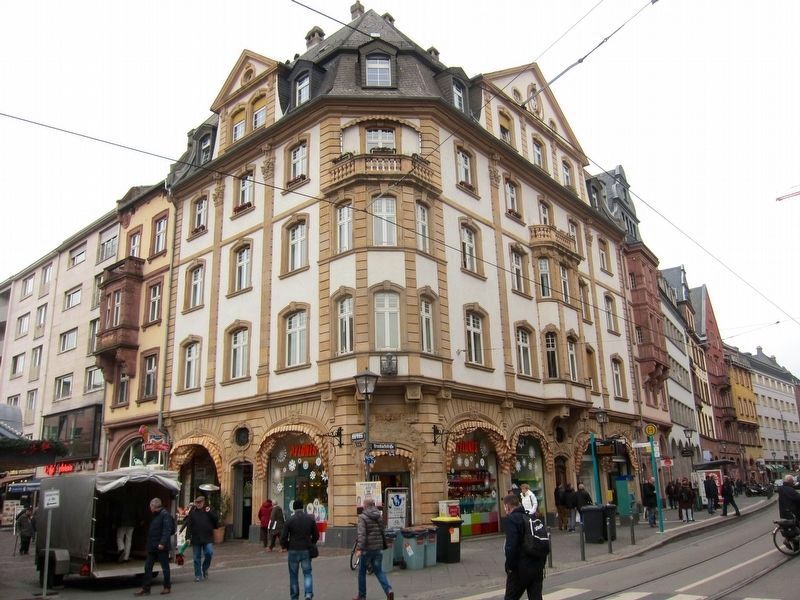
2. Joachim von Sandrart (1606 - 1688) Marker - Wide View
The marker is mounted to this building, barely visible here on the pillar between the two window-arches to the right of the doorway.
Credits. This page was last revised on January 28, 2022. It was originally submitted on December 8, 2016, by Andrew Ruppenstein of Lamorinda, California. This page has been viewed 388 times since then and 28 times this year. Photos: 1, 2. submitted on December 8, 2016, by Andrew Ruppenstein of Lamorinda, California.
