Anacostia in Southeast Washington in Washington, District of Columbia — The American Northeast (Mid-Atlantic)
Crossing Lines
An East-of-the-River View
| — | Anacostia Heritage Trail | — |
Photographed by Allen C. Browne, December 28, 2016
1. Crossing Lines Marker
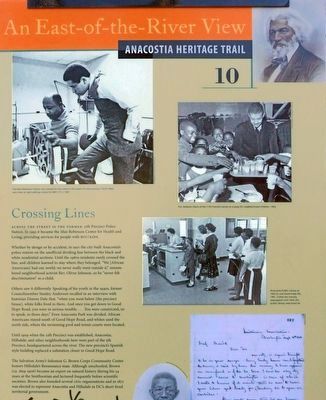
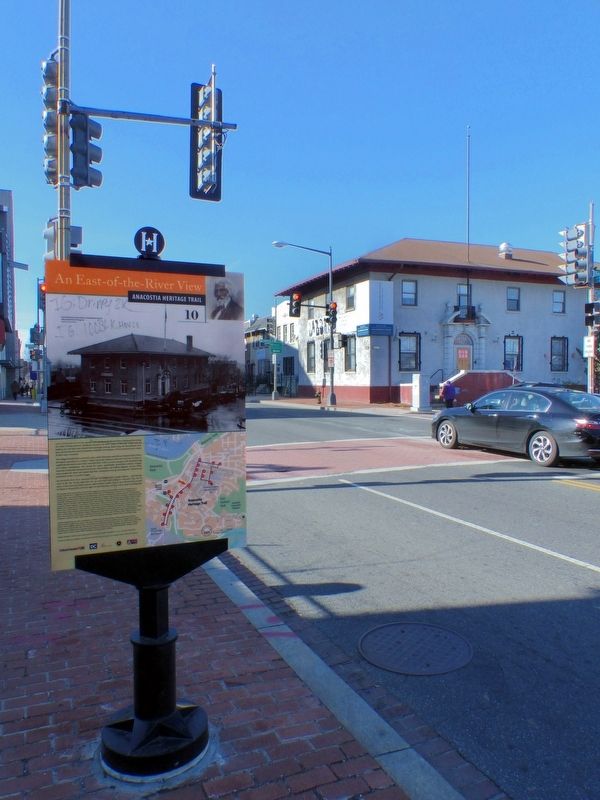
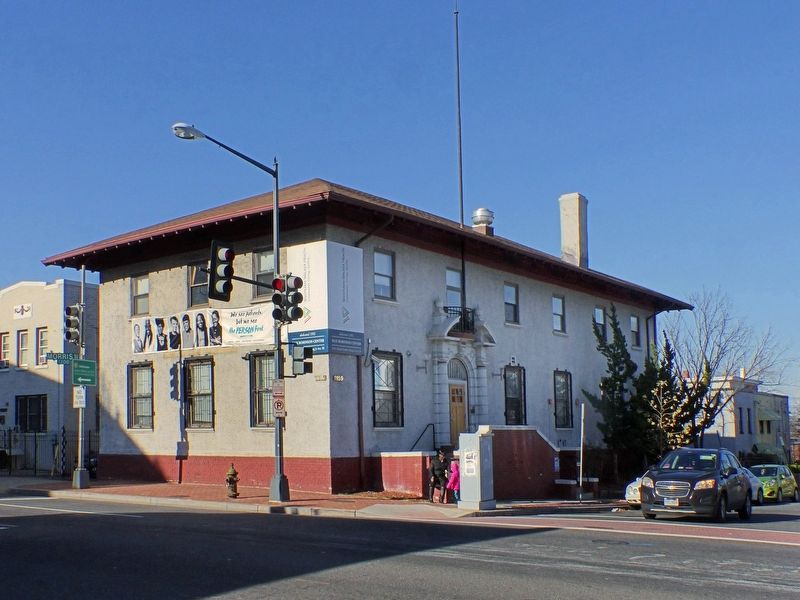
Across the street is the former 11th Precinct Police Station. In 1993 it became the Max Robinson Center for Health and Living, providing services for people with HIV/AIDS.
Whether by design or by accident, in 1910 the city built Anacostia's police station on the unofficial dividing line between the black and white residential sections. Until the 1960s residents rarely crossed the line, and children learned to stay where they belonged. "We [African Americans] had our world; we never really went outside it;' remembered neighborhood activist Rev. Oliver Johnson, so he "never felt discrimination" as a child.
Others saw it differently. Speaking of his youth in the 1940s, former Council member Stanley Anderson recalled in an interview with historian Dianne Dale that, "when you went below [the precinct house], white folks lived in there. And once you got down to Good Hope Road, you were in serious trouble .... You were constricted, so to speak, in those days." Even Anacostia Park was divided. African Americans stayed south of Good Hope Road, and whites used the north side, where the swimming pool and tennis courts were
this page online
Until 1909 when the 11th Precinct was established, Anacostia, Hillsdale, and other neighborhoods here were part of the 5th Precinct, headquartered across the river. The new precinct's Spanish style building replaced a substation closer to Good Hope Road.
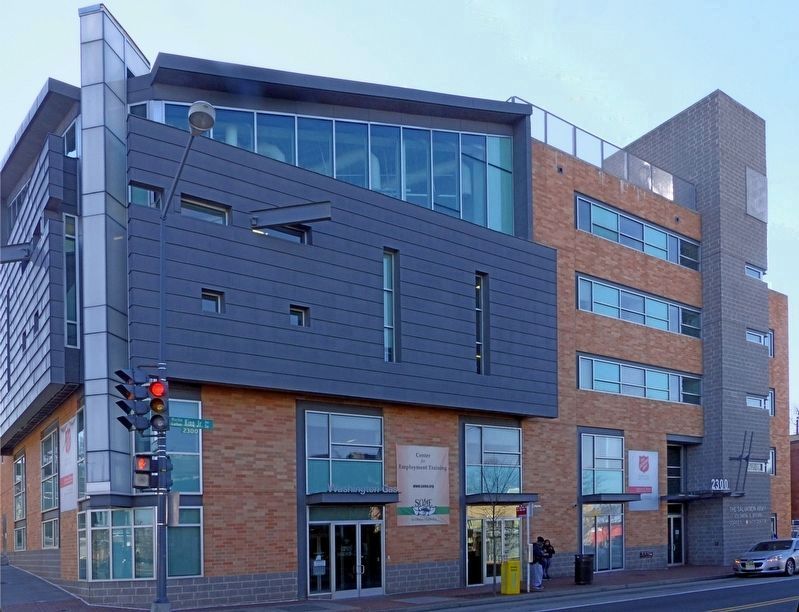
The Salvation Army's Solomon G. Brown Corps Community Center honors Hillsdale's Renaissance man. Although unschooled, Brown (ca. 1829-1906) became an expert on natural history during his 54 years at the Smithsonian and lectured frequently before scientific societies. Brown also founded several civic organizations and in 1871 was elected to represent Anacostia and Hillsdale in DC's short-lived territorial government.
Erected 2013 by Cultural Tourism DC. (Marker Number 10.)
Topics and series. This historical marker is listed in these topic lists: African Americans • Architecture • Charity & Public Work • Science & Medicine. In addition, it is included in the Anacostia Heritage Trail series list. A significant historical year for this entry is 1910.
Location. 38° 51.81′ N, 76° 59.444′ W. Marker is in Southeast Washington in Washington, District of Columbia.
Photographed by Allen C. Browne, December 28, 2016
2. Crossing Lines Marker

Regionally, this marker is in the Washington Metropolitan Area. It is also in the American Northeast, in the Upper South, in the Mid-Atlantic, in the Tidewater, and in the Chesapeake Bay Region. Globally, it is in North America, the Western Hemisphere, the Western World, and the Anglosphere.
Other nearby markers. At least 8 other markers are within walking distance of this marker: District Walls, 2016 (within shouting distance of this marker); Dr. Calvin W. Rolark, Sr. (May 18, 1927 - October 23, 1994) (about 300 feet away, measured in a direct line); A Museum for the Community (about 600 feet away); Transit and Trade (about 600 feet away); Union Temple Baptist Church (about 600 feet away); The Big Chair (about 800 feet away); The World’s Largest Chair (about 800 feet away); a different marker also named The Big Chair (approx. 0.2
Photographed by J. Makali Bruton, February 22, 2025
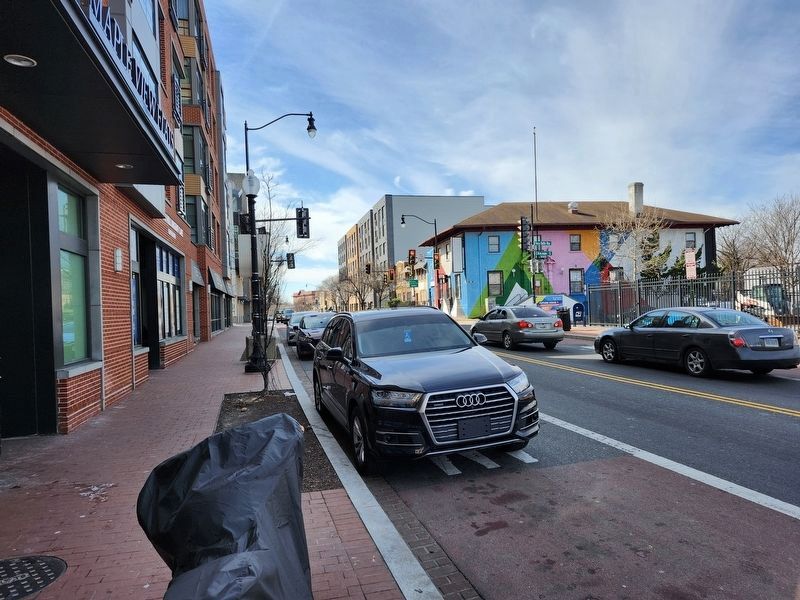
3. Crossing Lines Marker Missing
Photographed by Allen C. Browne, December 28, 2016
4. The Max Robinson Center for Health and Living
Photographed by Allen C. Browne, December 28, 2016
5. Salvation Army
Solomon G Brown Corps Community Center
Solomon G Brown Corps Community Center
Credits. This page was last revised on February 24, 2025. It was originally submitted on January 6, 2017, by Allen C. Browne of Silver Spring, Maryland. This page has been viewed 902 times since then and 22 times this year. Photos: 1, 2. submitted on January 6, 2017, by Allen C. Browne of Silver Spring, Maryland. 3. submitted on February 24, 2025, by J. Makali Bruton of Washington, District of Columbia. 4. submitted on January 6, 2017, by Allen C. Browne of Silver Spring, Maryland. 5. submitted on January 9, 2017, by Allen C. Browne of Silver Spring, Maryland. • Bill Pfingsten was the editor who published this page.
