Bealsville in Hillsborough County, Florida — The American South (South Atlantic)
Bealsville
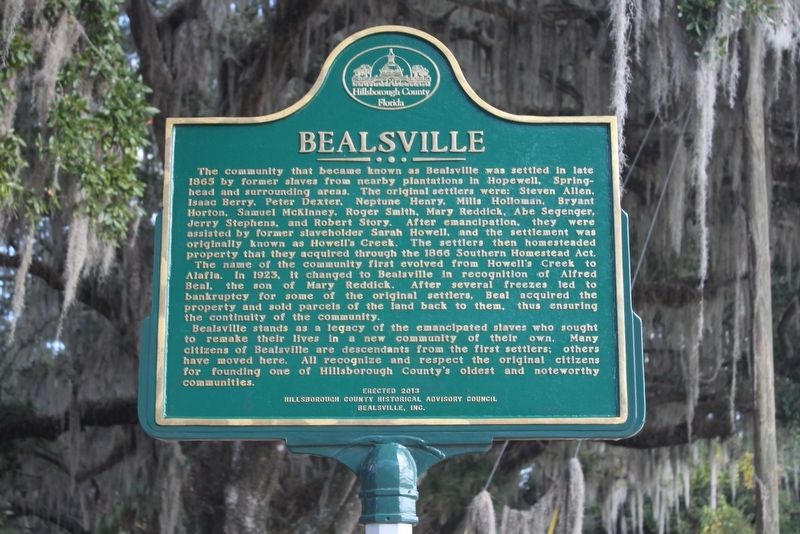
Photographed by Tim Fillmon, November 25, 2016
1. Bealsville Marker
Bealsville stands as a legacy of the emancipated slaves who sought to remake their lives in a new community of their own. Many citizens of Bealsville are descendants from the first settlers;
this page online
Erected 2013 by Hillsborough County Historical Advisory Council.
Topics. This historical marker is listed in these topic lists: African Americans • Settlements & Settlers. A significant historical year for this entry is 1865.
Location. 27° 56.728′ N, 82° 4.529′ W. Marker is in Bealsville, Florida, in Hillsborough County. It is at the intersection of Nesmith Road and Joe King Road, on the right when traveling west on Nesmith Road. Located in front of the Bealsville Recreation Center. Touch for map. Marker is at or near this postal address: 5009 Nesmith Avenue, Plant City FL 33567, United States of America. Touch for directions.

Regionally, this marker is on Tampa Bay. It is also in the American South and on the Gulf Coast. Globally, it is in the North Atlantic Region, North America, a Gulf of Mexico state, the Western Hemisphere, the Western World, and the Anglosphere. Historically, it finds itself in what was once New Spain, the territory of the Mississippian Culture,
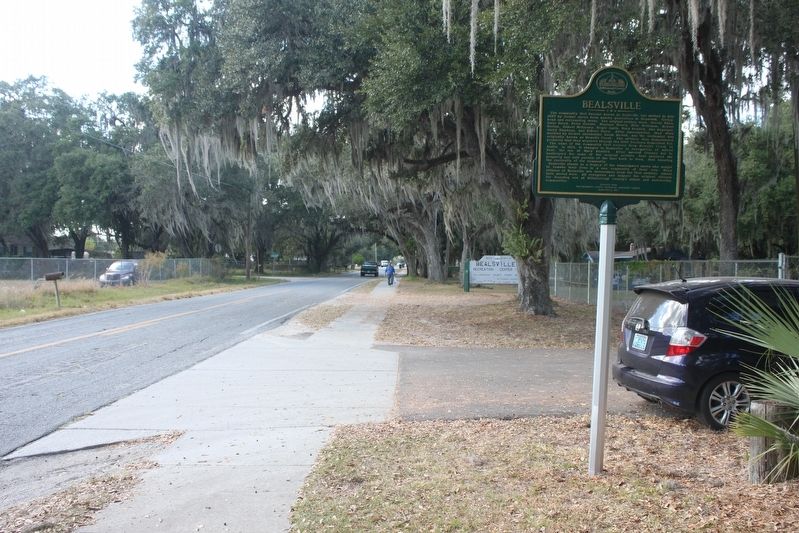
Photographed by Tim Fillmon, November 25, 2016
2. Bealsville Marker looking west on Nesmith Road.
Other nearby markers. At least 8 other markers are within 4 miles of this marker, measured as the crow flies: Glover School (approx. 0.4 miles away); C-47 “SkyTrain” (approx. 3.8 miles away); XF2Y Sea Dart (approx. 3.9 miles away); Convair F2Y F “SeaDart” (approx. 3.9 miles away); Sun 'n Fun Fly-in (approx. 3.9 miles away); Cirrus VK-30 (approx. 3.9 miles away); Boeing 307 Stratoliner 1939 (approx. 3.9 miles away); MiG-21 MF 1970 (approx. 3.9 miles away).
Credits. This page was last revised on January 26, 2017. It was originally submitted on January 23, 2017, by Tim Fillmon of Webster, Florida. This page has been viewed 1,172 times since then and 62 times this year. Photos: 1, 2. submitted on January 23, 2017, by Tim Fillmon of Webster, Florida. • Bill Pfingsten was the editor who published this page.
