San Miguel de Cozumel, Quintana Roo, Mexico — The Yucatan Peninsula (The Southeast)
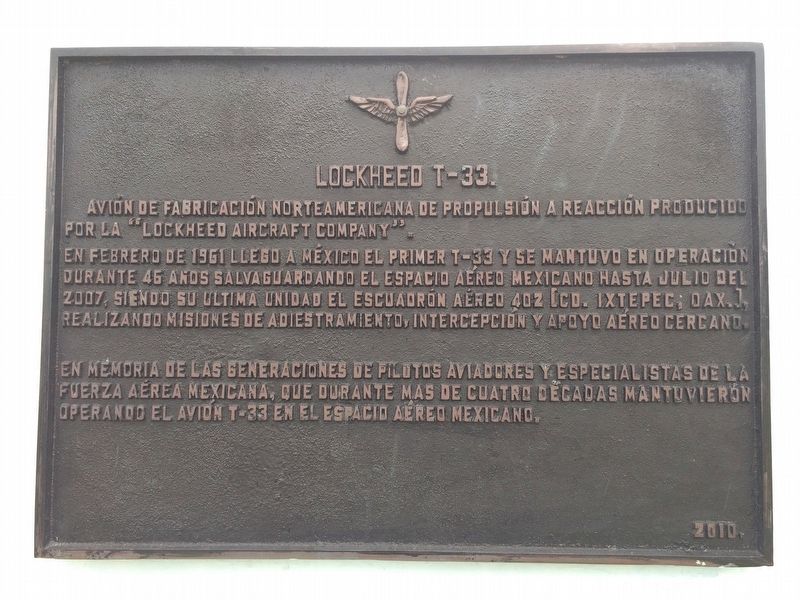
Lockheed T-33.
Photographed by J. Makali Bruton, January 15, 2017
1. Lockheed T-33. Marker
En febrero de 1961 llego a México el primer T-33 y se mantuvo en operación durante 46 años salvaguardando el espacio aéreo mexicano hasta julio del 2007, siendo su ultima unidad el Escuadrón Aéreo 402 [Co. Ixtepec, Oax.], realizando misiones de adiestramiento, intercepción y apoyo aéreo cercano.
En memoria de las generaciones de pilotos aviadores y especialistas de la Fuerza Aérea Mexicana, que durante mas de cuatro décadas mantuvieron operando el avión T-33 en el espacio aéreo mexicano.
English translation
North American jet propulsion aircraft produced by the Lockheed Aircraft Company.
In February 1961 the first T-33 arrived in Mexico and remained in operation for 46 years, safeguarding Mexican airspace until July 2007, with its last unit, the 402 Aerial Squadron [Co. Ixtepec, Oax.], performing training missions, interception and close air support.
In memory of the generations of aviators and specialists of the Mexican Air Force, who for more than four decades kept the T-33 airplane in operation in Mexican
this page online
Erected 2010.
Topics. This historical marker is listed in this topic list: Air & Space. A significant historical month for this entry is February 1961.
Location. 20° 31.261′ N, 86° 56.57′ W. Marker is in San Miguel de Cozumel, Quintana Roo. It is on Avenida Rafael E. Melgar, on the right when traveling north. The marker is in an area of memorials directly outside of the entrance to the Mexican Military Air Base #4 in Cozumel. Touch for map. Marker is in this post office area: San Miguel de Cozumel QR 77609, Mexico. Touch for directions.

Regionally, this marker is in the Mexican Maya Heartland and on the Yucatán Peninsula. Globally, it is on the Caribbean Sea, in North America, in Mesoamerica, in a Gulf of Mexico state, and in the Western Hemisphere. Historically, it finds itself in what was once New Spain and also a Spanish colony.
Other nearby markers. At least 8 other markers are within walking distance of this marker: Tribute to the 201st Squadron of the Mexican Expeditionary Force (within shouting distance of this marker); North American T-28A Trojan (within shouting distance of this marker); Mexican Air Force Expeditionary Squadron 201 Memorial
Photographed by J. Makali Bruton, January 15, 2017
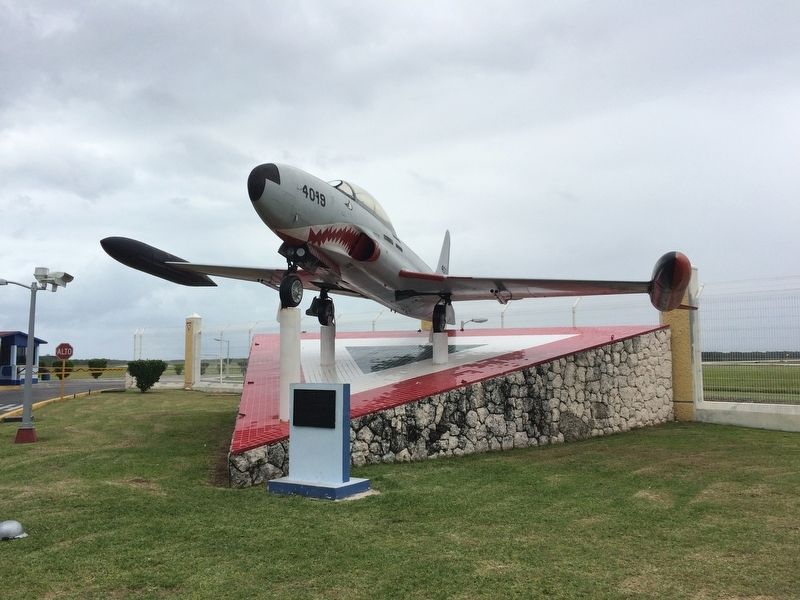
2. The Lockheed T-33 and Marker
Photographed by J. Makali Bruton, January 15, 2017
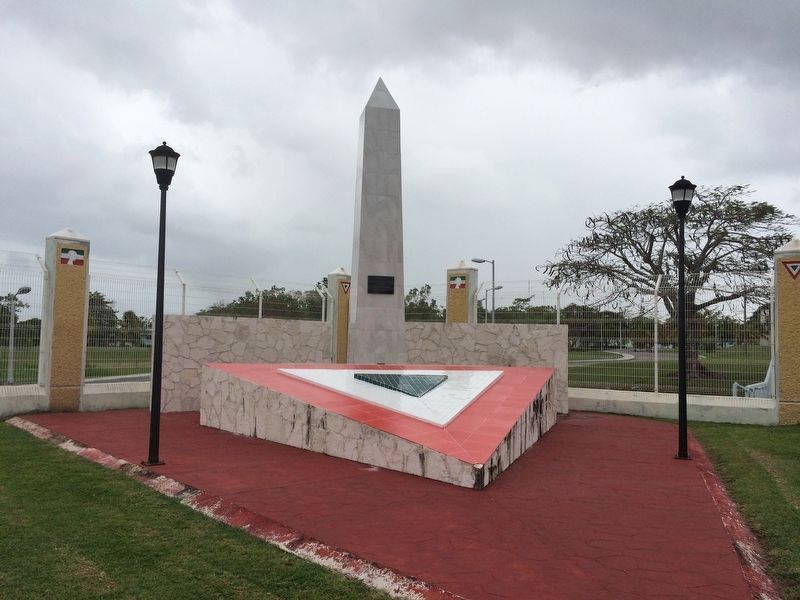
3. A nearby monument to the 100th Anniversary of the Mexican Air Force
This monument is just to the south of the entrance to Air Base No. 4 in Cozumel. Its marker reads:Inauguración del Obelisco en conmemoración del
Centenario
de la
Fuerza Aérea Mexicana
En honor a las mujeres y los hombres que
contribuyen a la seguridad y defensa
del espacio aéreo mexicano.
Cozumel, Q. Roo, 10 de febrero de 2015.
English translation:
Inauguration of this Obelisk in commemoration of the
Centennial of the Mexican Air Force
In honor of the women and men who contribute to the security and defense of Mexican airspace.
Cozumel, Q. Roo, February 10, 2015.
Centenario
de la
Fuerza Aérea Mexicana
En honor a las mujeres y los hombres que
contribuyen a la seguridad y defensa
del espacio aéreo mexicano.
Cozumel, Q. Roo, 10 de febrero de 2015.
English translation:
Inauguration of this Obelisk in commemoration of the
Centennial of the Mexican Air Force
In honor of the women and men who contribute to the security and defense of Mexican airspace.
Cozumel, Q. Roo, February 10, 2015.
Credits. This page was last revised on February 28, 2017. It was originally submitted on February 27, 2017, by J. Makali Bruton of Washington, District of Columbia. This page has been viewed 569 times since then and 17 times this year. Photos: 1, 2, 3. submitted on February 27, 2017, by J. Makali Bruton of Washington, District of Columbia.
