Augusta in Richmond County, Georgia — The American South (South Atlantic)
Two Early Augusta Churches
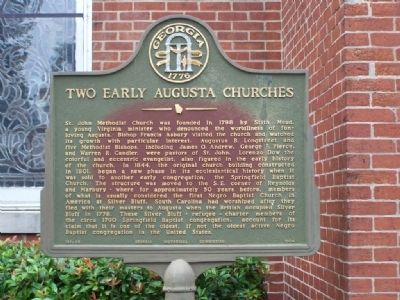
Photographed by Mike Stroud, July 2008
1. Two Early Augusta Churches Marker
this page online
Erected 1964 by Georgia Historical Commission. (Marker Number 121-45.)
Topics and series. This historical marker is listed in these topic lists: Notable Places • Religion & Religious Structures. In addition, it is included in the Francis Asbury, Traveling Methodist Preacher, and the Georgia Historical Society series lists. A significant historical year for this entry is 1798.
Location. 33° 28.37′ N, 81° 57.95′ W. Marker is in Augusta, Georgia, in Richmond County. It is on Greene Street. Touch for map. Marker is at or near this postal address: 736 Greene St, Augusta GA 30901, United States of America. Touch for directions.

Regionally, this marker is in the American South and specifically in the Deep South. Globally, it is in North America, the Western Hemisphere, the Western World, and the Anglosphere. Historically, it finds itself in what was once the territory of the Mississippian Culture, one of the original Thirteen Colonies, one of the Confederate States of America, and the Antebellum South.
Other nearby markers. At least 8 other markers
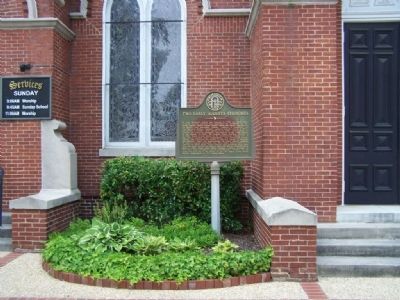
Photographed by Mike Stroud, 2008
2. Two Early Augusta Churches Marker
Also see . . .
1. Wikipedia entry for Lorenzo Dow. His autobiography at one time was the second-best selling book in the United States, exceeded only by the Bible. He was an important figure in the Second Great Awakening. (Submitted on August 14, 2008, by Mike Stroud of Bluffton, South Carolina.)
2. Wikipedia entry for Augustus Baldwin Longstreet. He graduated at Yale (1813) and practiced law in Georgia, becoming a district judge in 1822 and holding the position for several years, after which he resumed his legal practice in Augusta, did editorial work, and established the Sentinel,
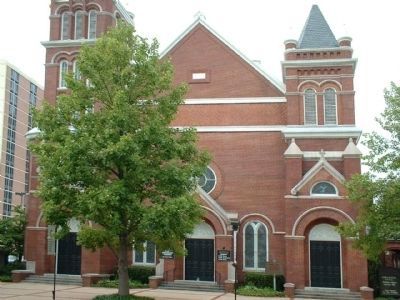
Photographed by Mike Stroud, 2008
3. St John United Methodist Church and Marker
3. Reminiscences of Famous Georgians By Lucian Lamar Knight, pages 599-602. Bishop James O. Andrew (Submitted on August 14, 2008, by Mike Stroud of Bluffton, South Carolina.)
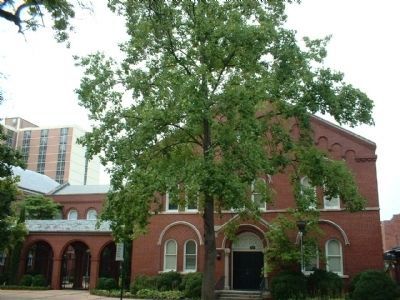
Photographed by Mike Stroud, 2008
4. St John United Methodist Church
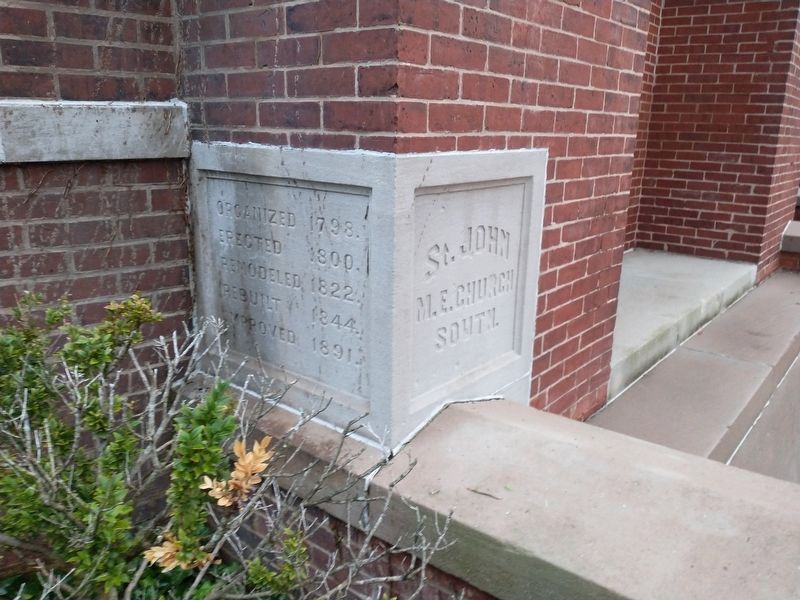
Photographed by Craig Doda, November 11, 2022
5. Two Early Augusta Churches Cornerstone
Credits. This page was last revised on November 26, 2022. It was originally submitted on August 13, 2008, by Mike Stroud of Bluffton, South Carolina. This page has been viewed 1,681 times since then and 50 times this year. Photos: 1, 2, 3, 4. submitted on August 13, 2008, by Mike Stroud of Bluffton, South Carolina. 5. submitted on November 15, 2022, by Craig Doda of Napoleon, Ohio. • Kevin W. was the editor who published this page.
