
City Hall
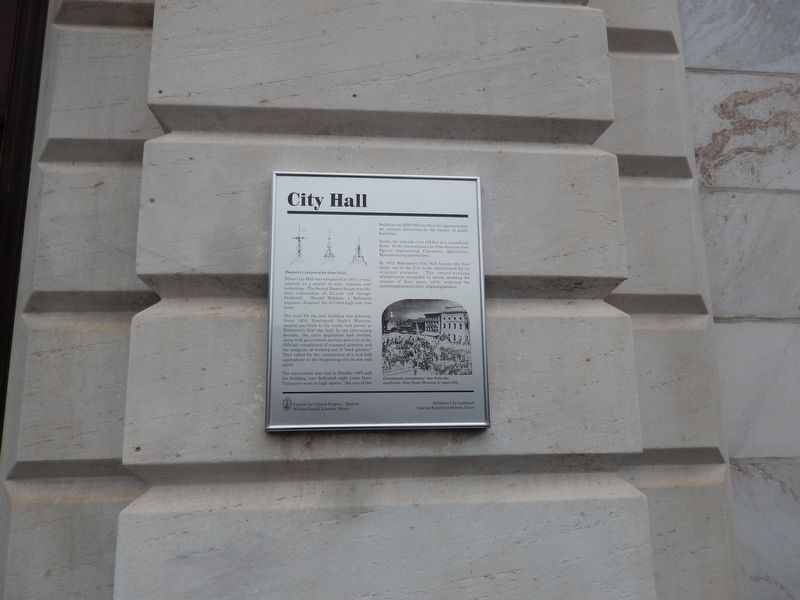
The need for the new building was pressing. Since 1830, Rembrandt Peale’s Museum located one block to the north, had served as Baltimore’s first city hall. In the intervening decades, the city’s population had swelled, along with government services and civic pride. Officials complained of cramped quarters and the indignity of working out of “back parlors.” They called for the construction of a new hall appropriate to the burgeoning city in size and spirit.
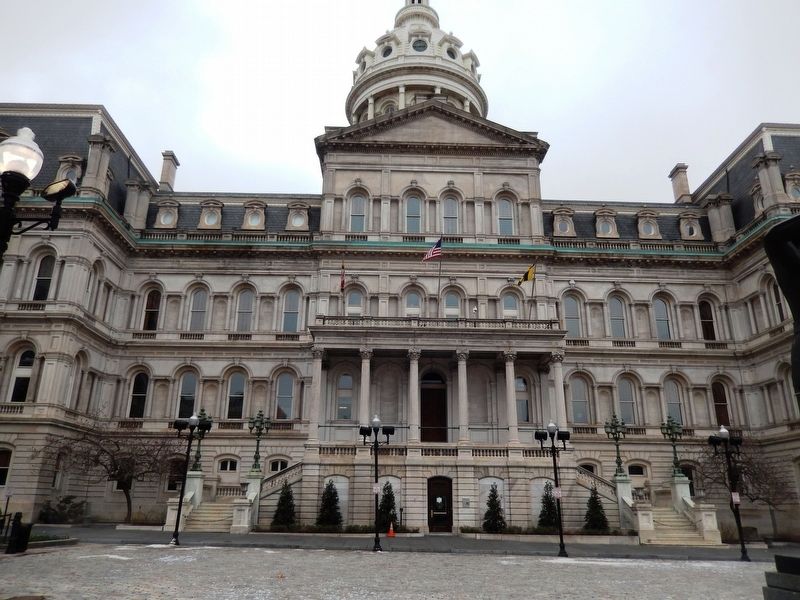
The cornerstone was laid in October 1867 and the building was dedicated eight years later. Taxpayers were in high spirits: the cost of the building was $200,000 less than the appropriation, and unusual distinction in the history of public buildings.
Inside, the rotunda rises 119 feet to a magnificent dome. In the stained glass eye of the dome are four figures representing Commerce, Agriculture,
this page online
In 1975, Baltimore’s City Hall became the first major one in the U.S. to be rehabilitated for its original purpose. The award-winning rehabilitation succeeded in almost doubling the amount of floor space, while restoring the ceremonial areas to their original grandeur.
(Inscription under the images in the upper left)
Frederick’s proposals for dome finial.
(Inscription under the image in the lower right)
Cornerstone ceremonies view from the southwest. Note Peale Museum in upper left.
Council for Cultural Progress, Sponsor; William Donald Schaefer, Mayor—Baltimore City Landmark; National Register of Historic Places.
Topics. This historical marker is listed in these topic lists: Architecture • Government & Politics. A significant historical month for this entry is October 1867.
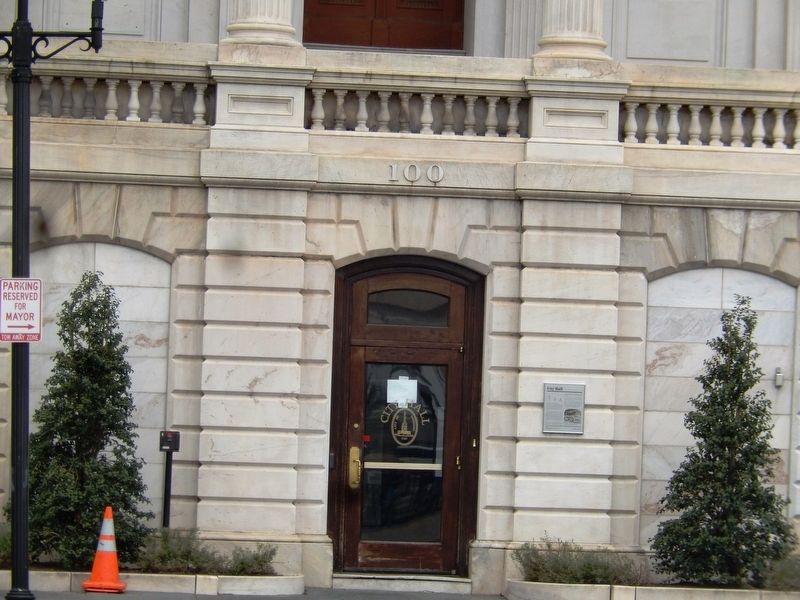
Location. 39° 17.455′ N, 76° 36.626′ W. Marker is in Baltimore, Maryland. It is in Downtown. It is on Holliday Street. The marker is on the right side of the lower front door of the City Hall. Touch for map. Marker is at or near this postal address: 100 Holliday Street, Baltimore MD 21202, United States of America. Touch for directions.
Regionally,
Other nearby markers. At least 8 other markers are within walking distance of this marker: The Negro Heroes of the United States (a few steps from this marker); Loyola College and High School (within shouting distance of this marker); On This Location (within shouting distance of this marker); A Tribute to Our Unsung Heroes (within shouting distance of this marker); Discover Holliday Street: A Stage for Culture, Politics, and Worship (within shouting distance of this marker); Zion Lutheran Church (within shouting distance of this marker); Harry Sythe Cummings (within shouting distance of this marker); Peale's Baltimore Museum - 1814 (about 300 feet away, measured in a direct line). Touch for a list and map of all markers in Baltimore.
Credits. This page was last revised on August 28, 2020. It was originally submitted on March 27, 2017, by Don Morfe of Baltimore, Maryland. This page has been viewed 612 times since then and 43 times this year. Photos: 1, 2, 3. submitted on March 27, 2017, by Don Morfe of Baltimore, Maryland. • Bill Pfingsten was the editor who published this page.
