Penn Quarter in Northwest Washington in Washington, District of Columbia — The American Northeast (Mid-Atlantic)
"Blodget's Hotel"
Photographed by Richard E. Miller, March 7, 2010
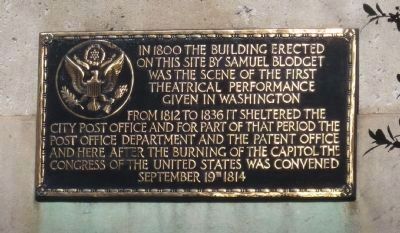
1. "Blodget's Hotel" Marker
[The Great Seal of the United States]
In 1800, the building erected on this site by Samuel Blodget was the scene of the first theatrical performance given in Washington.
From 1812 to 1836 it sheltered the city post office and, for part of that period, the Post Office Department and the Patent Office.
And here after the burning of the Capitol, the Congress of the United States was convened, September 19th 1814.
Topics and series. This historical marker is listed in these topic lists: Arts, Letters, Music • Communications • Entertainment • Industry & Commerce • War of 1812. In addition, it is included in the Postal Mail and Philately series list. A significant historical date for this entry is September 19, 1833.
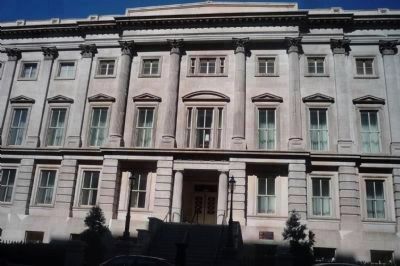
Location. 38° 53.776′ N, 77° 1.344′ W. Marker is in Northwest Washington in Washington, District of Columbia. It is in the Penn Quarter. It is on E Street Northwest west of 7th Street Northwest, on the right when traveling west. Marker is on the lower right side of the rear (south side) entrance to the old General Post Office building which is presently occupied by the Hotel Monaco. Touch for map. Marker
this page online

Regionally, this marker is in the Washington Metropolitan Area. It is also in the American Northeast, in the Upper South, in the Mid-Atlantic, in the Tidewater, and in the Chesapeake Bay Region. Globally, it is in North America, the Western Hemisphere, the Western World, and the Anglosphere.
Other nearby markers. At least 8 other markers are within walking distance of this marker: Samuel F. B. Morse (within shouting distance of this marker); Missing Soldiers (within shouting distance of this marker); Clara Barton: Angel of the Battlefield at Home (within shouting distance of this marker); General Post Office (about 300 feet away, measured in a direct line); a different marker also named The Roots of Freedom and Equality (about 400 feet away); Mary Church Terrell (about 400 feet away); The Chinese Hackberry Tree (about 400 feet away); Patent Office Building (about 400 feet away). Touch for a list and map of all markers in Northwest Washington.
Other markers no longer nearby. Clara Barton, Angel of the Battlefield at Home
Photographed by Richard E. Miller, March 7, 2010
2. "Blodget's Hotel" Marker - below the window, to the right of the south entrance
Also see . . .
1. History of the Patent Office, Chapter 7. ... Washington, in 1793, was a "city" of about 300 residents, most of them speculating on the future of the proposed new capital city. One of them, Samuel Blodgett Jr., a native of New Hampshire and a Revolutionary War officer, had made a fortune in the East India trade and hoped to increase it in Washington. He promoted a lottery to advance his real-estate interests and offered a "Great Hotel" worth $50,000 as first prize. He built Blodgett's Hotel as the prize but did not finish it before he went bankrupt. Little is known of the early use of the partially completed structure except that some public meetings were held there ... (Submitted on March 12, 2010, by Richard E. Miller of Oxon Hill, Maryland.)
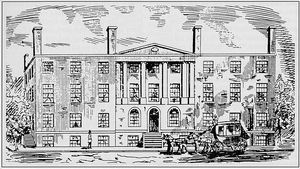
2. U.S. Senate - Emergency Quarters, 1814.
U.S. Senate Collection
3. Blodgett's Hotel Building
Additional keywords. Samuel Blodgett
Photographed by Allen C. Browne, February 16, 2015
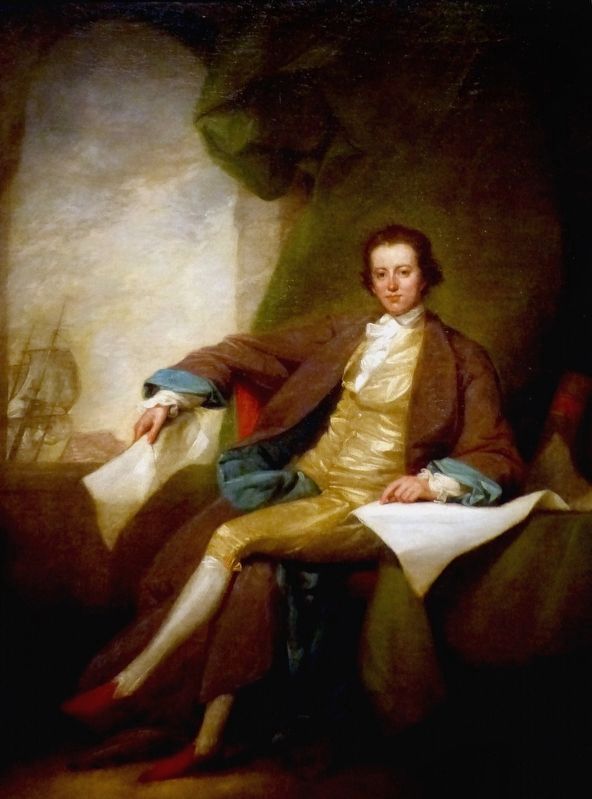
4. Samuel Blodget
This c. 1784 portrait of Samuel Blodget by John Trumbull hangs in the National Portrait Gallery in Washington, DC.
Financier Samuel Blodget convinced the DC commissioners that money could be raised to support public buildings by means of a lottery. Blodget had White House architect James Hoban design and build the Grand Union Public Hotel in 1793 as the $50,000 grand prize in his lottery.
This landmark would have been one of the first hotels in the United States (hitherto, travelers had stayed in taverns or inns), but it was never actually used as a hotel. After much tribulation, the lottery failed when the winner discovered that the hotel he had won was not yet finished. He sued both Blodget and the Commissioners. Blodget went bankrupt, landed in debtor's prison, and died in a Baltimore hospital in April of 1814.
Financier Samuel Blodget convinced the DC commissioners that money could be raised to support public buildings by means of a lottery. Blodget had White House architect James Hoban design and build the Grand Union Public Hotel in 1793 as the $50,000 grand prize in his lottery.
This landmark would have been one of the first hotels in the United States (hitherto, travelers had stayed in taverns or inns), but it was never actually used as a hotel. After much tribulation, the lottery failed when the winner discovered that the hotel he had won was not yet finished. He sued both Blodget and the Commissioners. Blodget went bankrupt, landed in debtor's prison, and died in a Baltimore hospital in April of 1814.
Library of Congress
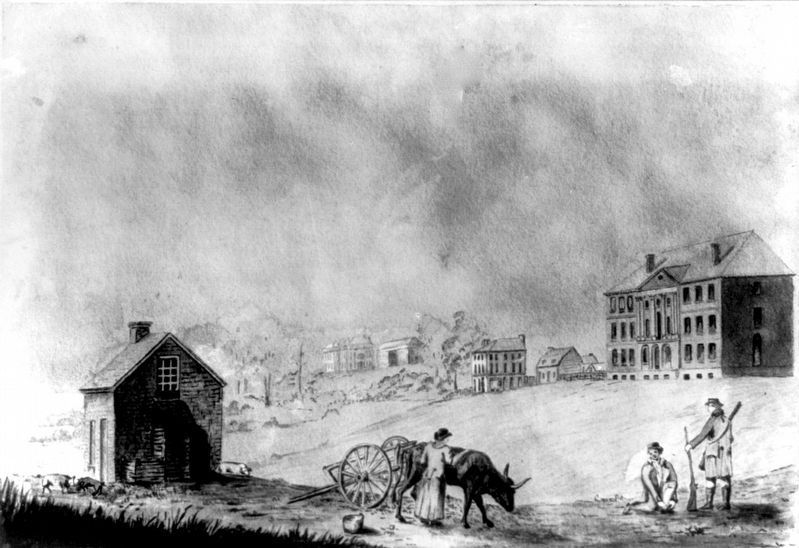
5. Blodget's Hotel, 1803
In 1803, Blodget's Hotel was one of only a handful of large buildings in Washington DC. This 1803 drawing shows Blodget's Hotel on the right and the President's House in the distance.
Credits. This page was last revised on January 30, 2023. It was originally submitted on March 12, 2010, by Richard E. Miller of Oxon Hill, Maryland. This page has been viewed 3,735 times since then and 195 times this year. Last updated on April 28, 2017, by Allen C. Browne of Silver Spring, Maryland. Photos: 1, 2, 3. submitted on March 12, 2010, by Richard E. Miller of Oxon Hill, Maryland. 4, 5. submitted on April 28, 2017, by Allen C. Browne of Silver Spring, Maryland. • Bill Pfingsten was the editor who published this page.
