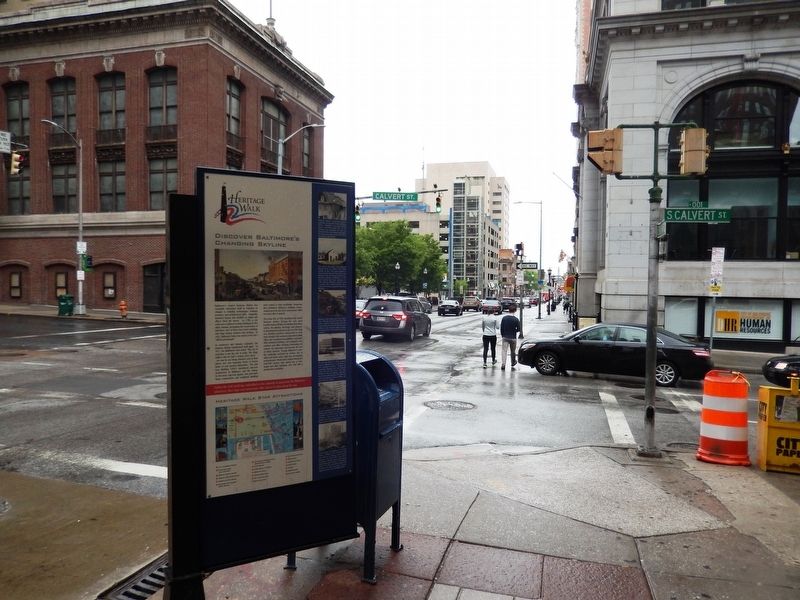
Discover Baltimore’s Changing Skyline
Heritage Walk
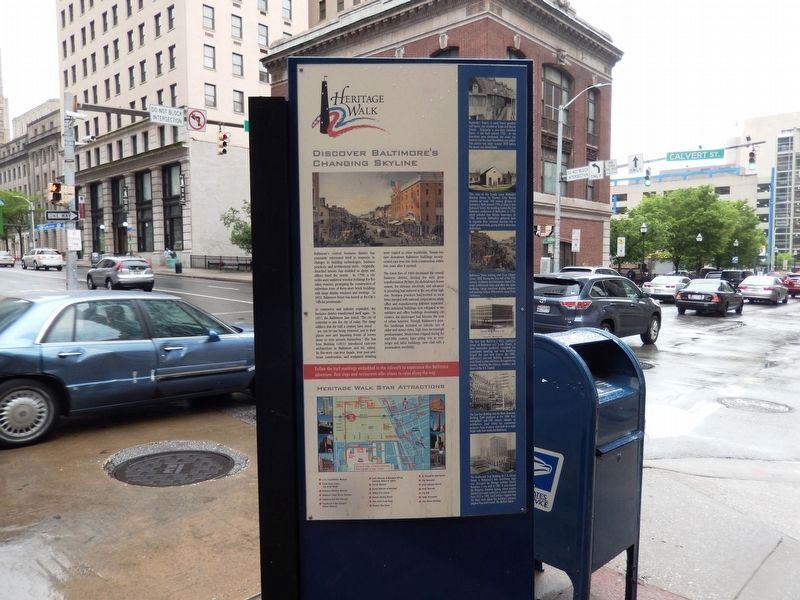
As commerce and industry expanded, the business district transformed itself again. In 1857, the Baltimore Sun noted: “The city of yesterday is not the city of today. The dingy edifices that for half a century have stood …are one by one being removed, and in their places new and imposing fronts of brown stone or iron present themselves.” The Sun Iron Building (1851) introduced cast-iron architecture to Baltimore and the nation. Its five-story cast-iron façade, iron post-and-beam construction, and sculptural detailing were copied in cities worldwide. Twenty-two new downtown Baltimore buildings
this page online
The Great Fire of 1904 decimated the central business district, forcing the next great transformation. By then, the skeletal steel-framed system, the elevator, electricity, and advances in plumbing had ushered in the era of the high rise. Business practices had evolved as local firms merged with national corporations while office and manufacturing activities separated. With industrial buildings now relegated to the outskirts and office buildings dominating city centers, the skyscraper had become the icon of urban America. Though Baltimore’s post-fire landscape included an eclectic mix of older and newer styles, high rises increasingly predominated. Modernism reigned during the mid-20th century, later giving way to ever-larger and taller buildings, now clad with a postmodern sensibility.
(Inscriptions under the images on the left)
(Image 1) Kaminsky’s Tavern, a wood frame gambrel roof house, was situated at Grant and Mercer Streets. Originally a one-story detached house, it was built around 1752. As the downtown area developed, the street was lowered
(Image 2) This view of the Lovely Lane Methodist Meeting House by Thomas Coke Ruckle provides an early 19th century glimpse of downtown. Built around 1774 on what is now Redwood Street, the building hosted the first Baltimore conference of Methodists in 1776, which included free African Americans. In 1784, American Methodists gathered here to organize their scattered churches into a single national body, giving birth to American Methodism.
(Image 3) Baltimore Street looking west from Calvert Street, 1850. During the first half of the 19th century, residences and businesses shared the same architectural styles and often the same buildings. Large storefront display windows and awnings helped differentiate shops from residences.
(Image 4) The Sun Iron Building (1851), southeast corner of Baltimore and South Streets. A local locomotive machinist fabricated the ornamental detailing, and local foundries forged the post and beams. By 1880, Baltimore’s cast-iron building components were found in cities and towns throughout the
(Image 5) The Sun Iron Building and the News-American Building (both destroyed in the 1904 Fire) exemplified mid-19th century changes in architecture. Used strictly for commercial purposes, these structures were built on a much larger scale than residential Baltimore.
(Image 6) The Continental Trust Building, at 1 S. Calvert Street, is Baltimore’s first steel-frame high rise. Designed by Chicago architect Daniel Burnham, it was built in 1901. It once housed the Pinkerton Detective Agency, where novelist Dashiell Hammett worked as a private detective from 1915 to 1922. Local folklore suggests that the black birds above the building’s entrance inspired Hammett’s novel, The Maltese Falcon.
Topics. This historical marker is listed in these topic lists: Architecture • Colonial Era • Industry & Commerce. A significant historical year for this entry is 1799.
Location. 39° 17.374′ N, 76° 36.751′ W. Marker is in Baltimore, Maryland. It is in Downtown. It is at the intersection of East Baltimore Street and South Calvert Street on East Baltimore Street. The

Regionally, this marker is in Central Maryland. It is also in the American Mid-Atlantic, in the Chesapeake Bay Region, and on the Eastern Seaboard. Globally, it is in the North Atlantic Region, North America, the Western Hemisphere, the Western World, and the Anglosphere. Historically, it finds itself in what was once one of the original Thirteen Colonies and also the Antebellum South.
Other nearby markers. At least 8 other markers are within walking distance of this marker: The Banking House of Alexander Brown & Sons (a few steps from this marker); Continental Trust Building (within shouting distance of this marker); The Munsey Building (within shouting distance of this marker); The Lovely Lane Meeting House (about 300 feet away, measured in a direct line); This Bomb (about 300 feet away); a different marker also named The Equitable Building (about 300 feet away); The Battle Monument (about 400 feet away); American District Telegraph (ADT) (about 400 feet away). Touch for a list and map of all markers in Baltimore.
Other markers no longer nearby. Alex Brown Investment Banking Company (was here, next to this marker but has been replaced with another marker now near it); Alex. Brown & Sons Company Building (was a few steps from this marker but has been replaced with another marker now near it); The Equitable Building (was about 300 feet away but has been replaced with another marker now near it).
Credits. This page was last revised on April 17, 2020. It was originally submitted on May 7, 2017, by Don Morfe of Baltimore, Maryland. This page has been viewed 582 times since then and 39 times this year. Photos: 1, 2, 3. submitted on May 7, 2017, by Don Morfe of Baltimore, Maryland. • Bill Pfingsten was the editor who published this page.
