Surfside Beach in Brazoria County, Texas — The American South (West South Central)
Velasco
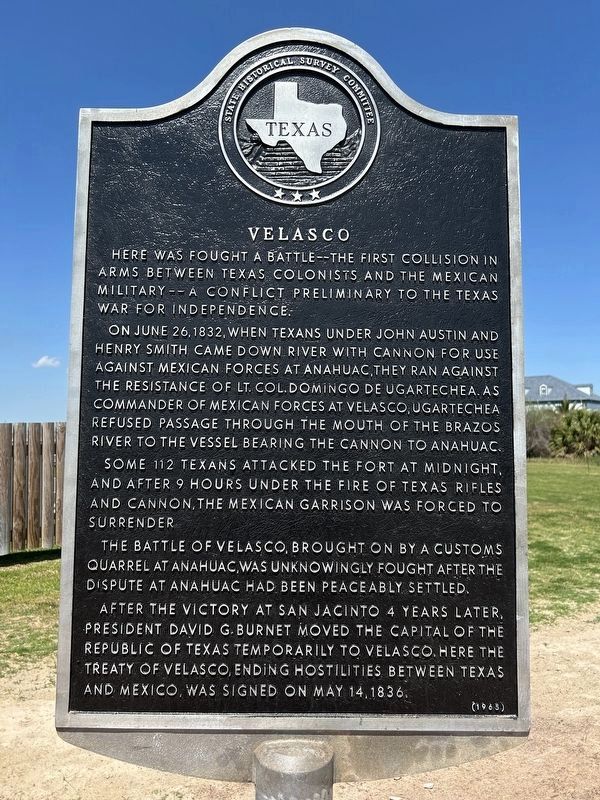
Photographed by Chris Kneupper, March 24, 2025
1. Velasco Marker
Here was fought a battle -- the first collision in arms between Texas colonists and the Mexican military -- a conflict preliminary to the Texas War for Independence.
On June 26, 1832, when Texans under John Austin and Henry Smith came down river with cannon for use against Mexican forces at Anahuac, they ran against the resistance of Lt. Col. Domingo de Ugartechea. As commander of Mexican forces at Velasco, Ugartechea refused passage through the mouth of the Brazos River to the vessel bearing the cannon to Anahuac. Some 112 Texans attacked the port at midnight, and after 9 hours under the fire of Texas rifles and cannon, the Mexican garrison was forced to surrender.
The Battle of Velasco, brought on by a customs quarrel at Anahuac, was unknowingly fought after the dispute at Anahuac had been peaceably settled. After the victory at San Jacinto 4 years later, President David G. Burnet moved the capital of the Republic of Texas temporarily to Velasco. Here the Treaty of Velasco, ending hostilities
this page online
Erected 1965 by Texas Historical Commission. (Marker Number 9605.)
Topics. This historical marker is listed in these topic lists: Forts and Castles • War, Texas Independence. A significant historical month for this entry is June 1832.
Location. 28° 56.522′ N, 95° 18.006′ W. Marker is in Surfside Beach, Texas, in Brazoria County. It is at the intersection of Monument Avenue when traveling west on Monument Avenue. The marker is located about a block southwest of Surfside city hall. Touch for map. Marker is at or near this postal address: 600 Parkview Rd, Freeport TX 77541, United States of America. Touch for directions.

Regionally, this marker is in the Houston Metropolitan Area. It is also in the American South and on the Gulf Coast. Globally, it is in North America, a Gulf of Mexico state, the Western Hemisphere, the Western World, and the Anglosphere. Historically, it finds itself in what was once New Spain, the Republic of Texas, one
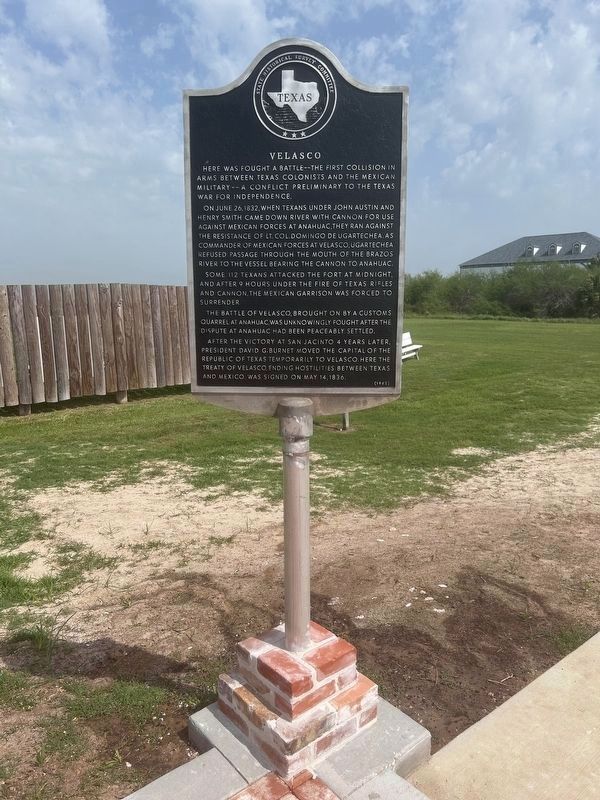
Photographed by Chris Kneupper, April 4, 2025
2. Velasco Marker
Other nearby markers. At least 8 other markers are within walking distance of this marker: Old Velasco, CSA (a few steps from this marker); Battle of Velasco Memorial (a few steps from this marker); Historic Site of the Republic of Texas (a few steps from this marker); Brown-Hoskins Hotel and Tavern (within shouting distance of this marker); Santa Anna signed Treaties of Velasco (within shouting distance of this marker); First Republic of Texas Navy: 1835-1837 (within shouting distance of this marker); The Lively (about 300 feet away, measured in a direct line); Confederate Civil War Forts at Mouth of Brazos (about 400 feet away). Touch for a list and map of all markers in Surfside Beach.
More about this marker. This marker was removed from its prior location (GPS coordinates 28.950776, -95.286027) in Jan-2025, repaired and refurbished, and relocated on Feb 23, 2025 to a nearby location in association with the new Battle of Velasco Memorial
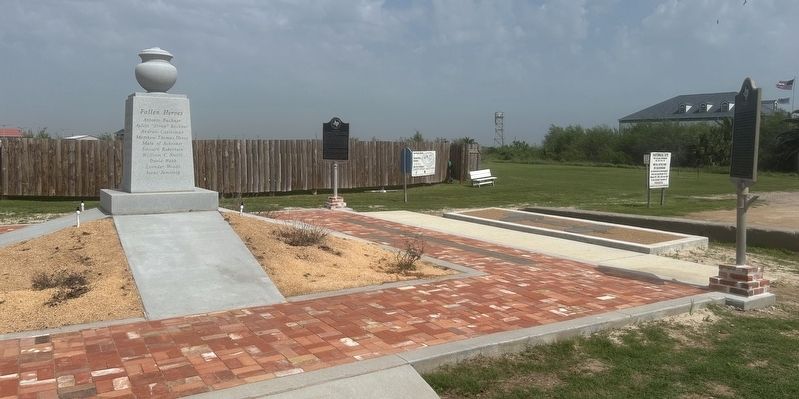
Photographed by Chris Kneupper, April 4, 2025
3. Velasco Marker (center) in proximity to Battle of Velasco Memorial and another marker (Old Velasco)
Regarding Velasco. This marker primarily describes the Battle of Velasco, which occurred over several days in late June of 1832, and was a skirmish between Mexican troops occupying the original Fort Velasco which they had just built, and Texian militia trying to capture the fort.
Related markers. Click here for a list of markers that are related to this marker.
Also see . . .
1. Battle of Velasco. From the Texas State Historical Association’s “Handbook of Texas Online”. (Submitted on October 31, 2015, by Duane Hall of Abilene, Texas.)
2. Battle of Velasco - Wikipedia entry. (Submitted on October 31, 2015, by Duane Hall of Abilene, Texas.)
3. Fort Velasco - Wikipedia entry.
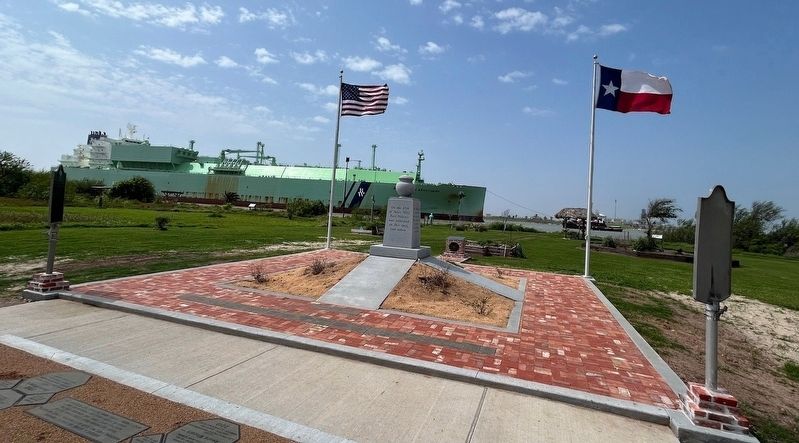
Photographed by Chris Kneupper, April 4, 2025
4. Velasco Marker (right) in proximity to the Battle of Velasco Memorial
LNG tanker in background is entering the old mouth of the Brazos River, now the entrance to Port Freeport.
4. Creation of the First Fort Velasco - 1832. This link contains details on the building of the 1832 Mexican Fort Velasco (Submitted on April 6, 2025, by Chris Kneupper of Brazoria, Texas.)
5. The Battle of Velasco. This link has details about the antecedents to and order of battle over several days in late June of 1832. (Submitted on April 6, 2025, by Chris Kneupper of Brazoria, Texas.)
Additional commentary.
1. Reference to The Battle of Velasco.
“While the battle of Velasco has not received much of a place in Texas history there is no denying this was the same funnel-shaped war cloud that a few years hence was to sweep over the swamps of San Jacinto.” —James Llewellyn Allhands, Gringo Builders, privately published book (The Clio Press, Iowa City, Iowa, 1931).
— Submitted April 6, 2025, by Chris Kneupper of Brazoria, Texas.
Photographed by Stiftung Westfälisches Wirtschaftsarchiv, Dortmund, Germany, 2020
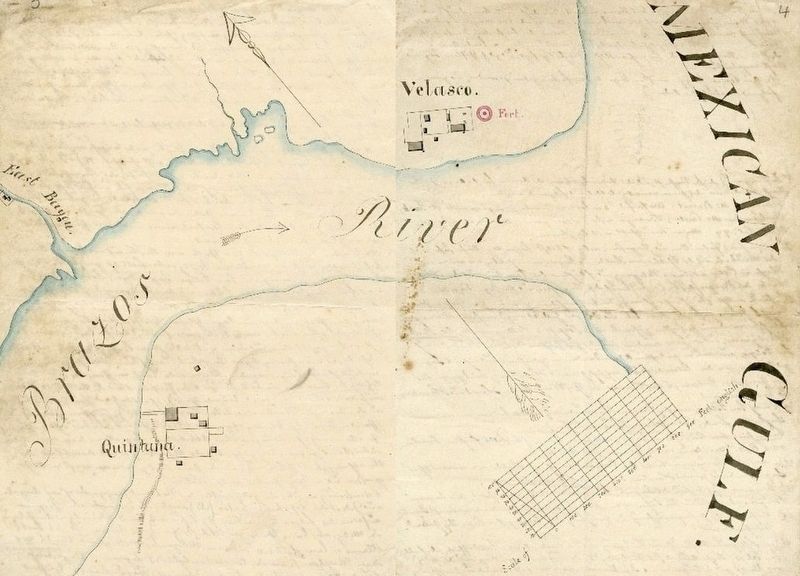
5. 1836 Scale Drawing of Mouth of Brazos River by Eduard Harkort
This drawing shows the infant towns of Velasco and Quintana at the mouth of the Brazos River, including a circular fort at Velasco, drawn by Eduard Harkort in Feb-1836 (in March, Sam Houston named him as Captain of Engineers of the Texas Revolutionary Army). The drawing includes a scale, which allows us to deduce that the 1832 fort was approximately 100' in diameter. It was discovered in Harkort's journal, found in the 1990's at an archive in Dortmund, Germany. To date, this is the only known reference that actually gives the size of the modest fort.
circa 2019
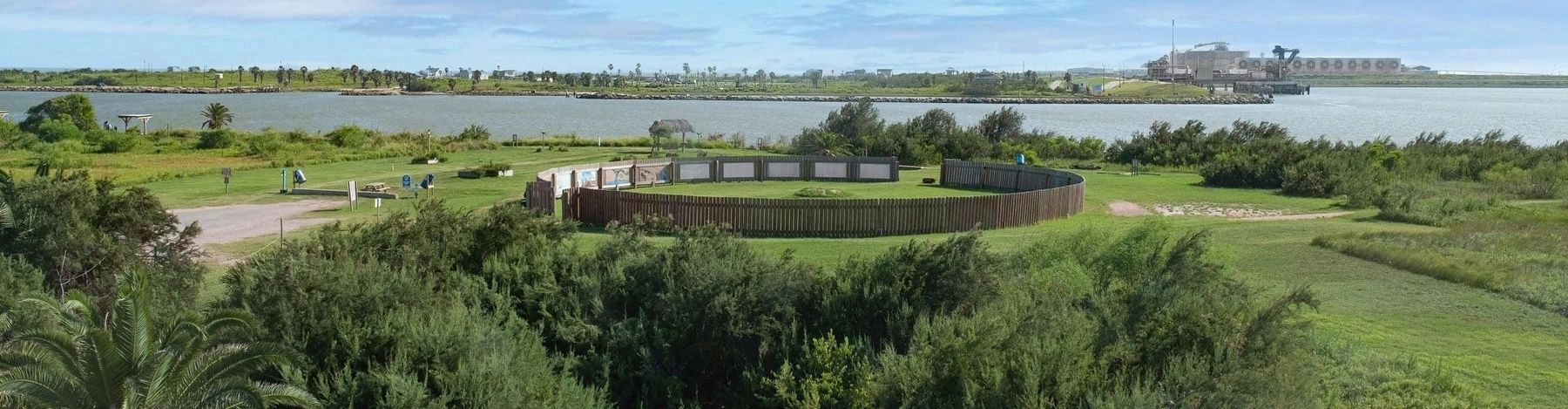
6. Timeline Circle at site of Old Velasco
This fence-like circular structure was built in about 2017, to simulate the approximate location and size of the 1832 Fort Velasco, at the southwest end of Monument Ave., as viewed from an upper floor of Surfside Beach city hall. In the background can be seen the original mouth of the Brazos River (the Gulf is to the left), and the far shore is the area of Quintana.

Photographed by Texmexfla, August 15, 2008
7. Fort Velasco Sketch
Artist’s conception from the 1970s. The sketch was photographed at the Surfside City Hall in 2008.
Photographed by Texmexfla, August 15, 2008
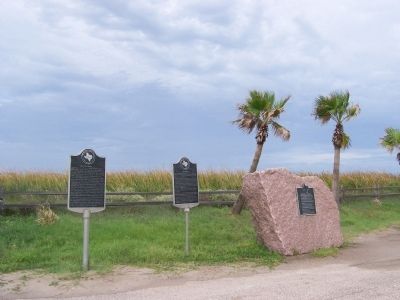
8. Old Location of the Velasco Markers
They faced the parking lot. The large stone monument is dedicated to the various jetties which have been built and lost near this site.
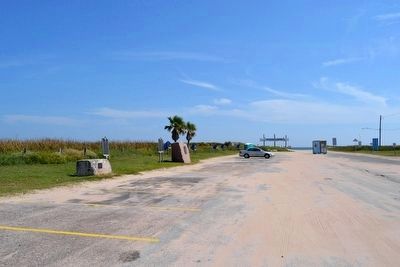
Photographed by Duane Hall, October 7, 2015
9. View to the Southwest towards Surfside Beach and the Gulf of Mexico - Old Location
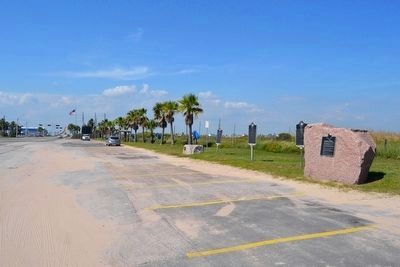
Photographed by Duane Hall, October 7, 2015
10. View to the Northwest - Old Location
Credits. This page was last revised on April 15, 2025. It was originally submitted on August 16, 2008, by Texmexfla of Houston, Texas. This page has been viewed 5,489 times since then and 168 times this year. Last updated on April 4, 2025, by Chris Kneupper of Brazoria, Texas. Photos: 1, 2, 3. submitted on April 4, 2025, by Chris Kneupper of Brazoria, Texas. 4, 5, 6. submitted on April 6, 2025, by Chris Kneupper of Brazoria, Texas. 7, 8. submitted on August 16, 2008, by Texmexfla of Houston, Texas. 9, 10. submitted on October 31, 2015, by Duane Hall of Abilene, Texas. • James Hulse was the editor who published this page.
